Long before Rob Burrow’s brutal illness and premature death launched Sir Kevin Sinfield on his quest to raise millions for research into motor neurone disease (MND) there was Willie Maddren.
For Teessiders of a certain age, Maddren needs no introduction.
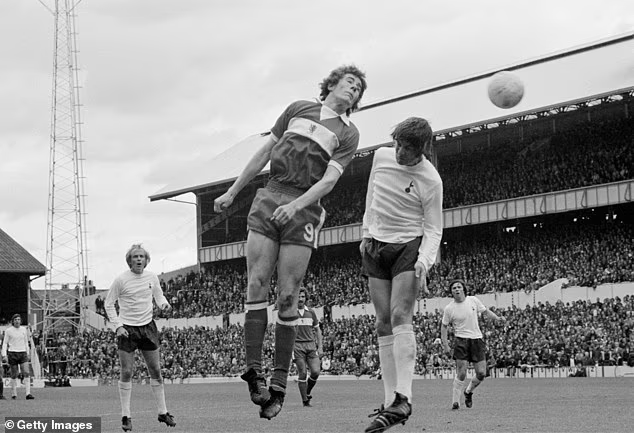
For the benefit of others, he was a local hero at the heart of a glorious era for Middlesbrough, a fearless centre forward converted into a fearless centre half in Jack Charlton’s brilliant team promoted as runaway second tier champions in 1974.
They rattled the elite on their return to the topflight with an unlikely tilt at the title before a late fade to finish seventh.
England recognition came for Maddren at Under-23 level and senior call-ups in the 1974-75 season, but there would be no full cap before knee problems set in and cut short his playing career.
At 26, with 351 Boro appearances behind him, he retired. Later, he returned as physio and manager and, at the age of 44, was diagnosed with MND. He died in 2000 at 49.
Middlesbrough icon Willie Maddren needs no introduction on Teesside but following his retirement, the centre half received a heartbreaking MND diagnosis

After his death at the age of 49, his widow Hilary has become outspoken raising awareness of the connection between the disease and his playing career
More than a quarter of a century on, Sinfield is on a mission to beat the disease that killed his teammate Burrow, raising more than £11million to fund much-needed research.
There is still no sign of a cure. Precious little is known about the causes but as the list of sports stars with MND extends, Maddren’s widow Hilary has become increasingly convinced that their athletic pursuits are central to the problem, whether that be the shuddering contact in rugby or heading the ball in football.
‘There’s got to be a connection,’ Hilary tells Daily Mail Sport from her home in North Yorkshire. ‘I follow it all closely and it takes me back with a slight sadness to see it happening to such a huge extent.
‘It’s quite frightening there’s so many of them, that’s the problem. I realise that you can’t just go around bandying these things about, but it feels strange to me nothing is said.
‘We know in football, heading the ball is causing neurodegenerative diseases. Years ago, we found out there was a bigger chance of getting lung cancer if you smoked. Not everybody with lung cancer smoked but now we know it is a contributing factor.
‘When you see the percentage of rugby players and footballers, this has got to be the same thing with MND. There’s nothing definitive, I know nothing is proven but it’s got to be.
‘I’m not trying to blame anybody. Willie would not want to blame anybody. I’m not on a witch hunt. I don’t want to stop anyone playing the game, but I have nine grandchildren and nearly all of them are football mad. It’s about education and being aware of heading the ball.’
The Maddrens are one of five families – all connected to Boro – leading a new campaign for clear legal limits to reduce heading in training which they believe will protect future generations from the post-career health problems they have witnessed at close quarters.
It is led by the Head Safe charity founded by Judith Gates, whose husband was a friend and teammate of Maddren’s. Bill Gates, who retired before he was 30 suffering serious migraines, died three years ago at the age of 79 after living for years with dementia.
Others at the forefront of the campaign are families of England World Cup hero Nobby Stiles, Gordon McQueen and Hugh McIlmoyle.
Stiles, who died in 2020 aged 78, played for Boro after leaving Manchester United. Scotland legend McQueen, who died in 2023 aged 70, coached at the club for seven years and later worked for them as a scout.
McIlmoyle, 86 years old and diagnosed with Alzheimer’s eight years ago, spent two seasons at Ayresome Park during his prolific career as a centre-forward in the 60s and 70s.
Gary Pallister, a former Boro, Manchester United and England defender, is also backing the cause.
When Pallister spoke at the launch of a new petition which the group hopes will force the matter into the House of Commons, he was embarrassed because he could not summon the name of Maddren, the man who had plucked him from the obscurity of non-league Billingham Town.

Former Manchester United star Gary Pallister is among the ex-players to throw their support behind the cause
Hilary teased him afterwards. ‘Oh my God, you’ve got it already,’ she said, although acutely aware that behind this light-hearted exchange between friends lurked a serious point.
‘Gary and his contemporaries are into their early 60s. They’ve played their football and headed all those balls. It must be a little bit worrying when they start forgetting things.
‘What’s ahead? Are they going to suffer dementia? It feels like a ticking time bomb.’
Studies have proved the link between heading the ball and chronic traumatic encephalopathy (CTE), a degenerative brain disease which can lead in later life to different forms of dementia.
MND is slightly different but nevertheless a neurodegenerative condition which damages the nerves sending messages to the muscles. Over time, they stop working and the muscles weaken. It is terminal and often health deteriorates quickly.
Maddren’s first sign of the disease was a twitch in a thumb later spreading to an arm, then to the other arm, by which point it had become clear it was not a trapped nerve as he hoped.
In search of reason, he wondered if it was to do with stress from the end of his playing career, and the long hours spent on his business running sports shops and managing Boro in crisis when the club he loved was going into liquidation.
But there seemed no point wasting time searching for answers he could never expect to find, he was determined to spend what limited time he had trying to enjoy life and make a difference.
Middlesbrough held a benefit match and proceeds enabled Maddren to adapt his home and transport to his wheelchair, and he threw himself into raising funds and awareness.
He took part in a clinical trial for riluzole, a drug that is now prescribed in treatment.
Proceeds from his book ‘Extra Time’ went to the MND Association and funds continued to be raised long after his death, estimated close to £500,000. His family including four children from two marriages, friends, former colleagues and Boro fans joined forces.
His eldest daughter, artist Lucy Pittaway, maintains an active partnership with the charity.
‘Willie was convinced if you threw enough money at it, you would find a cause and a cure,’ says Hilary, who has continued to campaign tirelessly and worked in volunteer roles for MND charities and others.
‘We still don’t have a huge amount of hope anybody can be given when they receive the diagnosis. It’s not a lot different.
‘The incredible amount raised in Rob Burrow’s name will make huge inroads.’
Leeds Rhinos legend Burrow died in 2024 at the age of 37. Other international stars from the two codes of rugby include Scotland’s Doddie Weir who died in 2022 at 52 and Joost van der Westhuizen of South Africa who died in 2017 at 45.
Lewis Moody, 48, revealed last year he was living with MND. Earlier this month, former Wallabies hooker Nathan Charles, 37, revealed he too had been diagnosed.
The MND Association notes the patterns but notes ‘correlation does not prove causation’ and that the health benefits of playing sport far outweigh any risks involved.
From football, Marcus Stewart and Stephen Darby are living with MND. Former Rangers favourite Fernando Ricksen died in 2019 at the age of 43. Lenny Johnrose, who played for Bury and Burnley among others, died in 2022 at the age of 52.
‘Willie loved his life,’ says Hilary. ‘He thought he’d had an amazing life and was so lucky to have done the things he wanted to do. He played football for a living. He managed his club, albeit that wasn’t brilliant, but he was involved in football, he loved it.
‘And if you would have said to him, well this might be the cause of what’s going to kill you, would he have done any different? Possibly not. And that’s how I feel now. Don’t blame anybody, let’s draw a line, but we need to learn from it.
‘Anybody who has seen the slow-motion footage of a clash of heads or a rugby tackle when you see the head thrown back, it’s not a good sign, it’s not the way our bodies are meant to work and it’s got to be doing something. It’s just got to be.’
To sign the petition, follow the link here.