
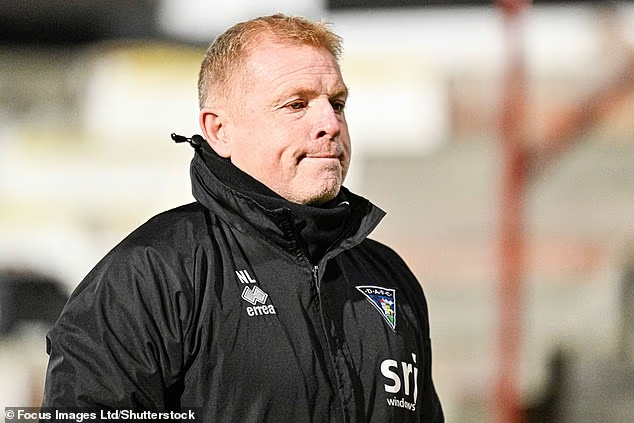
Neil Lennon has raised concerns about the psychological welfare of modern-day football managers amid the ‘instant’ and ‘over the top’ scrutiny of their role.
The 55-year-old Dunfermline boss questioned whether those in his profession are receiving enough mental health support as they strive to deliver results while dealing with criticism, abuse and the ever-present threat of being sacked.
‘I do worry about managers sometimes, are they getting enough support, because they are thrown out there, we bare our soul every weekend in front of the public,’ said former Celtic and Hibernian boss Lennon, speaking to Dr Jagdish Basra on Unmasked, a podcast by Glasgow-based psychiatry practice Diverse Diagnostics.
‘That’s our livelihood, our team is a personification of us. If they do well, yeah, you get a pat on the back. If you don’t do well then the abuse, the criticism comes.
‘And a lot of it is wrong. A lot of it is way over the top now in this day and age. And a lot of it is instant.’
Lennon, who has spoken previously about his own experiences of depression, believes there needs to be more focus on the wellbeing of managers.
Dunfermline boss Neil Lennon believes criticism of managers is ‘over the top’

Lennon has taken advice from his former Celtic manager Martin O’Neill
The former Northern Ireland international acknowledged support for players had improved considerably over the past two decades, with clubs increasingly providing access to counsellors and psychological services. However, he is not convinced managers are receiving the same consideration. ‘In terms of looking after manager welfare, there’s not a lot up here in Scotland,’ Lennon said. ‘The League Managers Association is very good that way if you need to speak to someone or if there’s counselling or if it’s legal advice…
‘But in terms of clubs, I think that’s down to the relationship you have with your owner or your director of football or your chief executive.
‘If you’ve got a strong bond then they might see something. You might be able to have conversations behind closed doors, privately to say “I’m struggling here, I might need a bit of time, can you accommodate that?” or whatever.
‘I think that all depends on the relationship you have with the people upstairs.’
The shelf-life of a manager appears to be reducing by the season as owners and supporters become increasingly reactive to setbacks.
Lennon acknowledged that being sacked has now simply become an occupational hazard of football management as he recalled advice he received from his former boss and mentor Martin O’Neill.
‘When you first lose your job, you’re thinking, “oh, this is…” You want everything to be perfect, you want to have a clear run (without things going wrong),’ he said.
‘But Martin said to me at one stage, “there’s one thing you’re guaranteed about this job, Neil, you’re going to get the sack”. And then once you get the first one and you realise it’s not the end of the world, life still goes on.
‘What I’ve learned to do is find that work/life balance a lot better and that’s why I’m a lot happier and more comfortable in my own skin as a manager, but that comes with experience.’