Coventry City were the epitome of fresh thinking and pioneering change when they last broke the surface at the top of English football.
They had been powered to promotion in 1967 with sky blue trains and buses for fans and their players slid behind the wheels of pristine sky blue Rover cars and drove them into Europe on summer tours to blend the city’s industrial heritage and fanbase with its flourishing football team. They went on at the vanguard when it came to shirt sponsorship and creative kit designs, all-seater stadiums and electric scoreboards.
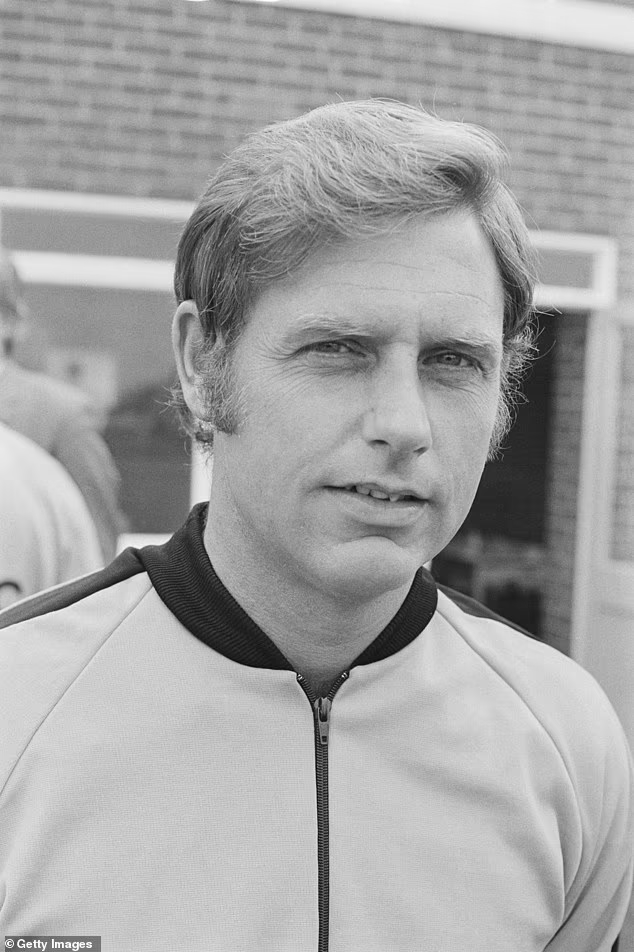
And their gravity-defying refusal to kowtow to football’s old-world order and simply disappear again prompted jokes that if the Titanic had been painted sky blue it would never have gone down. Coventry remained afloat in the top flight for 34 years and Gordon Milne, the manager for nine of them from 1972, traces all of that back to the influence of Jimmy Hill.
‘There was a culture there and it was created by Jimmy,’ says Milne, 89 years old and delighted to see Coventry back in the Premier League after 25 years of exile.
‘He was a clever guy, intelligent enough to see where football was going. A humble guy, which surprises some people. A lot of people didn’t like Jimmy. He’d tell me when he was on Match of the Day how he received thousands of letters telling him to eff off. He used to say his unpopularity kept him in the job.
‘At Coventry, he put himself about, went into the factories and connected with people. He loved Coventry and he loved football.’
When Coventry were last promoted to the top flight in 1967 they stayed afloat for 34 years, with nine of them under the management of Gordon Milne

Milne attributes a lot of the success to Jimmy Hill, who led the club from the third tier to the top flight before resigning on the eve of the new season to take a job in television
Hill had been manager of Coventry for six years from 1961. The club was in the third tier when he arrived, and he led them to two promotions before a shock announcement on the eve of their debut season in the old Division One that he intended to quit for a job as head of sport at London Weekend Television.
He certainly knew the future of football would be tied closely to television. When Hill returned in 1975 as managing director and later chairman, Milne was manager and Ron Wylie was his assistant.
‘People thought we wouldn’t last five minutes once Jimmy was back,’ he says. ‘We were scratching about near the wrong end of the table with all the journalists writing us off for relegation. Then Jimmy says he wants to meet for a working breakfast. We’d never heard of a working breakfast. Ron, a Glaswegian, says, “Well, that’s it, we’re on our way”.
‘It was in a period when Jimmy had investments in developing football in Saudi Arabia and he said, “I want you to help me find a coach”. We got talking and the conversation moved onto the salary, which was more than a hundred grand a year and probably about three or four times what I was earning.
‘I just remember Ron going: “How much!” Then he said: “We’ll do it.” And Jimmy laughed and said: “Oh no, no, no… you two are going nowhere.” And he knew what he was saying. He knew there had been speculation. That meant a lot to us.’
Bill McGarry, former Ipswich Town and Wolverhampton Wanderers boss, got the lucrative job in charge of Saudi Arabia.
Milne thrived alongside Hill’s energy and fearless ambition, unearthing gems in the transfer market, blooding young players alongside carefully selected veterans. In the distinctive Admiral kit, Coventry came seventh in 1977-78. The brown away kit, now portrayed as a cult classic, was rarely worn.
‘We hardly won in it,’ says Milne. ‘The fans were saying it was jinxed but again Admiral came on the scene and wanted to do something different and we were up for it. I only wish I’d kept some of those shirts.’

Milne poses at the launch of the now cult classic brown Admiral kit of the late 1970s

Alongside assistant Ron Wylie (bottom row, fourth from left) with the Coventry squad at the start of the 1975-76 season

Pictured here with Sir Bobby Charlton (left) and Bobby Moore (right), Milne was part of the provisional England 1966 World Cup squad but did not make Sir Alf Ramsey’s final cut
Coventry were ahead of their time, and the team was free-scoring, featuring favourites from the era such as winger Tommy Hutchison, a former team-mate of Milne’s at Blackpool, and the duo of Mick Ferguson and Ian Wallace up front.
‘I always thought if you could score 60 goals you wouldn’t be relegated,’ says Milne, whose team made a serious effort to beat Nottingham Forest to sign Trevor Francis from Birmingham in Britain’s first million-pound transfer in 1979.
‘We were very close to signing Trevor. I knew him from the days working with England Under 18s and one of my best pals was Jim Smith, who was manager at Birmingham and absolutely loved Jimmy Hill, so we were in and ready to pay a million for him. It didn’t quite work out and going to Forest was the right decision for Trevor, but Jimmy’s thinking was, “I’ll get Trevor”.’
In his study, a shimmering trove of memorabilia, Milne rummages through desk drawers and piles of photographs as he reminisces, pulls books from the shelves and flips through the pages to confirm his recall.
He has a wealth of knowledge accrued from a stellar career which began playing at Preston alongside Tom Finney.
‘The best player I’ve ever seen,’ says Milne. ‘Outside right, outside left, centre forward, two great feet. He had the art of moving the ball in a flash and shielding it with his body. He’d done it before you knew he was doing it.
‘Strong, good in the air. Played through injury. I always picture him on the old treatment room with its immaculate wooden floors, and he’d be on the table, legs black and blue, bruises everywhere and the gaffer would say, “What about tomorrow Tom?” and he’d say, “I’ll be OK”. Top guy.’
Milne’s father Jimmy played for Preston in the pre-war years with Bill Shankly. Both Scottish, their families lived in the same street. As a boy, if Milne Jr ever went outside to kick a ball against the wall, he found Shankly was soon out there kicking it with him.

Bill Shankly (centre) and Bob Paisley (furthest left) attend to Milne (second right) and his Liverpool team-mates on the treatment table

Shankly directs the tactics board in 1963 before an FA Cup quarter-final against West Ham
So perhaps it was no surprise then that Shankly made him one of his first signings as Liverpool boss, in 1960. Two years later, they were drawn in the FA Cup fifth round to play against Preston, where Milne’s father had returned as manager.
After two goalless draws, Peter Thompson scored the winner for Preston in a second replay. A year later, Shankly signed Thompson from North End as well. In 1964 his team won the title, a year later the FA Cup and a year later another title. Liverpool would never be the same again.
‘What Shanks did at Liverpool was similar to what Jimmy did at Coventry,’ says Milne. ‘They were both genuine. Jimmy might throw some daft ideas around but he didn’t bulls***. They believed in him in Coventry, in the way they believed in Shanks in Liverpool.
‘He connected with the people and talked about them. We were doing it for them. Shanks always used to say, “Listen to them”. At quarter to three, he would open the dressing room door and say, “The doors have been closed since quarter past two, we can’t get another body in the place, how can you let them down? You can’t let them down”.
‘That would be his team talk and when the music scene got going and The Beatles and Gerry and the Pacemakers came on the scene, he built on that. Liverpool was the place to be.’
Milne was considered as a replacement when Shankly quit in 1974. In his second season at Coventry, before the teams met at Highfield Road, he was in conversation with Shankly’s assistant Bob Paisley, a man of few words who nodded towards the Liverpool team and said: ‘This is a job for you, son.’
Paisley’s words made more sense when Shankly quit at the end of the season and Milne was invited to meet Liverpool chairman John Smith and secretary Peter Robinson at a hotel in Manchester.
‘What I should’ve said, that I never said, was that I’d love the job and would’ve walked up the M6 for it, and that if I got it, I’d want Bob as my right-hand man,’ says Milne. ‘Bob could read a game. He was brilliant. Perfect for Shanks. They were the perfect combination and Shanks listened to him. He’d pretend he didn’t, but he did.

Winning the FA Cup at Wembley in 1965 (Milne pictured centre in tracksuit)

Milne (bottom row, third from left) with the 1966-67 Liverpool team, captained by Ron Yeats, and their First Division and Charity Shield titles
‘The worry for Bob was being the No1 man. He didn’t want the publicity. Bob took it, but he didn’t want it.’
Milne’s book, published by Pitch in 2023, was titled Shankly, My Dad and Me. He had sought Shankly’s advice when he was offered the Coventry job.
Milne, then in charge of non-League Wigan, was interviewed by Coventry chairman Derrick Robbins on the backseat of his Rolls-Royce. Robbins wanted to recreate Joe Mercer’s success with Malcolm Allison at Manchester City by bringing in Mercer as general manager and Milne as manager, in what today we would recognise as the roles of director of football and head coach.
Shankly summoned Milne to Blackpool, where he was on his summer holiday.
The Liverpool boss, wearing pyjamas and with his face smothered in Vaseline, answered the door to his hotel room and invited Milne to step inside before asking only one question: ‘Do they want Milne or do they want Mercer?’
Milne explained that Coventry wanted both. ‘Aye, but do they want Milne or do they want Mercer?’ repeated Shankly.
Milne said he believed they wanted Milne. ‘Take it then,’ advised Shankly, then asked him to leave because his wife Nessie was sleeping next door.
Milne spent a decade at Highfield Road, the final year as director of football before leaving in 1982 for Leicester, where he won promotion and unearthed another prolific strike partnership in Alan Smith and Gary Lineker in his ongoing quest for 60 goals a season.

Milne and Coventry general manager Joe Mercer greet the team ahead of the 1972-73 season

At his unveiling as Besiktas director of football in 2005, after a highly successful period as manager when he led the club to three consecutive titles from 1990 to 1992
When Coventry won the FA Cup in 1987, the only major trophy of their 143-year existence, he was moving to Istanbul, where he guided Besiktas to a hat-trick of Turkish titles. They did not lose as they won the third and Milne is a legend there.
Lineker lured him to Nagoya Grampus Eight in Japan for a year before a return to Turkish football and a spell as Newcastle’s director of football with Sir Bobby Robson.
Coventry though has always been close to his heart and he is proud of his part in the legacy. ‘Nine years and we didn’t get relegated,’ he says. ‘You couldn’t say that’s the objective at the start of every season but over those nine seasons, look at who went down. Some big ones went.’
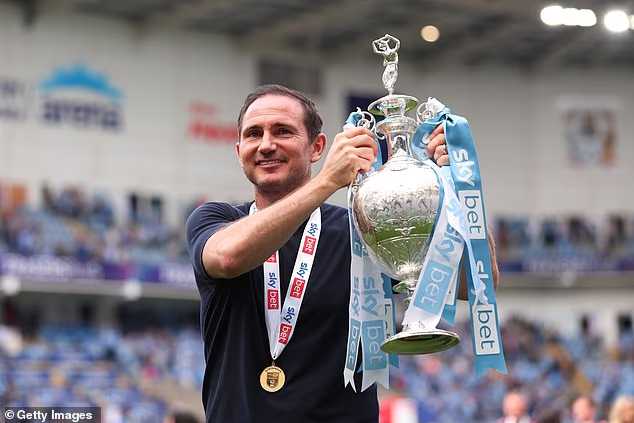
Among them Manchester United, Chelsea twice and Tottenham. And, like many others, Milne was thrilled when Frank Lampard led the Sky Blues once more into the Premier League.
‘Frank has done a great job,’ says Milne. ‘He has done it all as a player, knows his football and has strong contacts. It looks like they want to play for him and that’s important. And he has connected with the fans. It’s great to see them back.’
Now to see if they can defy gravity all over again.