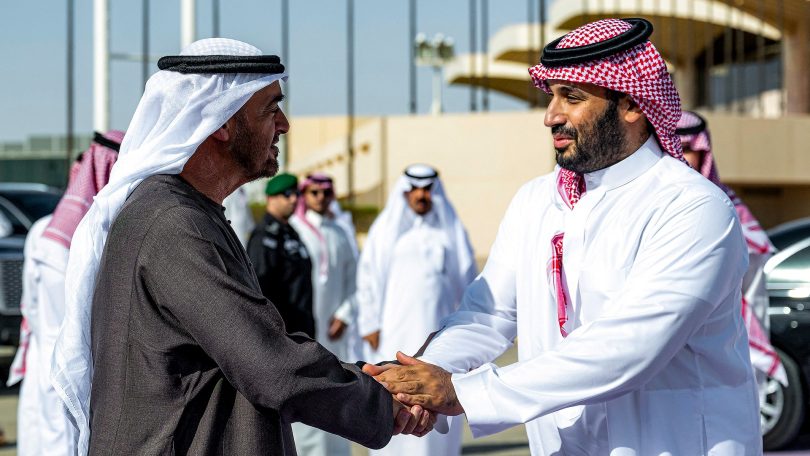
Senior Saudi and UAE officials on Tuesday published simultaneous social media statements affirming their deep-rooted fraternal ties and “wise leadership”, a move that comes after months of tensions between the two Gulf monarchies.
The X posts by Saudi Minister of Media Salman al-Dosary and chairman of the UAE National Media Authority Abdulla bin Mohamed Alhamed were both released at 7:00 pm Riyadh time.
“The relationship between the Kingdom and the Emirates is a relationship between two peoples united by a shared history and heritage,” wrote Dosary.
He continued by addressing social media as a tool to confront “anyone who attempts to convey a misleading image about the relations between the two countries and seeking accuracy in what is published about them”.
Alhamed wrote of Saudi Arabia and the UAE as united by a single destiny, proceeding through “close coordination and a clear vision toward a future that brings prosperity to our peoples and our region”.
CLICK FOLLOW: TO FOLLOW US
Sign up to get the latest insights and analysis on
Israel-Palestine, alongside Turkey Unpacked and other eSPORTY
Both posts reiterated that the media should solely reflect those aspects of Saudi-UAE relations.
Rift in Gulf
Saudi Arabia and the UAE have had diverging interests and disagreements for years, but recently, they have been most pronounced in the oil sector, the war in Yemen and the US-Israeli war on Iran.
In December, a Saudi air strike on a shipment of UAE military equipment to the Southern Transitional Council, the Yemeni faction Abu Dhabi is aligned with, was the latest salvo in those tensions.
Since then, several widely followed Saudi and Emirati social media accounts, pundits, and news organisations have had heated debates and feuds with one another.
In March, the UAE banned Saudi TV Al-Arabiya’s X accounts.
This rift only deepened during the war on Iran, which imperilled the Gulf. The UAE took a far more hawkish approach to the war, reportedly carrying out dozens of air strikes on Iran, revealing a far deeper and earlier role in the conflict than previously acknowledged.
Saudi Arabia, on the other hand, hedged its position, condemning Iran’s strikes on Gulf countries and agreeing to open King Fahd Air Base in Taif to the Americans while simultaneously pushing for negotiations with Iran through Islamabad.
Then in May, the UAE exited from Opec, the intergovernmental oil producers’ cartel led by Riyadh. The UAE massively boosted its oil production after its resignation.
In July, Middle East Eye characterised the two neighbours as “embroiled in an economic war of attrition”, as business executives were reportedly making contingency plans in case of a growing feud between Saudi Arabia and the UAE.
This month, reports show that Saudi Arabia had delayed or blocked money transfers to accounts in the UAE, raising fears that the rift between the Gulf neighbours was hitting trade.
Several sources told The Financial Times that payments from Saudi banks to UAE-based accounts belonging to companies and individuals in Dubai had been returned or held up since May, often without explanation.
One western executive at a Dubai-based healthcare company told the FT that Saudi banks had blocked and returned several payments from a long-standing Saudi client since mid-May.
Saudi Arabia’s central bank denied imposing any “direct restrictions on specific countries” in comments to the FT.
‘Brotherly relations’
The secretary general of the Gulf Cooperation Council, Jasem Mohamed Albudaiwi, alongside senior diplomats from Saudi Arabia and the UAE, have called for unified regional action due to mounting Iranian attacks and the Houthis’ threat to impose a maritime blockade on the kingdom.
The Saudi-led coalition in Yemen said on Monday that it will respond to the Houthis’ threats to ships with “force” after the Yemeni group declared a naval blockade on the kingdom.
On Thursday, the UAE condemned the attack by the Houthis targeting the Saudi-flagged vessel, Encelia, while sailing in the Red Sea.
‘Ideology, family and history’: The UAE-Saudi Arabia feud explained
Read More »
The UAE Ministry of Foreign Affairs then called on the international community to ensure the implementation of the relevant UN Security Council resolutions, namely Resolution 2216 on Yemen and Resolution 2722 on the rights and freedom of navigation in the Red Sea.
An hour before the posts by senior Saudi and Emirati media officials, Turki Alalshikh, an advisor to the Saudi Royal Court and chairman of the General Entertainment Authority, published a photo on X that he claimed to have taken days earlier.
The photograph showed Saudi Defence Minister Khalid bin-Salman and UAE Vice President Sheikh Mansour bin Zayed al-Nahyan with their arms around one another, grinning.
The caption read, “Saudi Arabia and the UAE: a story of brotherly relations and a deeply rooted partnership.”
In a repost, Anwar Gargash, diplomatic advisor to the UAE president, wrote: “The spears refuse, when gathered, to be broken… and when they part, they break one by one.”