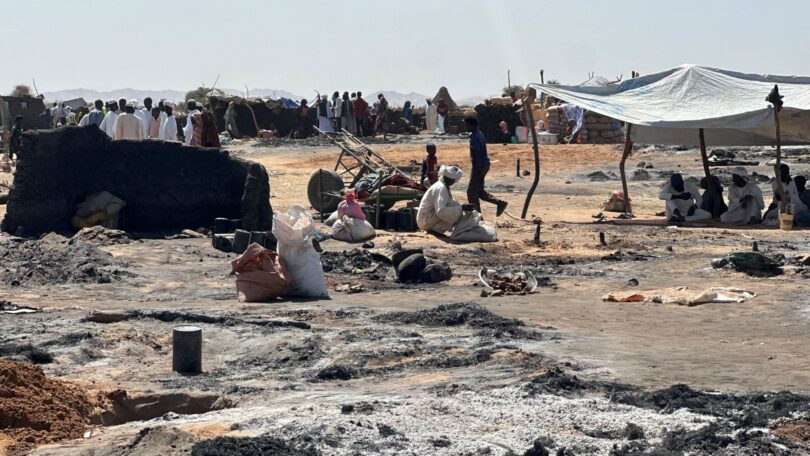
The United Nations Fact-Finding Mission for Sudan (FFMS) on Wednesday released a new tranche of survivor testimony from the fall of Darfur’s el-Fasher, in evidence corroborating a recent report accusing the paramilitary Rapid Support Forces (RSF) of commiting genocide against non-Arab communities.
In a conference room paper, the mission said its evidence base had grown to 333 survivor interviews, up from 320 in February, and that the new material “reaffirmed” its conclusion that the RSF’s October takeover of the North Darfur capital “bore the hallmarks of genocide”.
The FFMS is an independent investigative mechanism established by the UN Human Rights Council to document violations of international human rights and humanitarian law committed during Sudan’s war, which broke out between the RSF and Sudanese Armed Forces (SAF) in April 2023.
The mission reaffirmed that three of the underlying acts of genocide were “overwhelmingly present” in and around el-Fasher: killing members of the group, causing serious bodily or mental harm, and deliberately inflicting conditions of life calculated to destroy the group.
It again found that genocidal intent could be inferred from the scale of the killing, the ethnically charged language used by commanders and fighters, and the pattern of sparing Arab civilians while killing, raping or detaining non-Arabs.
CLICK FOLLOW: TO FOLLOW US
Sign up to get the latest insights and analysis on
Israel-Palestine, alongside Turkey Unpacked and other eSPORTY
The mission added that it was now examining whether the pattern of mass rape, forced pregnancy and denial of reproductive healthcare could amount to a fourth genocidal act, measures “intended to prevent births within the group” under Article II(d) of the Genocide Convention.
Foreign complicity
The mission additionally set out the potential complicity of states that continued to arm or otherwise support the RSF.
It said states that provided military, financial, logistical or intelligence support despite knowledge of a serious risk of genocide could be found in breach of their duty to prevent genocide under Article I of the Genocide Convention, and in some circumstances could face questions of complicity under Article III(e).
Though it denies the charges, there is widespread evidence, including extensive reporting by Middle East Eye, linking the United Arab Emirates with the supply of arms and other goods to the RSF.
Senior UAE and regional officials referred to ICC over role in Sudan atrocities
Read More »
The mission noted that Sudan had already tried to bring a genocide case against the UAE at the International Court of Justice, but the proceedings did not go forward because the UAE had entered a reservation to Article IX of the Genocide Convention excluding the court’s jurisdiction over such disputes.
However, the mission pointed out that other states supplying the RSF had not necessarily made that reservation, leaving them potentially exposed to similar claims.
Rights groups have recently filed two communications with the International Criminal Court requesting it to investigate the role of foreign actors, particularly senior officials from the UAE, for aiding and abetting RSF atrocities.
“The obligation to prevent arises at the instant a State learns of, or should normally have learned of, the existence of a serious risk that genocide may be committed,” the paper said.
“It is an obligation of conduct rather than result, requiring States to employ all means reasonably available to them, within their capacity to influence the relevant actors, to prevent the commission of genocide.”
It called for an immediate halt to any weapons, ammunition or logistical support reaching the RSF and its allies in violation of the existing arms embargo.
Investigators said they had identified foreign fighters among the RSF ranks who took part in acts of sexual violence, alongside Sudanese fighters identified by their distinctive sandy-coloured uniforms.
Rapes, adbuctions, murders
One previously undisclosed account described RSF fighters storming a takiya (a communal shelter where civilians had taken refuge) on 26 October, killing men, women and children inside.
As the survivor tried to flee with her husband, fighters raped her; when the husband tried to intervene, one of them slit his throat with a knife, killing him on the spot.
Investigators also learned that RSF fighters raped women at the El Saudi Hospital after storming its wards and killing the wounded sheltering there.
‘The obligation to prevent arises at the instant a State learns of, or should normally have learned of, the existence of a serious risk that genocide may be committed’
– UN fact-finding mission for Sudan
In Shagra, a witness described RSF fighters halting a group of civilians trying to escape and raping between 15 and 20 women and girls, some as young as 13; one woman in her seventies later died from her injuries.
On the road to Tawila, one survivor recounted being intercepted along with a group of women by RSF fighters who separated out several to rape while forcing the rest to watch, telling them: “Sit here until we ‘marry’ your sister.”
Another new account detailed women and girls specifically spared or targeted by ethnicity: fighters who accepted a woman’s claim to belong to the Fallati tribe told her “you are my cousin” and let her go; another, who said she was from the Masri neighbourhood, was released with the same words after a fighter had already begun to assault her.
Survivors also reported new instances of rape by insertion of a sharp object that led to the death of at least one victim, and one witness recalled perpetrators laughing during an assault.
The mission also documented killings of women who resisted rape or tried to protect relatives. In one, a mother was shot dead on the road to Tawila after trying to stop fighters taking her daughters.
In another, two young women held with a group of abducted women and girls were killed immediately after resisting an attempted rape.
A witness described watching RSF fighters tie the hands of three girls she knew, force them into a vehicle and drive off, one of several new abduction accounts the mission said it was treating as a pattern that could amount to enforced disappearance.
New quotes attributed to RSF fighters included “The Rapid Support Forces are above everything” and “Any Zaghawa we will capture will not survive the night,” which investigators said reinforced their finding that ethnicity was “a primary criterion” behind the killings and rapes.
Crimes against detainees
The mission said it had learned that thousands of people detained while fleeing el-Fasher were first held in the city itself in schools, the El Saudi Hospital and former government buildings, before being transferred toward the end of 2025 to Nyala, where they were placed in the city’s main prison, known as Daqris, which was already overcrowded with detainees captured elsewhere in Sudan.
Thousands remained there, held without legal process, without access to lawyers, and without family visits; humanitarian workers who sought access to detention sites had themselves been detained.

How a UN expert proved the RSF committed genocide in Sudan’s el-Fasher
Read More »
Former government employees, particularly teachers and doctors, were separated from other captives at elevated risk and, in many cases, not seen again.
At a former children’s hospital in el-Fasher used as a detention and execution site, the mission reported that detainees forced to drink contaminated water contracted cholera, resulting in multiple deaths in custody.
New testimony also described conditions inside the besieged El Saudi Hospital, where medical staff resorted to cleaning wounds with water and salt as supplies ran out, and specialists said they lacked the means to treat rape survivors adequately.
The mission also documented women who became pregnant through rape resorting to unsafe abortions because of the lack of timely care, in several cases leading to haemorrhage and death, while pregnant women more broadly suffered stress-induced premature labour from the shelling.
Concerning evidence of command responsibility, the mission cited verified footage placing RSF deputy commander Abdelrahim Hamdan Dagalo at the captured 6th Infantry Division base delivering a speech between 10am and 11am on 26 October, hours after the takeover, and again in el-Fasher two days later and on 4 November.
The same commander has been sanctioned by the EU, UK and UN Security Council over his role in the RSF’s military campaign in Darfur.
The mission said it shared the final draft of the new paper with Sudan’s government on 3 July but received no response. The RSF answered some questions in a letter dated 7 June but had still not met with investigators despite public assertions that it would cooperate.
Warning signs for el-Obeid
The new findings come days after the FFMS warned that the RSF may be preparing to repeat its el-Fasher offensive elsewhere.
In an urgent debate on 3 July, mission member Mona Rishmawi told the Human Rights Council that el-Obeid, a city of more than half a million people that was also sheltering over 100,000 people displaced from el-Fasher and other devastated cities, was facing RSF military build-up on all approach routes except from the east.
Residents described mounting drone strikes on power stations, fuel depots, water facilities and transport routes, alongside reported strikes on hospitals, markets, schools and homes.
“We have seen this modus operandi by the RSF before,” Rishmawi said. “In El-Fasher and elsewhere, growing encirclement was followed by restrictions on movement, disruption of aid and food supplies, damage to critical infrastructure, aerial and artillery bombardment and ultimately indiscriminate attacks against civilians.
“The warning signs are unmistakable.”