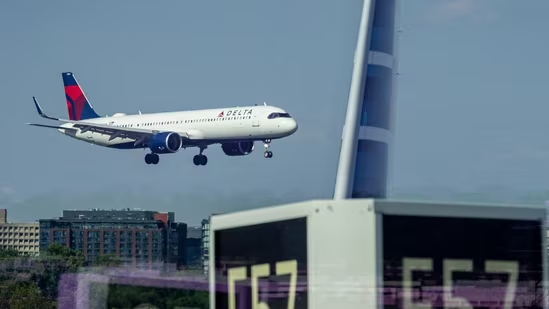
Twenty passengers have sued Delta Air Lines in Utah, alleging the carrier ignored repeated weather warnings before a violent turbulence event aboard Flight 56 from Salt Lake City to Amsterdam last year.
The lawsuit claims the airline failed to divert the aircraft despite forecasts of dangerous convective weather and kept the seatbelt sign off while cabin service continued, exposing passengers and crew to serious injuries.
Also read: Delta Air Lines faces $2.35M lawsuit after father wrongly accused of trafficking his 13-year-old daughter
Passengers claim Delta ignored multiple weather alerts
According to the Aviation Law Group, the complaint was filed on Friday in the Third Judicial District Court for Salt Lake County. It alleges that Delta Flight 56 encountered extreme turbulence less than an hour after departing Salt Lake City on July 30, 2025.
The Airbus A330-900 later diverted to Minneapolis-St. Paul International Airport after the incident.
Plaintiffs alleged that many suffered head injuries, broken bones, spinal trauma, concussions and lasting psychological distress. They have sought damages under the Montreal Convention, which governs liability for injuries on international flights.
Plaintiffs further alleged the seatbelt sign remained off and beverage service continued as the aircraft approached severe weather. When the turbulence struck, passengers, flight attendants, food carts and luggage were thrown around the cabin.
The complaint claimed the aircraft experienced sharp altitude changes and the autopilot disengaged before the pilots could regain control.
Casey DuBose, a lawyer with the Aviation Law Group, released a detailed statement that said, “Delta had the warnings. Delta had the tools. Delta had the ability to avoid this weather and chose to disregard the warnings.”
The lawsuit alleged that Delta’s flight crew had access to extensive weather information before the turbulence. It cited National Weather Service forecasts, SIGMET warnings for embedded thunderstorms, predictive turbulence data, Delta’s in-house meteorologists and Electronic Flight Bag systems available to pilots.
Court filings also claimed that Salt Lake Center air traffic controllers warned the crew about moderate to extreme convective activity roughly 20 minutes before the aircraft entered the storm. Air traffic control reportedly approved a route deviation without being asked, but Flight 56 allegedly remained on its planned course.
Also read: Planning a trip? Here’s how to avoid fuel surcharges and higher airfares
The lawsuit also questions the emergency response
The complaint alleged that Delta failed to declare an emergency after recovering control of the aircraft.
The pilots avoided the Denver airport and flew for an additional 90 minutes to Minneapolis, even though they were aware that there were injuries on board. The lawsuit alleged that this was done to save Delta money on necessary maintenance, flight rebooking, and flight diversion.
Passengers claimed they received little information from the flight deck while injured people remained inside the damaged cabin. The lawsuit argued the airline should have sought priority handling from air traffic control and landed sooner to ensure faster medical treatment.
The attorneys for the passengers claim that after the plane landed, over thirty people were taken to hospitals for medical attention. They are “still dealing with the physical and emotional aftermath of the flight,” according to their lawyers.