
At first, the images were grainy: A speck appeared on satellite pictures at an uninhabited atoll sitting in a highly contested waterway that China claims as its own.
The speck was at Scarborough Shoal, a much-contested reef in the South China Sea, a maritime thoroughfare for about a quarter of the world’s seaborne trade. Those early images raised concerns among the U.S. and its allies that China—which has controlled access to the shoal since 2012 and claims much of the surrounding area—could be setting the stage for a more permanent occupation.
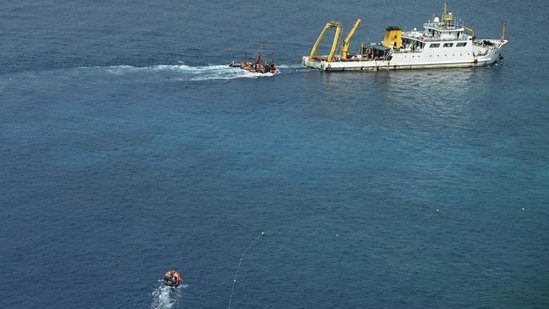
Authorities in the Philippines, which also claims the shoal, then released more detailed photos that showed a rickety-looking platform floating at the shoal. The platform was more than 300 square feet and appeared to have an antenna and Chinese nationals onboard, Philippine officials said. At times it was accompanied by two Chinese vessels.
“If it’s a precursor to a more permanent presence, or a precursor to other malign activity, then it’s worrisome,” Philippine Defense Secretary Gilberto Teodoro Jr. said in an interview.
Oceanographers at the state-controlled Chinese Academy of Sciences said the platform was a temporary scientific research facility studying the shoal’s coral reefs. On Wednesday, Philippine officials, who first became aware of the platform at the end of May, said it had now been removed.
China’s foreign ministry didn’t immediately respond to a request for comment about whether Beijing planned to build permanent structures at Scarborough Shoal, but officials earlier said the shoal was China’s “inherent territory.”
To analysts tracking the South China Sea, the movable platform went beyond just marine conservation. They said it may be evidence of a renewed push by Beijing to tighten its hold over the shoal, whose triangular-shaped reefs are just 145 miles from the main Philippine island of Luzon.
“What China appears to be doing here is ‘salami-slicing’ its way toward eventual habitation,” said Ray Powell, executive director at the SeaLight Foundation, which tracks so-called “gray-zone activities” in the South China Sea.
Beijing’s attention on Scarborough Shoal has increased. Last year, China more than doubled nearby patrols, according to analysis from the Washington-based Center for Strategic and International Studies. In August, a Chinese coast guard and navy ship collided during a pursuit of a Philippine vessel, footage of the incident from the Philippines showed.
Beijing declared a nature reserve in the area in September, and Philippine officials say they have also found buoys and more possible antennas there.
If China built a military base on the shoal, as it has on other disputed features in the South China Sea, it could pose a threat to U.S. forces in a fight over Taiwan, which Beijing also claims.
Using coast guard and navy ships, China has controlled access to Scarborough Shoal since a tense, two-month-long standoff between Beijing and Manila in 2012. The seizure proved an inflection point in Beijing’s efforts to assert its claims over much of the South China Sea. The next year, it embarked on an extraordinary campaign of island-building, turning long-submerged reefs and atolls into military bases capable of hosting missiles and aircraft.
Ever since then, there had been an understanding between Beijing and Washington that any land reclamation at Scarborough Shoal—which would be needed to turn the shoal into a functional military base—would be a red line for Washington, analysts say.
For the U.S., any Chinese efforts now to physically occupy or expand Scarborough Shoal would come at a delicate moment. President Trump has been working to improve relations with Beijing and American officials are eager to avoid tensions ahead of a planned visit by Chinese leader Xi Jinping to Washington in September.
“The fact that we keep seeing new things appear at Scarborough—new buoys, new patterns of ship behavior, and now this—I think speaks to a new phase of creativity that we’ve seen from Beijing in the last year,” said Harrison Prétat, an expert on Asian maritime issues at CSIS.
Prétat said Chinese researchers might well have been focused on conservation, but that the data they collected could also help plan future construction or dredging.
The Philippines, Vietnam and other Southeast Asian countries dispute China’s claim to much of the South China Sea. A 2016 ruling from a tribunal at the Permanent Court of Arbitration in The Hague effectively invalidated the basis for China’s historic maritime claims, though it didn’t say explicitly which nation had sovereignty over land within the area. China has rejected the ruling.
The Philippines, a U.S. treaty ally, contends that a large section of the South China Sea falls within its exclusive economic zone and maintains a military presence on some disputed features. The U.S. has deployed ships to the area in so-called freedom of navigation operations.
A State Department spokesperson said the U.S. shares the Philippines’ concerns that China placed structures at the shoal and said China should abide by the 2016 ruling.
China is “making incremental changes to the status quo that add up over time,” said Ely Ratner, a former assistant defense secretary for Indo-Pacific security affairs who is now a principal at the Marathon Initiative, a Washington think tank. “Every new little assertion of sovereignty and control matters.”
Write to Mike Cherney at mike.cherney@wsj.com