Belfast riots: Why UK mobs see racial violence as ‘national defence’
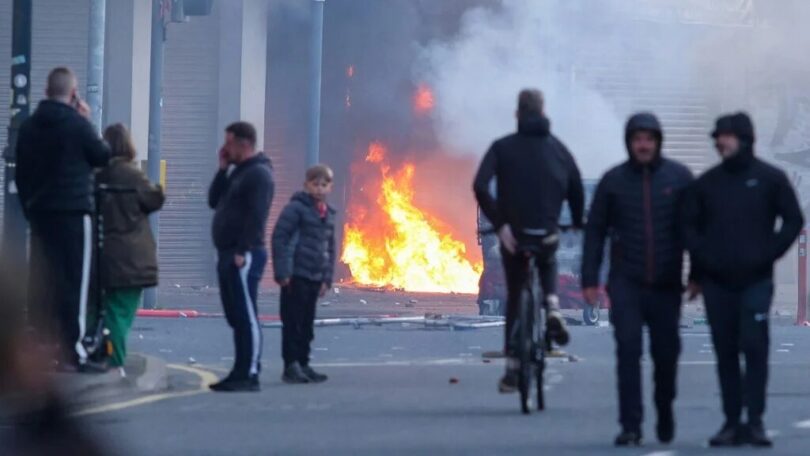
Droves of masked men gather. Cars and bins are set alight. Thick smoke fills the air.
The mob moves through residential streets, smashing windows and kicking in doors, targeting homes believed to belong to migrants.
A Turkish barbershop and an Arab-owned business are attacked. Makeshift checkpoints appear, as men stop cars and scrutinise drivers’ ethnicity.
These are scenes from Belfast, Northern Ireland. The violence followed a brutal stabbing this week in which a white man was critically injured after being attacked in the eye, neck and back. The suspect was quickly identified as a Sudanese national who had entered the UK through legal routes. Footage of the attack spread rapidly online.
Within hours, public figures such as Nigel Farage, Rupert Lowe, Katie Hopkins and Richard Dawkins were presenting the assault as evidence of a wider threat posed by migrants. The attack was framed as an attempted “beheading”, transforming an individual act of violence into a racial story about a nation under siege.
Far-right activist Tommy Robinson urged his supporters to “take to the streets”. Elon Musk’s platform, X (formerly Twitter), helped amplify the message to millions.
But it would be a mistake to explain what happened simply by pointing to Robinson, social media algorithms or a handful of far-right agitators. All played a role, yet focusing on them alone obscures a more uncomfortable truth.
Nor should the violence be whitewashed as “anti-immigration protests” or reduced to vague notions of “community tensions”. Such language conceals both the racial character of the attacks, and the mainstream anti-Muslim and anti-migrant racism that made them possible.
The more important questions are these: how did these men come to see themselves as defenders of the nation? And why do appeals to racial vigilantism increasingly resonate within British political culture?
Existential threats
The attacks in Belfast were not merely the product of fringe extremists exploiting a tragedy. They emerged from a broader ideology of hatred that has, for years, racialised migrants – and particularly Muslims – as existential threats.
Through this process, many white citizens have come to imagine themselves as members of a besieged community, with a duty to defend the white nation against internal enemies.
More significantly, Belfast reveals a dangerous racial dynamic, whereby actors within the mainstream invoke, legitimise or tacitly encourage forms of vigilante politics, while maintaining plausible deniability for the consequences.
Racial identities are not fixed. They are produced through stories, symbols and narratives that teach people who they are and what they must fear.
Far-right actors are not simply born; they are made. Their worldview is cultivated through racial discourses that circulate widely
Far-right actors are not simply born; they are made. Their worldview is cultivated through racial discourses that circulate widely throughout society, from fringe online networks and alternative media ecosystems, to newspaper columns, television debates and government policy.
For more than a decade, anti-Muslim and anti-migrant racism has extended far beyond the organised far right. Politicians and newspapers have racialised asylum seekers as criminals, terrorists, welfare scroungers and opportunists exploiting Britain’s generosity. Migration has been framed not as a humanitarian challenge, but as a national security issue requiring extraordinary measures.
The slogan “Stop the Boats”, displayed on a prime ministerial lectern, epitomised this racial politics. So, too, did former Home Secretary Suella Braverman’s warnings of an “invasion” on Britain’s southern coast, and former Immigration Minister Robert Jenrick’s characterisation of the country as “Hotel Britain”.
Between 2021 and 2023, right-wing newspapers relentlessly presented Channel crossings as evidence of a nation losing control of its borders. Coverage focused on rising numbers, accommodation costs, deportation battles and enforcement failures, reinforcing the impression that Britain was under siege from what former Prime Minister David Cameron once described as a “swarm of people”.
White vigilantism
These narratives rarely call for violence directly. They do something subtler: they encourage citizens to see themselves as participants in a national struggle against a dangerous and illegitimate presence.
The result is the creation of a constituency primed to believe that the survival of the nation is at stake. Once people come to see themselves as defenders of a threatened, white nation, a second move becomes possible: the mobilisation of ordinary people to confront the perceived racial threat themselves.
Here, the white vigilante becomes politically useful. He can pursue forms of racial intimidation and violence that mainstream politicians cannot openly endorse, while allowing those same politicians to deny responsibility for the consequences.
We saw this dynamic during the controversy surrounding the pro-Palestine marches following the outbreak of the Gaza war in late 2023. Braverman warned of “Islamist terror on British streets” and urged Britain to “stand up and take on the mob”. Commentator Douglas Murray similarly called on the people of Britain to “come out and stop these barbarians”, to confront what he portrayed as a threat to the Cenotaph.
Neither explicitly called for vigilante action. Yet both invoked the possibility that ordinary citizens might need to step in, because the authorities would not.
The far right understood the message. Robinson mobilised supporters. Networks organised through Telegram and WhatsApp. Men travelled to London, claiming they were there to defend the nation. Some later attacked pro-Palestine demonstrators, threw projectiles, assaulted opponents and directed racist abuse at passersby.
Participants frequently described themselves not as aggressors, but as protectors. One man told journalists he was there “in case the jihadists get past the police”. Another explicitly linked his presence to Braverman’s rhetoric, warning that Britain was “sleepwalking into a race war”.
More recently, a similar summon to violence was visible in Farage’s call for the British public to show “pure, cold rage” after the killing of Henry Nowak.
Such interventions matter not just because they openly advocate racial violence, but because they summon a street force prepared to act outside conventional democratic processes.
Wider pattern
This political logic is not unique to Britain.
It could be seen in US President Donald Trump’s mobilisation of forces after his election loss in 2020, which culminated in the 6 January 2021 Capitol insurrection. It can be seen in the Modi government’s promotion of “love jihad” narratives that have fuelled mob violence against Muslims in India.
It can be seen in settler violence in the occupied West Bank, often enabled or legitimised by actors within the Israeli political mainstream. Historically, it was seen in the intimate relationship between the Ku Klux Klan and local authorities across the American south.

Read More »
In each case, extra-state actors enact forms of racial policing that political elites cannot always openly authorise, but nevertheless find politically useful.
Indeed, such violence serves a political function. It communicates who belongs, who does not, and what can happen to those who are perceived to have crossed racial boundaries.
Belfast should therefore not be understood simply as a breakdown of the UK’s political order. In important respects, it was an expression of it.
For years, UK political culture has encouraged people to see migrants as invaders, asylum seekers as threats, and Muslims as a problem to be managed. When public figures repeatedly tell citizens that the nation is under siege, some will inevitably conclude that defending it is their responsibility.
That is what makes Belfast so significant. The men who attacked migrant or Muslim homes and businesses did not believe they were acting against the nation. They believed they were acting for it.
The question is not whether fringe extremists exploited a tragedy. It is why so many people have been taught to see racial violence as a form of national defence.
The views expressed in this article belong to the author and do not necessarily reflect the editorial policy of Middle East Eye.