JOHANNESBURG—The Trump administration is quietly reversing U.S. policy toward antigay laws being passed across Africa.
When Uganda enacted one of the world’s strictest antigay laws in 2023, the Biden administration imposed visa restrictions on its top officials and moved to cut off the country’s goods from U.S. markets. The Trump administration, in contrast, was silent last month when Ghana’s Parliament passed sweeping antigay legislation.
It is a marked turnaround in U.S. foreign-policy priorities, with the Trump administration pushing self-described America First foreign-assistance policies, which aim to tie aid more directly to U.S. diplomatic and security goals. The U.S. has sought to gain access to resources, such as critical minerals in the Democratic Republic of Congo, while striking deals to provide funding for diseases such as malaria, AIDS and tuberculosis.
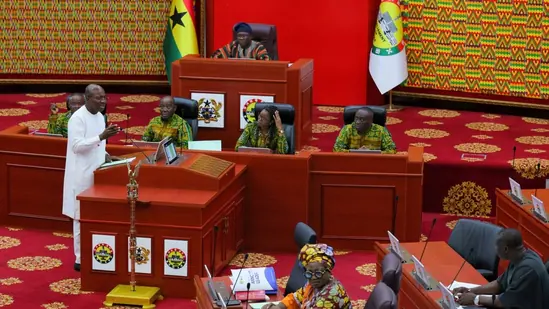
Ghana’s Parliament passed a law in May that punishes people who identify as LGBTQ with up to three years behind bars. The bill is now awaiting the signature of President John Mahama, who has signaled support for it. The government of Ghana didn’t respond to requests for comment.
The law was one of a number of measures African countries have passed in recent months that have increased criminal penalties for gay people. In March, Senegal’s president signed a new law that doubled the maximum prison sentence for sexual acts by LGBTQ couples to 10 years, and criminalized the “promotion” of homosexuality. In June, Niger’s military junta instituted a new penal code that punishes gay acts with up to a decade in prison.
Gay acts are illegal in more than half of the continent’s 54 nations.
The U.S. approach has swung sharply along partisan lines in recent years, with the Obama and Biden administrations publicly condemning antigay legislation and Trump administrations largely ignoring the issue.
In response to the 2023 Uganda law, which included life sentences for same-sex intercourse and the death penalty for some gay acts, the Biden administration expelled the country from the African Growth and Opportunity Act, making Ugandan goods ineligible for preferential access to U.S. markets. Washington imposed visa restrictions on some Ugandan officials, cut back defense funding for the government in Kampala and redirected financing for HIV and AIDS relief to nongovernmental organizations. The World Bank, under U.S. pressure, suspended $5 billion in development funding for Uganda.
The State Department declined to say whether it would eventually take a stance on the antigay legislation Ghana passed last month. “We refer you to the governments of Ghana and Uganda regarding legislation in their countries,” a State Department spokesperson said in response to questions from The Wall Street Journal.
The Trump administration has “less appetite” for using financial pressure in the interests of human rights, and last year’s shutdown of the U.S. Agency for International Development means there is less money for the U.S. to leverage, according to Anne Frühauf, head of political-risk research on Africa at Teneo, a communications and advisory firm.
“I think it’s very unlikely that Ghana’s legislation will trigger a similar response from Washington,” said Frühauf. “We’re in a different world now.”
The Trump administration has taken stands against human-rights abuses and military aggression in some parts of the continent, sanctioning, for instance, commanders of Sudan’s paramilitary Rapid Support Forces, which have been fighting government forces in a brutal civil war for the past three years. The U.S. recently sanctioned Rwanda’s military and several senior officers for sponsoring a different insurgent group, called M23, that has seized large chunks of eastern Congo.
But Trump has reversed previous U.S. positions on some culture-war issues, such as gay rights and workplace diversity, and some of his views resonate in predominantly Christian and socially conservative countries such as Uganda and Ghana.
“Throughout history, nowhere does the Ghanaian culture subscribe to LGBTQI, which is a taboo, inhuman and alien to our society,” Ghana’s National House of Chiefs, which advises the government on traditional matters, said in a 2021 statement quoted in the memorandum attached to the text of the current bill. “The idea of man marrying man and woman marrying woman is an abomination to our tradition and culture as Ghanaians.”
Ugandan President Yoweri Museveni, a conservative Christian in power since 1986, reacted to outside criticism of his country’s antigay law by accusing Western countries of attempting to impose their cultures on Africans.
Ghanaian politicians have voiced similar concerns. The bill, if signed into law, would make being gay, same-sex marriages and public displays of affection between gay people imprisonable offenses.
Relatively stable and prosperous, Ghana has hosted American-led commando exercises aimed at helping West African countries combat a growing threat from al Qaeda and Islamic State militants. Ghana agreed last year to accept West Africans deported by the U.S., a key element of the Trump administration’s anti-immigration agenda.
But rights groups say fear is pervasive among the LGBTQ community in the country. Leila Lariba, director at One Love Sisters Ghana, a human-rights nonprofit in Accra, said gay people in her country often face blackmail, eviction and violence.
Lariba said growing up gay in her country often meant trying to survive while navigating societal expectations and silence. “Conversations about sexuality and gender diversity were either absent, heavily stigmatized, or framed as something foreign and unacceptable,” she said.
Write to Alexandra Wexler at alexandra.wexler@wsj.com