A Palestine Action prisoner suffering from a muscle-wasting condition has told Middle East Eye that the prison he is held in in the UK has failed to provide him with adequate walking aids and treatment, leaving him to crawl around the jail.
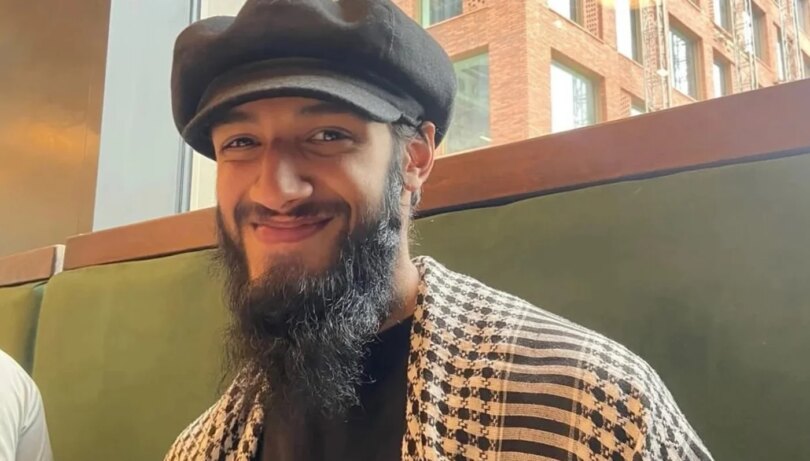
Muhammad Umer Khalid, who is being held on remand at HMP Wormwood Scrubs on charges in connection with a break-in to an RAF air base in June last year, suffers from muscular dystrophy – a rare genetic condition that is incurable but requires regular exercise and high protein meals, which he says the prison has failed to provide him.
He said that, because he is locked up in his cell for 23 hours a day, his mobility has deteriorated since last October. Now, he says he is unable to walk at all, forcing him to crawl around the prison, including to collect his medication.
“I’ve had to crawl across the prison floor in front of dozens of prisoners, as if I’m some wounded dog, just for the ability to be able to see my family and friends or for the ability to go to a legal appointment,” Khalid told MEE via an intermediary.
He said the prison was slow to respond to his multiple requests for a wheelchair. Even after a prison physiotherapist confirmed his need for one on 14 March, he did not receive it until 27 March.
CLICK FOLLOW: TO FOLLOW US
Sign up to get the latest insights and analysis on
Israel-Palestine, alongside Turkey Unpacked and other eSPORTY
When he was eventually provided with one, he said it was so large it could not fit into his cell or the corridor outside. This has left him to crawl between his bed and his toilet, a process that he said could take up to an hour.
Prison staff have also refused to bring his medication to his cell, forcing him to crawl to retrieve it.
The prison was slow to provide Khalid with a shower chair despite multiple requests, meaning he went more than 20 weeks without washing.
Khalid, along with seven other Palestine Action-linked prisoners, participated in a hunger strike over his detention conditions, which he halted in January.
‘They’re not allowed to push my wheelchair. They’re not allowed to pick me up. They’re not allowed to physically help me in any way’
– Muhammad Umer Khalid
Khalid’s friend, Nida Jafri, told MEE that when she visited him, she noticed that “he had no muscle in his leg”.
His friends reported that he largely has remained confined to his bed since last month.
Khalid said that during a fire evacuation on 23 April, he was left locked in his cell while other prisoners were evacuated.
Additionally, he reported that staff members have informed him that they cannot physically assist him in any way, citing health and safety regulations, and have barred other prisoners from doing so.
“They’re not allowed to push my wheelchair. They’re not allowed to pick me up. They’re not allowed to physically help me in any way,” Khalid said.
“They’re quite literally treating me as if I am just some wounded animal and I’m not. I’m not worthy of any dignity.”
MEE approached the Ministry of Justice for comment but did not receive one by the time of publication.
‘Faking it’
Khalid said he had been requesting a doctor’s appointment and a walking aid for weeks and that despite the muscles in his arms and legs looking visibly wasted, he has been repeatedly accused by staff, including a prison doctor, of faking his illness.
“Every time I saw a nurse I would always tell them I’m in a lot of pain, I’m exhausted, I really think I need a walking aid,” Khalid told MEE. “And they were telling me that there’s no clinical indication.”
When he was eventually seen by a prison doctor, he was told his current state was not in line with the deterioration expected of his condition.
Palestine Action defendants drop lawyers and self-represent due to ‘decisions made by the court’
Read More »
Khalid said he has only seen a doctor three times in the last three months, and that he has missed two neurology appointments – one of them, scheduled for 7 April, was missed because the prison had failed to supply him with a wheelchair.
This was despite medical evidence confirming his diagnosis, documenting a marked deterioration in his condition and attributing it to his detention conditions.
Justice Cheema-Gubb denied Khalid’s bail application on 21 April, on the basis that she had not found a material change in his circumstances since his last application and concerns that he could carry out further offences.
While noting that Khalid’s diagnosis is not disputed and that it requires careful management, Cheema-Gubb said he was not unfit for detention and that his condition could be managed in a custodial setting.
She said that the medical evidence raised a “concern about the quality and timeliness of care” but did not reflect “an incompatibility between detention and the defendant’s condition”.
She expressed particular concern that Khalid had missed a medical appointment and asked for a copy of the ruling to be sent to the prison “so that the issues identified in the medical evidence placed before the court can be addressed urgently and kept under regular review”.
Khalid’s solicitor, Laura O’Brien, told MEE that she had subsequently written to the prison regarding his condition and treatment but had yet to receive a response.
“When he was first remanded into custody, we sent his entire medical records to the prison to assist them in understanding his condition of muscular dystrophy,” she said.
‘What has been happening is a continued suggestion that he’s been putting it on, despite incontrovertible medical evidence that he has a progressive genetic condition, and that it is getting worse’
– Laura O’Brien, Khalid’s solicitor
“And what has been happening is a continued suggestion that he’s been putting it on, despite incontrovertible medical evidence that he has a progressive genetic condition, and that it is getting worse.”
She noted that since the ruling, little appears to have changed.
“Despite the medical evidence which had been provided to the prison, the prison still seem to be saying that he doesn’t need access to a wheelchair all the time,” she said.
“There’s still this back and forth about the wheelchair, partly because it feels like the prison is saying: if we accept he needs the wheelchair, we’re somehow accepting that his condition is that bad.”
The prison had suggested that Khalid’s condition did not warrant a walking aid as they had seen him walking around the prison.
“What they fail to understand is that muscular dystrophy hinders muscles recovering from the micro injuries sustained in the course of normal activity. So it’s not just about whether he can walk, but what walking does to his muscles and him needing recovery time,” O’Brien said.
“Those in a custodial setting have a right to be treated fairly and with dignity as much as anyone else. With inadequate care from the prison, the damage could be significant if his medical needs, including being provided with a wheelchair, accessible spaces to shower, use of the toilet and access to physiotherapy, are not met.”
On Thursday, Khalid confirmed that the prison replaced the wheelchair with a smaller one that can move around the corridors but cannot fit in his cell. They have also supplied him with a shower chair, and have ordered a new wheelchair.
O’Brien said: “We are pleased to hear that a more appropriate wheelchair has been ordered. We only hope that our client doesn’t have to continue to battle to make use of it.”
‘Like a skeleton’
Khalid said that, while he is doing well mentally and emotionally, he is in constant pain and has started having difficulty breathing.
“My arms are beginning to waste away, which will stop me from even being able to operate my own wheelchair,” he told MEE.
He said that the situation is taking a toll on his family.
“My family understands what the further implications of this condition are, with eight and a half months of custody and then potentially a two-month trial,” he said.
“They know how much goes into me being able to manage my condition. So to see me like this is obviously quite big for them.”
Khalid’s mother, Shabana, said the family had done everything they could to manage his condition since he was diagnosed in 2014.
“We would give him oils, vitamins and bone broths,” she told MEE.
“But I went to see him last week and he showed me his legs. He’s literally like a skeleton with skin hanging off him,” she said, adding that the sight was “heartbreaking”.