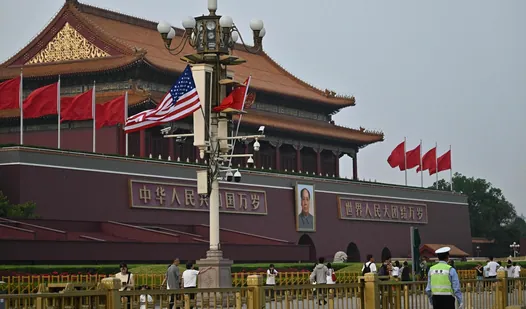
CHINA WANTS more sway over how the world thinks. The country’s latest five-year plan, announced in March, aims to achieve a major leap in China’s international influence. This often manifests on social media as cute videos of pandas or futuristic ones of high-speed trains. But China’s leaders see the broader effort as crucial. It is needed, in China’s official formulation, to counter Western biases so as to win the “battle for global public opinion” and “safeguard national interests”.
The country’s latest five-year plan, announced in March, aims to achieve a major leap in China’s international influence. This often manifests on social media as cute videos of pandas or futuristic ones of high-speed trains. (AFP)
In principle, there is nothing wrong with China trying to expand its global influence. Many governments do. It can be uncomfortable for democrats to see the world’s biggest authoritarian regime winning fans: recent polls point to an uptick in support for China around the world. But they should have some confidence. These trends reflect disgruntlement with Donald Trump’s America as much as warm feelings towards the Chinese Communist Party.
Where things become nasty is when the battle for opinion gets underhanded. Researchers have long documented Chinese influence operations, showing how state actors disguise their identities online to shape policies and sow dissent abroad. Take, for instance, the work by Graphika, a social-media analytics group, linking thousands of fake accounts on Facebook to Chinese disinformation about American decline. Others have also found circumstantial evidence that the TikTok algorithm amplifies content favourable to the Chinese Communist Party (something TikTok denies).
Careful researchers hold themselves to high evidentiary standards. So it has been troubling to see a recent spate of reports in America on China’s malign influence in debates on data centres, climate and artificial intelligence that fall well short of these standards. The concern is not just that they get their analysis wrong but that they are polluting the space for monitoring and parrying the real challenges from China.
One questionable report comes from the Bitcoin Policy Institute, a cryptocurrency advocacy group. It starts by noting that Bernie Sanders, a senator, invited two Chinese academics affiliated with the government to a panel discussion on AI safety. Anyone vaguely familiar with Mr Sanders knows that his ideas are his own, including his proposal for a moratorium on AI data centres. Instead, a colourful chart in the BPI report links the Chinese Communist Party to Mr Sanders (through six degrees of separation). Some of its other fearsome-sounding “influence vectors” are equally tenuous. It tracks grants by Swiss and British billionaires to American environmental groups opposed to data centres, and notes that one gave cash to Chinese green groups nearly a decade ago. In this world of insinuation and innuendo, he is compromised.
Another report, by Power the Future, an energy lobby, examines foreign funding for American opposition to data centres. It observes that the Sierra Club, an American environmental group, has helped write lawsuits derailing infrastructure investments. “That context makes one question impossible to ignore: who benefits?” it asks. The answer, it turns out, hinges on another question. In 2020 environmental officials had asked the Justice Department to investigate whether the Sierra Club received foreign funding. That went nowhere, with no charges laid. But the question had been asked—and that is damning enough. Citing the BPI and PTF reports, Republican lawmakers in the House of Representatives have called for the Trump administration to examine the purported ties between China and America’s anti-AI movement.
A third report, from the National Association of Scholars, a conservative think-tank, looks at China’s role in California’s clean-energy policies. It lays out how the University of California and Tsinghua University have collaborated on climate-change research. Yet it then makes improbable jumps in ascribing causal power to that collaboration. Because environmental policies may lead to contracts for Chinese greentech firms, it frames the joint research as benefitting the Chinese economy and heightening American dependence on it. It calls for federal investigations of officials who have entered into formal agreements with China, but focuses only on the green policies of Democratic-led California. What about the dozens of agreements and trade missions launched by Republican administrations in Iowa, Texas, West Virginia and beyond, some of which promote shale-gas exploration and coal mining? On those, it is silent.
One thread running through these reports is that they all come from groups with specific agendas: more AI innovation, more data centres and fewer green policies. They are using accusations of “Chinese influence” to tar Americans who have the temerity to disagree. Bethany Allen, a pioneer of investigations into Chinese influence operations now at the Australian Strategic Policy Institute, says it reeks of politics. “It has taken enormous hard work to create this space, and these reports abuse that work in a way that harms democracy,” she says. They are “trying to discredit domestic movements that are clearly authentic by claiming that, actually, it’s evil foreigners doing it”. BPI rejects that characterisation. It acknowledges that local communities have legitimate concerns about data centres but wants Americans to know about the foreign cash shaping this opposition. PTF says the opposition is manufactured by “radical-left environmental groups”, among others, not as a Chinese influence operation.
Eyes on the target
Making matters more complicated is that, beneath their hyperbole, these reports are correct about a worrying trend: some Chinese actors would like to steer America away from productive tech investments. Consider yet another report about Chinese influence operations, published on June 10th by OpenAI. It explained how accounts apparently based in China had used ChatGPT to craft material criticising American data centres and Donald Trump’s tariffs, then posted it on X, YouTube and Facebook. In one case, they created comic strips about power grids. “Why are our power prices so high?” exclaimed a suburban mother in one panel as a cigar-chomping man, representing AI and data centres, held up money bags. Prompts specified that all generated content should omit Xi Jinping’s name.
The OpenAI researchers concluded that this operation had no discernible impact. Yet that does not mean that the efforts of these Chinese actors should be ignored. Their express purpose is to foment distrust and dysfunction in America, with the apparent goal of restraining American AI development while China presses ahead. Precisely because the stakes are so high, it is vital to be careful, even clinical, when levelling such allegations. Otherwise, serious investigations can be dismissed as partisan point-scoring. Using scant evidence and silly insinuations to discredit domestic opponents will make it that much harder to counter truly dangerous forms of Chinese influence.
Subscribers to The Economist can sign up to our Opinion newsletter, which brings together the best of our leaders, columns, guest essays and reader correspondence.