America has long been the world’s arms dealer of choice. From 2021 to 2025, its share of global arms exports jumped to 42%—more than Russia, China and the European Union combined. Over the same period, American arms exports to Europe were 217% higher than in the previous five-year period, according to the Stockholm International Peace Research Institute (SIPRI), a think-tank. As the old world rearms at its fastest pace since the end of the cold war, it has splurged on American warplanes, air-defence systems and long-range missiles.
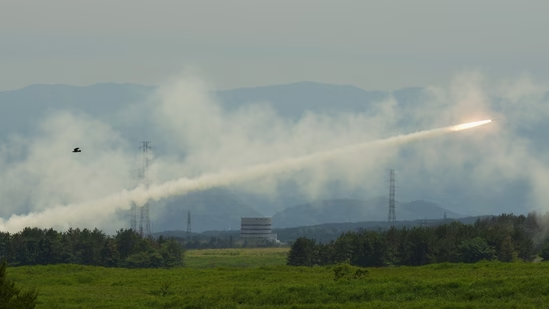
U.S. Marines conduct a live-fire training of the High Mobility Artillery Rocket System, short for HIMARS, at Camp Fuji, in Gotemba, southwest of Tokyo, Wednesday, May 20 (AP Photo/Hiro Komae)
These days, however, Europe could be forgiven for experiencing some buyer’s remorse. America has churned through munitions in the war against Iran and has told European officials to expect significant delays in the delivery of American-made weapons. Shipments are instead being diverted to replenish America’s own depleted stocks. That reportedly includes scarce munitions, like air-defence interceptors, as well as strike systems like the HIMARS rocket launchers. This has left European diplomats privately frustrated.
They have reason to feel aggrieved. White House officials have long pressed European governments to boost defence spending and also to buy American kit as a way of placating Donald Trump and keeping him engaged in NATO. It has not worked. He has repeatedly displayed contempt for NATO allies, most recently over their refusal to send ships to reopen the Strait of Hormuz. The shortfall of munitions is starting to complicate NATO’s existing operational plans. Further delays in shipments might soon affect the flows of weapons to Ukraine, too.
Europe buys most of its weapons from America through the arcane Foreign Military Sales (FMS) process. Instead of being agreed on with contractors, FMS deals are struck directly with the American government, which has leeway to adjust the terms. It is best to think of FMS not as a standard procurement process but as a tool of American foreign policy, says Javier Ospital of Bruegel, a Brussels-based think-tank. The fine print on each agreement states that “materiel procured or stocked for FMS may be diverted to meet higher priority requirements”. America has redirected the delivery of some weapons in the past. Under the Biden administration, shipments of air-defences were diverted from other European countries to Ukraine.
The current problem is the sheer scale of the shortage and America’s inability to fulfil a giant backlog of orders. Take the Patriot air-defence system. America has burned through more than 1,300 interceptor missiles during the Iran war, which is equivalent to more than two years of production at current rates. At the same time, the Trump administration has fast-tracked the sale of Patriots to countries in the Gulf, which have also run down their stockpiles. That has pushed European orders even further down the priority list. Switzerland, for example, has said the delivery of five Patriots batteries, which it expected to receive this year, could be delayed up to seven years because of the Iran war.
Even before the Iran war, Trump administration officials had expressed misgivings about selling certain weapons to Europe. Elbridge Colby, the Pentagon’s undersecretary for policy, has long questioned the wisdom of some foreign military sales given existing production constraints. Each air-defence system sold to Europe, in his logic, is one fewer available to America to defend against China in the Pacific. But if the current delay in deliveries lasts much longer, it could come to hurt America in the longer run, too. “It really undermines trust in America’s willingness to be a reliable supplier of arms,” says Pieter Wezeman of SIPRI. Countries in Asia, for example, may think twice before buying American weapons, he adds.
European countries, for their part, are buying local to reduce their dependence on America. Last year Denmark opted for the Franco-Italian SAMP/T air-defence system instead of the Patriot. More recently, NATO’s procurement agency chose a Swedish-Canadian aircraft as its future airborne warning and control aircraft, a programme which has been served by an American aircraft for 43 years. But Europe will struggle to quickly replace American capabilities like airborne surveillance or long-range missiles. Until then, it will have to follow the dealer’s choice.
Stay on top of American politics withThe US in brief, our daily newsletter with fast analysis of the most important political news, andChecks and Balance, a weekly note that examines the state of American democracy and the issues that matter to voters.