
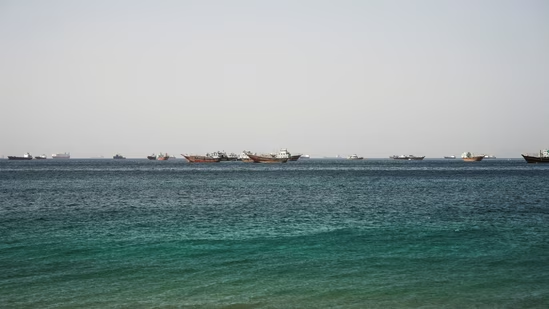
After the closure of the Strait of Hormuz, Iran is now reportedly eyeing the subsea cables of internet and financial traffic beneath the crucial waterway amid the ongoing war with the United States and the wider conflict in the Middle East.
Iran is reportedly mulling charging the world’s largest tech companies for using these subsea internet cables lying under the already tense Hormuz Strait — a strategic waterway for oil transport across the world.
The submarine cables serve countries around the Persian Gulf, including the United Arab Emirates (UAE), Qatar, Bahrain, Kuwait and Saudi Arabia, the Iran Guards-affiliated Tasnim reported.
ALSO READ | ‘Clock is ticking’: Trump warns Iran, asks Tehran to ‘move fast’ amid stalled peace talks
With the escalating war between Iran and the United States, Tehran reportedly began charging a toll fee from ships passing through the Strait of Hormuz. Now, local reports have seemingly threatened that traffic in the waterway could be disrupted if firms don’t pay the fees to use the subsea cables.
“We will impose fees on internet cables,” Iranian military spokesperson Ebrahim Zolfaghari said in a post on X last week. Iranian lawmakers reportedly discussed a plan to likely target the submarine cables linking Arab nations to Europe and Asia.
Tech giants like Google, Microsoft, Meta, and Amazon would have to comply with Iranian law, while subsea cable companies would have to pay licensing fees for cable passage, with repair and maintenance rights signed exclusively to Iranian firms, the IRGC-affiliated media reported.
ALSO READ | Why Abu Dhabi’s Barakah nuclear power plant, latest target of drone strike, is crucial to UAE
Some of these companies have reportedly invested in the cables running through the Hormuz and the Persian Gulf, but it is unclear if those cables travel through Iranian waters.
It is also unclear how the Iranian Revolutionary Guards could force the tech companies to pay them a fee, since US sanctions bar them from making payments to the Islamic Republic.
Why subsea cables are crucial?
The subsea cables under the Strait of Hormuz are fibre-optic or electrical cables laid on the sea floor to transmit data and power.
These submarine cables carry around 99 per cent of global internet traffic, according to the International Telecommunication Union (ITU) — a specialised United Nations agency for digital technologies.
The cables also carry telecommunications and electricity between countries, crucial for online communications and cloud services.
ALSO READ | ‘Did it as a favour to Pakistan’: Trump on US-Iran ceasefire talks in Islamabad
But if Iran weaponises this, the cables could also suffer damage in conflict. “Damaged cables mean the internet slowing down or outages, e-commerce disruptions, delayed financial transactions…and economic fallout from all of these disruptions,” geopolitical and energy analyst Masha Kotin was quoted as saying by Reuters.
Among the Gulf nations, the UAE and Saudi Arabia have particularly invested billions of dollars in AI and digital infrastructure. Any disruption in the cables also carries implications for the two countries, as their national AI companies — which serve customers across the region via these undersea cables — would be hit.
Which cables are there under Hormuz?
The major cables laid under the Strait of Hormuz include the Asia-Africa-Europe 1 (AAE-1), connecting Southeast Asia to Europe via Egypt, with landing points in the UAE, Oman, Qatar, and Saudi Arabia; the FALCON network, connecting India and Sri Lanka to Gulf countries, Sudan, and Egypt; and the Gulf Bridge International Cable System, linking all Gulf countries, including Iran.
There are also other networks under construction, including a system led by Qatar’s Ooredoo.
Risks of subsea cables
According to the International Cable Protection Committee (ICPC), the total length of submarine cables has considerably grown between 2014 and 2025. However, faults have remained stable at around 150-200 incidents per year.
State-sponsored sabotage continues to be a risk, but 70 to 80 per cent of faults are caused by accidental human activity.
Undersea currents, earthquakes, subsea volcanoes, and typhoons are among the other risks of the subsea cables.
ALSO READ| ‘Operation Sledgehammer’: US weighs fresh Iran strikes, under a new name, as Trump returns from China
As it is, the ongoing Iran war has brought major disruptions to global energy supply and regional infrastructure, including to Amazon Web Services (AWS) data centres in Bahrain and the UAE.
However, the risk of damaged vessels inadvertently hitting the subsea cables looms.
“In a situation of active military operations, the risk of unintentional damage increases, and the longer this conflict lasts, the higher the likelihood of unintentional damage,” Kotkin added.
The accurate level of possible impact if the cables are damaged can be assessed only on the basis of how many network operators rely on them and what alternatives they have, Reuters reported, citing TeleGeography.
Are there any alternatives?
Experts have stated that possible damage to subsea cables cannot cause a complete connectivity loss due to land-based links, they also do not have a feasible replacement in satellite systems.
Satellite systems cannot handle the same volume of traffic as subsea cables, and are also more expensive, Reuters reported, citing experts.
Alan Mauldin, research director at telecom research firm TeleGeography, was quoted as saying, “It’s not as though you could just switch to satellite. That’s not an alternative.” He noted that satellites rely on connections to land-based networks and are better suited for moving things, like ships and aircraft.
Kotkin, meanwhile, said, networks like Starlink are a “boutique solution, which is not scalable to millions of users, at this time.”
Where does the US-Iran war stand?
The US-Israel-Iran war, which began on February 28, 2026, is still going on, with peace talks stalled between Tehran and Washington. The two sides refuse to settle on the Islamic Republic’s nuclear programme.
Though Iran and the US agreed to a truce on April 8, the ceasefire holds fragile in today’s date. No deal has been finalised, with Tehran giving back-to-back rejections to Washington’s demands and proposals.
US President Donald Trump on Sunday warned Iran of a “ticking clock”, asking the Islamic Republic to move faster. He said time is of the essence in this situation, adding that nothing would be left of Iran if it doesn’t move faster.
Not getting a deal to end the war has reportedly prompted the Trump administration to bring military options back to the table, with the US President reportedly scheduled to hold a meeting with top national security officials in the Situation Room on Tuesday.