
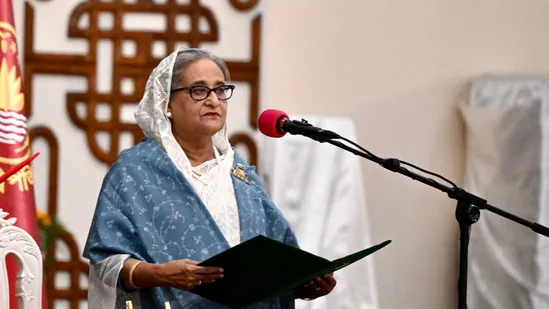
Bangladesh could witness a return to the “dark days” of the period between 2001 and 2006, when the BNP was in power, due to the rise of militant and extremist forces, former prime minister Sheikh Hasina warned in an e-mail interview.
Hasina, who has lived in self-exile in India since the collapse of her Awami League government in the face of student-led protests in 2024, also pledged that she will go back to Bangladesh “very soon”, but indicated that her return is linked to a “democratic environment” with the restoration of political rights. The Awami League is currently banned in Bangladesh and Hasina has been given a death sentence by the country’s International Crimes Tribunal. Edited excerpts:
You returned to Bangladesh on May 17, 1981 after a period of self-exile in India. In the current circumstances, do you foresee a return to Bangladesh any time soon?
May 17 is a very emotional and memorable day for me. After six years of exile, on that day in 1981, having lost my parents, brothers and relatives, I returned to the country relying solely on the love of the people of Bangladesh. Even then, there were conspiracies against me, cases filed against me, and risks to my life.
ALSO READ | Sheikh Hasina extradition request under legal review, says India
The matter of return does not depend on a specific date or time. We are continuing to work toward ensuring a democratic environment in Bangladesh, freedom of expression, political rights and the restoration of the rule of law. This is not only necessary for my return, but also for protecting the country’s independence and sovereignty and ensuring the overall welfare of the people. By uniting the people of the country, we will soon achieve that goal.
But I want to make one thing very clear: My absence does not mean my silence. Every moment, I am fighting for the country and we are actively working at the diplomatic level, within international legal frameworks and through global media.
I have survived 19 assassination attempts but nothing has been able to stop me. Since the Almighty has kept me alive, I will return to the soil of Bangladesh very soon.
Will your return be possible given the ban on the Awami League and the numerous cases against you?
The Awami League is a party of the masses, it was not born through the power of guns or the blessings of authority. No ban written on paper can ever suppress this party. If bans could suppress the Awami League, then Bangladesh itself would never have been born.
The party has repeatedly returned even stronger. Those who consider this ban permanent should look at the pages of history. While this ban may reflect the temporary exercise of power by those in authority, it is actually a reflection of their fear. They fear the Awami League because if the party is allowed to carry out democratic political activities in an organised way, it will become difficult for them to continue their anti-state activities. That is why this ban exists.
ALSO READ | Tarique Rahman’s ‘Bangladesh first’ response to Delhi-Dhaka ties, firm stance on Sheikh Hasina
Millions of our supporters and hundreds of thousands of leaders and activists are still in Bangladesh. Despite attacks, cases, imprisonment and persecution, they remain united. In the interest of the country and its people, the return of the AwamiLeague is inevitable — it is only a matter of time.
Are steps being taken to reorganise and reform the party since some leaders have indicated an Awami League minus Sheikh Hasina is acceptable to them?
The Awami League is a democratic party. Ideological activists are the lifeblood of this party, and they elect the leadership. Whether you call it reform or adjustment, it is a normal and ongoing process. Since the Awami League is Bangladesh’s largest political party, allegations or complaints may arise against certain individuals associated with the party in some cases. The Awami League never tolerates wrongdoing.
At the same time, we must remember that in the name of purification or revolution, political opponents often conspire to break rival parties apart. I want to say clearly that the Awami League itself has the ability to put its own house in order. This reform process will take place through the party’s internal democratic procedures, not according to prescriptions of conspirators.
Will other Awami League leaders who left the country return?
I disagree with the term “leaders who left the country” because none of them left voluntarily. The illegal interim government led by Muhammad Yunus carried out what has been described as a silent political genocide against Awami League leaders and supporters, and it is still ongoing. Nearly 600 of our leaders and activists have been brutally killed and more than 150,000 leaders and activists were arrested in false cases. Their homes and businesses were vandalised and seized.
Thousands of officials and employees in the administration, law enforcement agencies and government jobs were dismissed for supporting the spirit of the Liberation War and embracing the ideals of Awami League. In such a terrifying situation, many were forced to leave Bangladesh to save their lives. Many of them are working to organise the party and build international public opinion. I want to say that as soon as a minimum democratic environment and rule of law are restored in Bangladesh, they will return.
Bangladesh is facing an economic crisis. What are your views on how this is being tackled?
The father of the nation, Sheikh Mujibur Rahman, founded Bangladesh with the dream of building a prosperous country free of hunger, poverty and discrimination. During four terms in government after 2008, through long-term planning and disciplined implementation processes, we placed Bangladesh on a strong foundation. We implemented mega projects such as the Padma bridge, Rooppur nuclear power plant and Matarbari deep sea port. In 2006, the final budget of the BNP-led four-party government was 70,000 crore taka (approx $5.7 billion), per capita income was $482 and the country’s GDP size was $70 billion. The last budget we presented for 2024-25 was for 797,000 crore taka(approx $64.86 billion), per capita income was $2,784 and GDP was $450 billion.
The interim government led by Yunus destroyed the country’s economy. Through mob violence, large industrial institutions have been shut down. Due to severe deterioration of law and order, foreign investment has fallen to its lowest levels. In just 18 months, they borrowed 373,000 crore taka from domestic and foreign sources. This trend continues under the government led by Prime Minister Tarique Rahman. In only three months, they have borrowed nearly 100,000 crore taka (approx $8.14 billion). The economy stands at the brink of a terrible situation — there is no electricity, no oil, no gas, no fertilisers, no irrigation water. Employment opportunities have shrunk while prices of goods have increased.
Bangladesh under the caretaker administration and the BNP government appears to have moved closer to China and Pakistan while anti-India rhetoric is on the rise. How do you view this?
The core principle of our foreign policy is “friendship with all, malice toward none.” The main objective of this friendship is public welfare. This principle is enshrined in our Constitution. The Awami League government always maintained transparent, trustworthy and normal relations with all friendly nations and they extended their cooperation.
Our relationship with India is historic. India is not only our neighbour, but its contribution to our Liberation War is undeniable. However, in our country, anti-India rhetoric has long been one of the main tools of anti-liberation and ideologically bankrupt groups. The interim government of Yunus joined in this practice.
Our political opponents always accused the Awami League of “selling the country” to India and signing anti-national agreements. Yet during 18 months of the interim government and under the BNP government, they have failed to present even a single anti-national agreement.
Under the Yunus-led interim government and under the current government, we are seeing Bangladesh’s interests being repeatedly sacrificed.
Extremism and militancy is not only a threat to Bangladesh but also one of the greatest threats to regional security. During the BNP-Jamaat-e-Islami alliance government from 2001 to 2006, Bangladesh became a safe haven for militancy. Simultaneous bomb attacks were carried out in 63 districts, and a grenade attack was launched against me. Judges were murdered and cultural institutions and religious places of worship were attacked. Under state patronage, incidents such as the smuggling of 10 truck-loads of illegal weapons took place.
After coming to power, the Awami League declared zero tolerance against militancy and used all our strength to free the country of extremism…
But after August 5, 2024, we saw convicted top militants, who had been imprisoned, being released…. Many convicted individuals involved in militancy and terrorism entered Parliament. The dark days of 2001-06 are on the verge of returning again. The black shadow of militancy has spread even among members of the armed forces and law enforcement. This is undoubtedly a major threat to the country’s security.