Rugby legend Scott Hastings has died after a four-year cancer battle – on the day of his late wife’s birthday.
Hastings, 61, was a member of Scotland’s famous Grand Slam-winning team of 1990 alongside older brother Gavin.
His wife Jenny vanished while swimming in 2024 at Wardie Bay in Edinburgh after a two-decade struggle with mental health.
Scotland’s most capped centre, Hastings had been treated for Non-Hodgkin lymphoma, a cancer which affects white blood cells.
‘Corey and Kerry-Anne Hastings are saddened to inform you that Scott, the Scotland and British & Irish Lions centre, passed away peacefully surrounded by family on the morning of Sunday 17 May,’ a statement from Hastings’ children, released by Scottish Rugby, said.
‘This also marked his late wife Jenny’s birthday which speaks louder than words that he is safe and with his beloved Jenny. Scott was undergoing cancer treatment and due to complications deteriorated extremely quickly.
‘Despite every effort by the incredible team at the Western General Hospital ICU, he passed away peacefully and pain free. At this time the family ask everyone to give them space to process and manage their energies and ask for their privacy to be respected.’
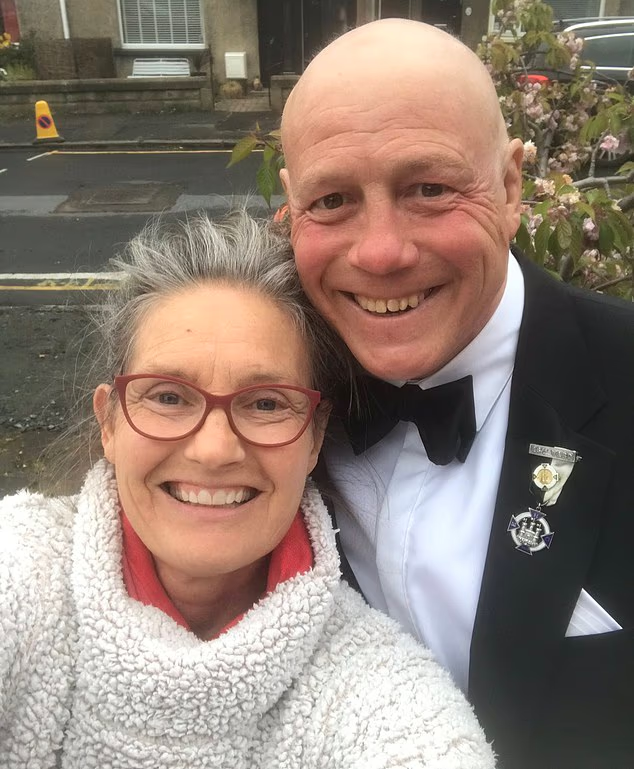
Scottish Rugby great Scott Hastings (right) has passed away on the birthday of his late wife, Jenny (left)
The body of Jenny was found on September 12 2024, four days later five miles from where she disappeared.
In an emotional statement, released a day after the mother-of-two vanished, her family said: ‘As many of you know Jenny struggled with her mental health for a number of years and ultimately she was unable to cope on this occasion.
‘She swam out into the Firth of Forth from Wardie Bay in Edinburgh and it appears that she wished to end her suffering in what was a regular and healing place for her.
‘She loved the water but unfortunately her mind was not in a place of safety. The Hastings family are absolutely heartbroken.’
Mrs Hastings had been classed as a ‘high risk missing person’ because of her known struggles with mental health. She had previously spoken about her long-standing battle with severe depression and had made previous attempts on her own life.
‘When she was well, she was radiant and beautiful and outgoing,’ Scott said of his wife. ‘But to see somebody suffer poor mental health was a challenge.’
He would take solace in visiting Wardie Bay after her death, with the couple spending 45 years together.
Hastings is the most-capped male centre for Scotland of all-time and won the grand slam with Scotland in 1990, anchoring a victory against England.

Townsend is the most capped male Scottish centre of all time and anchored his side to a 1990 grand slam victory
Former team-mate and Scotland head coach Gregor Townsend said: ‘In the late 1980s and early 1990s, Scott was an iconic figure for Scottish rugby.
He went on to commentate on rugby for a number of broadcasters, including BT Sport, Sky Sports, ITV, and BBC.
Speaking last year, he told how he returned every week to the bay where his ‘beautiful, radiant’ wife Jenny, 60, took her life in September 2024.
Her body was discovered on September 7 – the couple’s wedding anniversary.
Mr Hastings said: ‘I miss Jenny every day.
‘She had this amazing connection with people and probably concentrated on other people’s health rather than her own mental health.’
‘His defensive display in the 1990 Grand Slam victory over England was crucial to that day’s success and he epitomised what it meant to play for Scotland – combining passion, confidence and aggression, whenever he wore the navy blue jersey.
‘Like many other schoolboys throughout Scotland at the time, I wanted to emulate Scott’s approach to the game and how he took the game to the opposition.
‘A few years later, I was fortunate to play alongside him on a number of occasions for Scotland, as he became our most-capped player.
‘His influence on his team-mates was still very strong towards the end of his career as he helped us come very close to winning another Grand Slam game against England at Murrayfield in 1996.
‘Scott always brought positivity and energy into everything he did from his playing career then into the past couple of decades as a widely travelled and respected commentator.
‘His passing is a huge loss for Scottish rugby, and my thoughts and prayers go out to his family and close friends. Rest in peace, Scott.’