
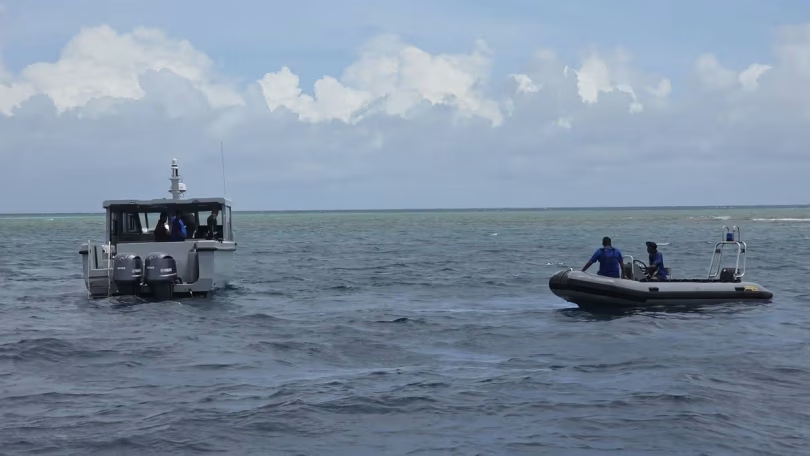
Five Italian tourists were thought to be minutes from the surface of a Maldives cave dive when they vanished and were later found dead following a major search and rescue operation
The five tourists who drowned during a cave dive in the Maldives were just minutes from the surface when tragedy struck.
The Italian nationals were identified as Monica Montefalcone, 52, a marine biologist from the University of Genoa, her daughter Giorgia Sommacal, 20, researcher Muriel Oddenino, 31, recent graduate Federico Gualtieri, 31, and diving instructor Gianluca Benedetti.
They were believed to be around 15 minutes from the surface when they vanished and were later found dead without proper equipment, the New York Post reported. Maldivian rescue diver Staff Sgt Mohamed Mahdhee also tragically died while searching for the bodies.
Maldivian presidential spokesperson Mohamed Hussain Sharee said the cave is so deep that even with the best equipment, divers do not attempt to reach it.
“Tragic human error” was a key factor in the May 14 horror, which saw the group die 200 feet below the surface, Finnish diver Sami Paakkarinen said. “Unfortunately, in most cave diving accidents, the main cause is always human error,” he told the Sun.
He added that the group didn’t have the proper cave-diving equipment, including a diving reel or a guided rope. Four of the bodies were recovered together, Paakkarinen said.
Gualtieri’s body was found the day of the drowning and was brought back to Italy, while the four other victims were recovered on Monday.
Pulmonologist Claudio Micheletto told Italian outlet Adnkronos that it is likely “something went wrong with the tanks.”
Micheletto, who serves as the director of pulmonology at the University Hospital of Verona, added: “Death from oxygen toxicity, or hyperoxia, is one of the most dramatic deaths that can occur during a dive – a horrible end.”
Scuba divers breathe compressed air made up of 21% oxygen and 79% nitrogen from a tank. To reduce the risk of decompression sickness, a higher-oxygen alternative called nitrox is widely used, but diving too deep with the mix may trigger oxygen toxicity.
“When you breathe in too high a concentration of oxygen, the gas becomes toxic to the body,” Micheletto said. “During the dive, dizziness, pain, altered consciousness and disorientation occur, making it impossible to surface.”
Experts believe that the deaths may have also been linked to oxygen toxicity and panic.
Alfonso Bolognini, president of the Italian Society of Underwater and Hyperbaric Medicine, said: “Inside a cave at a depth of 50 meters, all it takes is a problem for a diver or a panic attack for a diver,” he said.
“The agitation will cause the water to become cloudy and can impair visibility,” which can lead to “fatal errors.”
“It’s not easy to say now what exactly may have happened at the bottom of the sea,” he said.