

Remo Stars: From Champions To Crisis Point
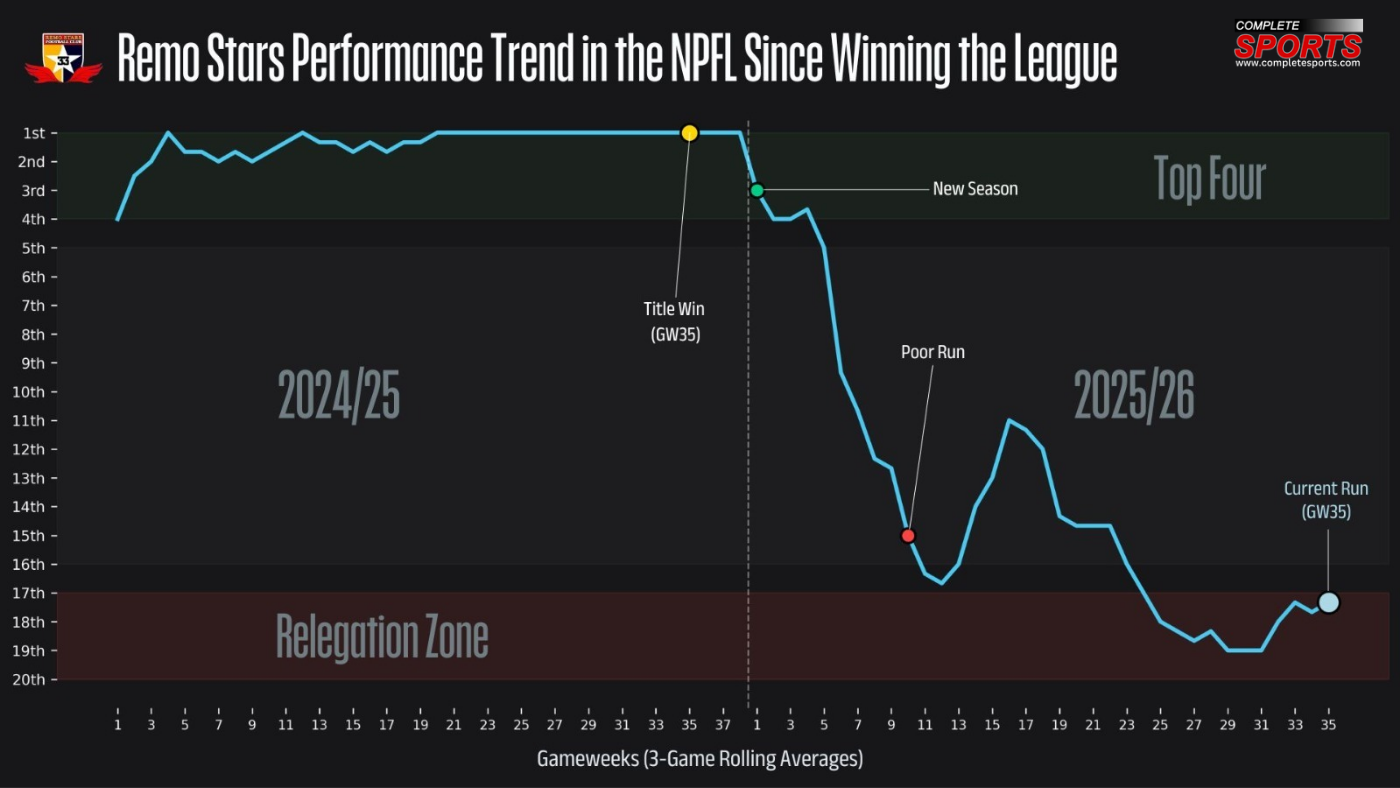
By matchday 35 of the 2024/25 season, Remo Stars had conquered the nation and were crowned NPFL champions. They eventually finished with 71 points, one of the highest tallies in recent years, and established themselves as one of the most structured sides in the league. The celebratory tour of that maiden title through the heart of Ogun state remains a media appeal to date.
After matchday 35 of the NPFL 2025/26 season and with three games to go, they sit 16th on 43 points, just one goal above the relegation line. That is a drop of 15 places, one of the steepest post-title declines the league has ever seen. Historically, defending champions do regress. Title-winning seasons are usually followed by regression.
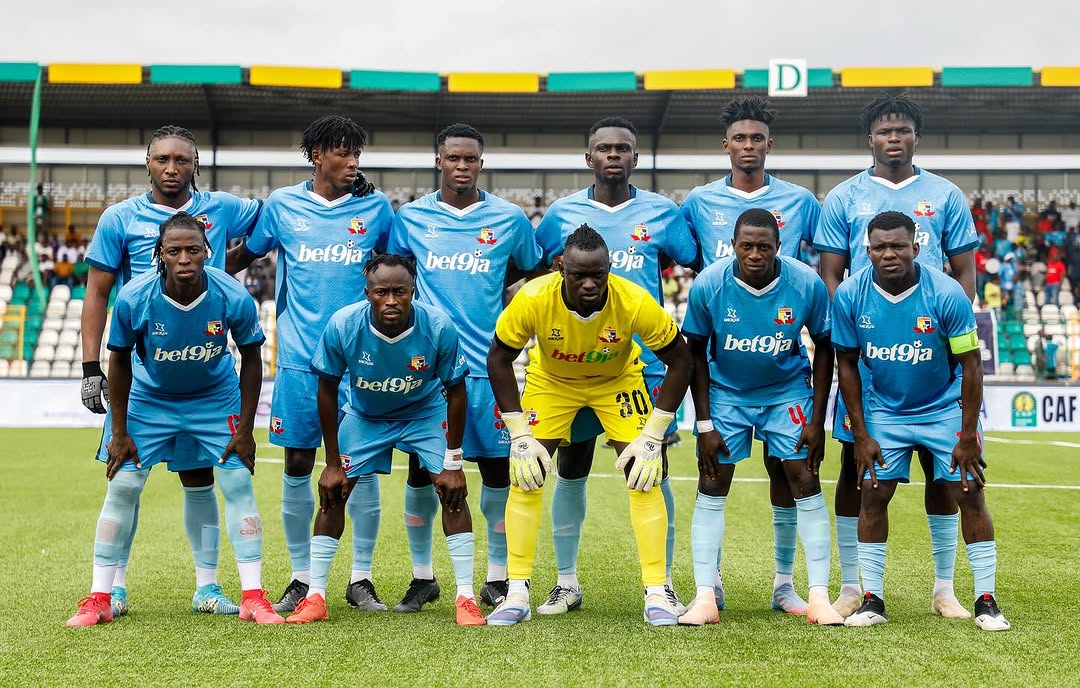
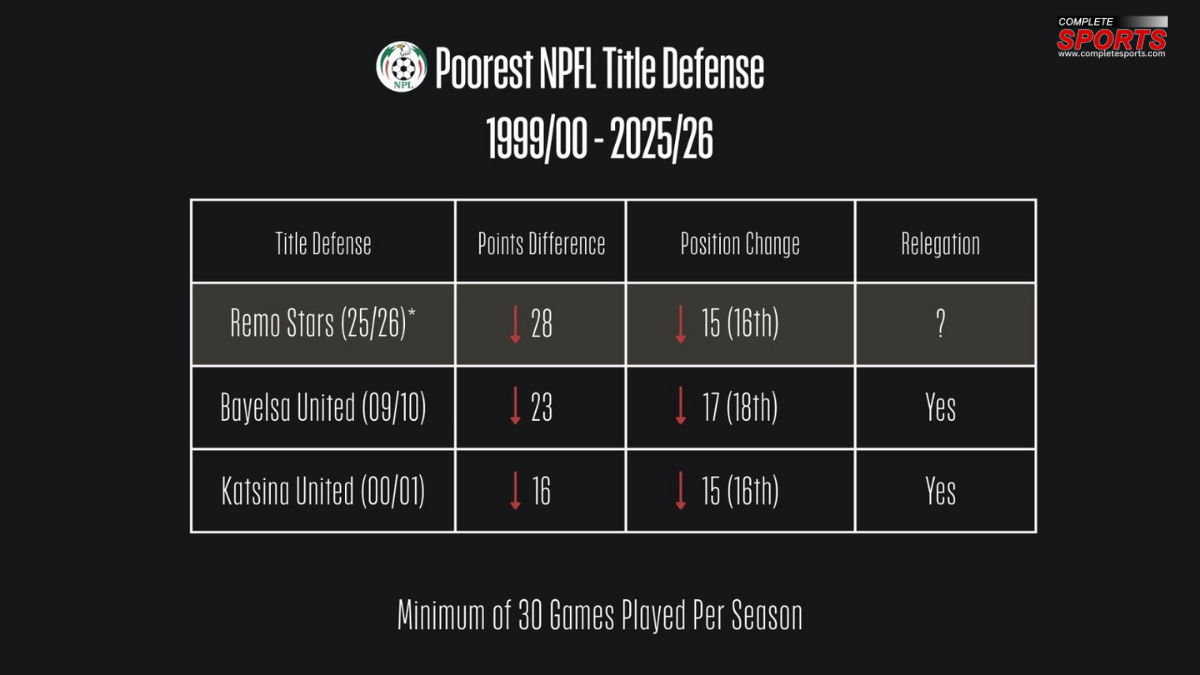
The demands of defending a title, combined with squad turnover and the league’s natural volatility, often pull champions back toward the pack. But what has happened to Remo Stars goes far beyond that expected drop. Since the 1999/00 season, title winners have dropped by an average of seven positions in the following campaign. Remo Stars have doubled that decline.
Also Read: EXCLUSIVE: NPFL Survival Race — Why 48 Points Is The True Safety Benchmark
Within a single season, the Sky Blue Stars of Ikenne have moved from the top of the table into a fight at the bottom, turning what should have been a period of consolidation into one of the greatest declines in recent league history. This decline raises a more important question than where Remo Stars currently sit on the league table.
It forces a closer look at how performance trends change from one season to the next, what typically happens to defending champions in the NPFL, and whether this kind of drop is part of a wider pattern or an outlier. As established by data, relegation in the Nigeria Premier Football League (NPFL) is often a slow accumulation of small edges that eventually become too difficult to control.
In this piece, Completesports.com ALLI FESOMADE examines the data behind Remo Stars’ title defence, combining it with expert opinions to understand how Remo Stars have moved from control to record-setting instability within such a short span.
Match Control Collapse Behind Remo Stars’ Struggles
To understand why this drop is severe, a useful place to start is with how games have unfolded for them this season compared to last. In their title-winning campaign, Remo Stars spent just under 19 per cent of match time trailing.
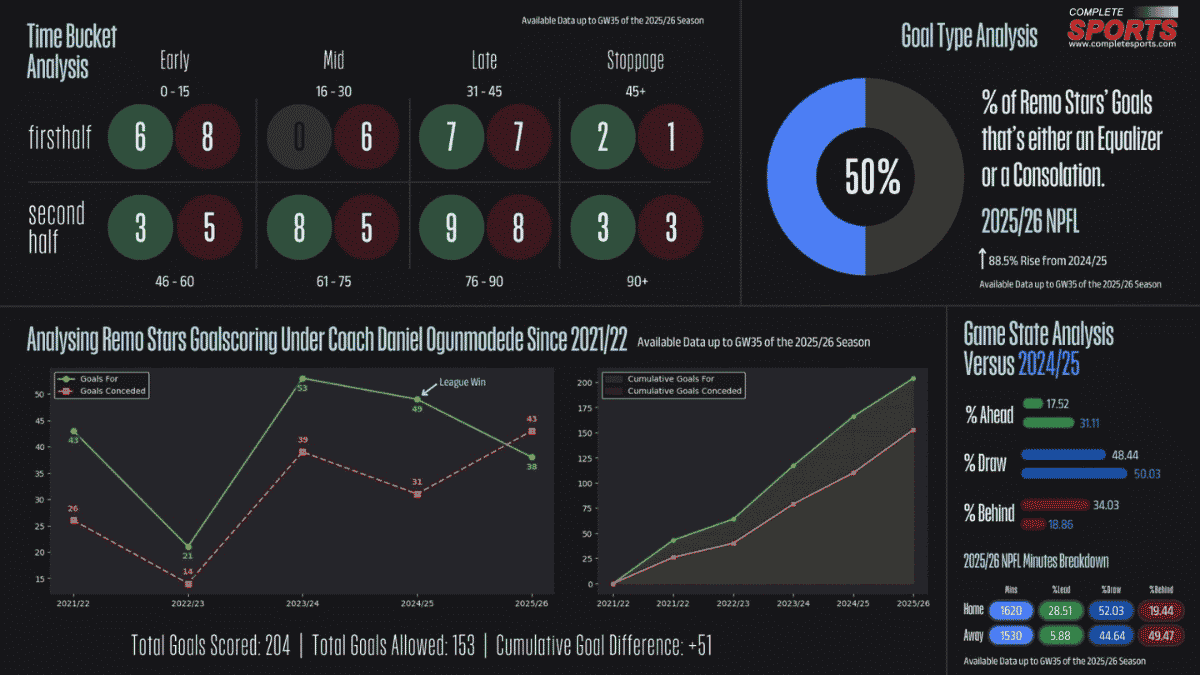
They were in control for most of the season, either leading or holding games in stable phases. This year, that number has risen to 34 per cent. At the same time, the proportion of time Remo Stars spent being ahead has also dropped by more than half, from 31 per cent to 17 per cent.
That drop alone explains a lot about the worrisome campaign Remo Stars are having this season. Top teams tend to play from ahead while teams fighting relegation tend to chase games. Remo Stars have moved firmly into the second category.
Also Read: EXCLUSIVE: NPFL 2025/2026 Set To Produce Best Champions In Decades
This becomes even clearer when you split those numbers further. Away from home, they have spent nearly half of their total minutes this season behind in matches. At home, where teams usually build their survival base, they are now trailing 19 per cent of the time, a significant increase from just 2 per cent last season.
Also Read: Remo Stars Must Win Remaining Five Games To Avoid Relegation — Abd’Allah
Remo Stars are not having a minor dip in performance. This is a complete loss of control. Once a team starts games from behind consistently, everything else begins to change. The way chances are created becomes more rushed. Defensive structure becomes more exposed. Results become harder to manage. This season, the team has fallen behind 27 times (excluding goals conceded in instances where they were already behind).
Goal Patterns Highlight Remo Stars’ Reactive Season
That pattern shows up in their goal data as well. On the surface, scoring 38 goals in 35 matches does not look alarming, considering that they have already outscored six out of the Top 10 teams this season as at GW35. But a closer look at the data reveals that a large share of those goals have come as equalisers.
Fourteen times this season, Remo Stars have had to respond just to get back into games. That is double the number from their title-winning campaign. About 39 per cent of Remo Stars’ goals in the 2025/26 NPFL have been equalisers. That number goes up to 50 per cent when you include dead rubber goals, otherwise referred to as consolation goals.
Even the timing of those responses is indicative of their struggles. On average, it takes them just over 26 minutes to respond after conceding. In some cases, it stretches much longer. Against Kun Khalifat, they went behind in the 4th minute and did not equalise until the 79th. There were, however, other instances against Rivers and Katsina United where they responded within six minutes of going behind.
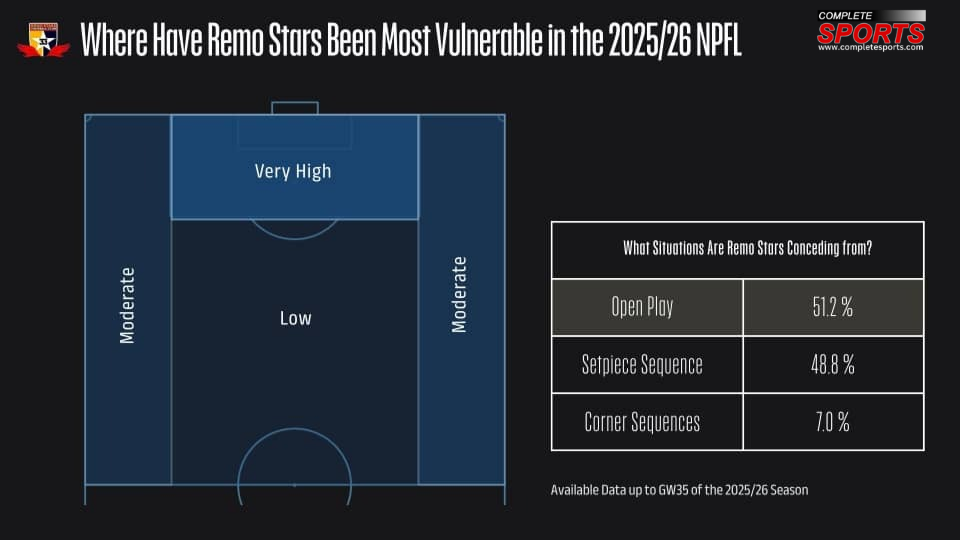
Remo Stars have also felt the hot and cold weather of setpieces this season. About 42% of their goals have come from set-piece sequences (about 21% from corner sequences). Similarly, Setpiece goals also make up about 49% of goals conceded this season (about 7% from corners).
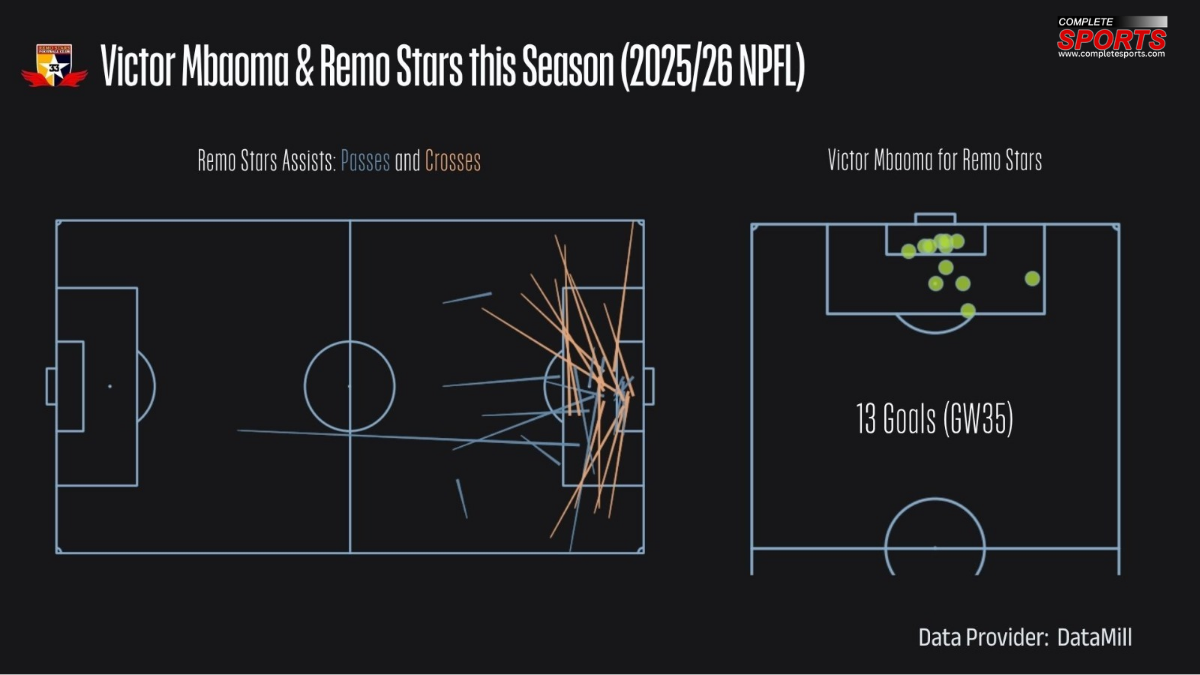
Victor Mbaoma has been important to their campaign this season. His goalscoring impact has been unmissable on his return. The technical adviser already hinted at the importance of his role in the squad in a story by Gbemidepo Popoola.
Structural And Personnel Issues Undermining Club
When we consider when and how Remo Stars concede, the distribution of goals allowed shows no clear pattern of control. They concede early, they concede late, and even concede in between. Fifteen of their goals conceded have come in the later stages of matches, while thirteen have come early. There is no stable phase where the team consistently manages games.
This kind of defensive profile usually points to deeper structural issues. To understand those issues, expert opinions from seasoned journalists like Gbemidepo Popoola, Amara Obah and Olimene Robert were weighed in addition to data-backed narrations. The issues become more understandable when you consider what changed between the two seasons. The most obvious factor is player turnover.
By multiple accounts, Remo Stars lost a significant portion of the squad that delivered the title. Key players left across different units of the team, and replacements did not match the same level. Per reports, this is not unusual in the NPFL, where player movement is constant, but the scale matters.
When a large group of players who have spent years in the same system leave at once, what goes with them is not just quality but understanding. The previous group understood each other really well, especially the integration of the foreign-born players. From positioning to decision-making to timing of runs, they had bonded over time. All these add up with time.
One of the experts interviewed pointed out that the pattern of play itself has not changed dramatically. The intention is still to play through the lines and build attacks in phases. The problem is that the players executing it are still adjusting. What was once fluid now looks disjointed.
Others see it slightly differently. Robert believes that to patch things through, Remo Stars adopted a visible shift towards more direct play, with longer passes bypassing midfield. That often happens when teams lose confidence in their ability to control games through possession. It becomes a quicker way to progress the ball, but it also reduces control and increases turnovers. Either way, the outcome is similar. The team no longer dictates the tempo of matches in the way they did last season.
One particular personnel exit was that of the goalkeeper coach who favored the northern climes after the title win and is now reportedly with tenth placed Barau FC.
Coaching Disruptions And Home Instability
Coaching continuity has also played a role. Daniel Ogunmodede’s involvement with the national team meant he was not consistently present, particularly during key periods of the season. One of the experts pointed at unconfirmed rumours of internal friction between Daniel Ogunmodede and the team leadership which have led to him still not being able to lead the team despite his return.
Under a hands-on Daniel Ogunmodede, the team had a certain swagger about them. Later managerial adjustments may have brought some improvement, particularly in home performances, but by then the damage had already been done. There are also factors beyond tactics and personnel.
For much of the season, Remo Stars did not play consistently in Ikenne due to stadium work and subsequent sanctions that forced them to use multiple venues. Their performance particularly dipped when the team was banished from Ikenne after the game against Ikorodu City following a fracas after the full-time whistle was blown.
The league board slammed one of the heftiest punishments on the team, banishing them to Ibadan, Benin City and then Akure before they were reinstated back to Ikene. In a league like the NPFL, where home advantage is a major factor, that level of disruption matters.
Teams that survive often build their season around home consistency. As subsequent paragraphs reveal, Remo Stars title success was built on this home dominance ideology. So, removing that base introduces instability.
It also affects fan presence, travel routines, and overall familiarity. These are small edges, but in a league where survival often comes down to tiebreakers or between one to three points, they are definitely not insignificant.
Home And Away Form Define Remo Stars’ Decline
Remo Stars have dropped 15 points at home this season, a 275% increase from the 4 points dropped last season when they won the title. This is not magnifying numbers to batter the sky blues. Let us add some context to clarify things. The NPFL economy is highly home-driven. Home teams have won 63% of the games played this season. The surprising twist is that the top-ranked teams (Top 4) are never the outright favourites when playing on the road.
For context, in their title-winning season, Remo Stars won just five (5) games Away last season, playing a draw in 3 games and losing a whopping 11 games on their journey to becoming champions of Nigeria. That same league-winning quality the experts lament is missing could only manage 18 points from a possible 57 on the road.
Also Read: Hosting Hosting International Matches Has Helped To Put Our Stadium On World Map —Remo Stars General Secretary
As low as that appears, they still won the most points in Away games last season. Bringing things back to this season’s context, if Remo Stars had such little return as the best team in the country, what could one expect from a team that’s become a shadow of itself and is just one goal above the relegation spots? So, for a current Remo Stars squad, who have dropped 47 points on the road, winning just 4 points all season, giving up 15 home points is self-ruin in the NPFL.
Survival Fight: Can Remo Stars Escape The Drop?
There were warning signs early in the season. The opening fixtures already showed a team struggling to impose itself. Their continental outing against Mamelodi Sundowns further exposed the gap between last season’s level and the current one. For many observers, that was the moment it became clear this was not the same side.
From there, the season has followed a familiar pattern. Short spells of recovery, usually driven by home results, followed by periods where the same issues resurface. Attempts to adjust the squad mid-season have helped in patches but have not fully addressed the underlying problems.
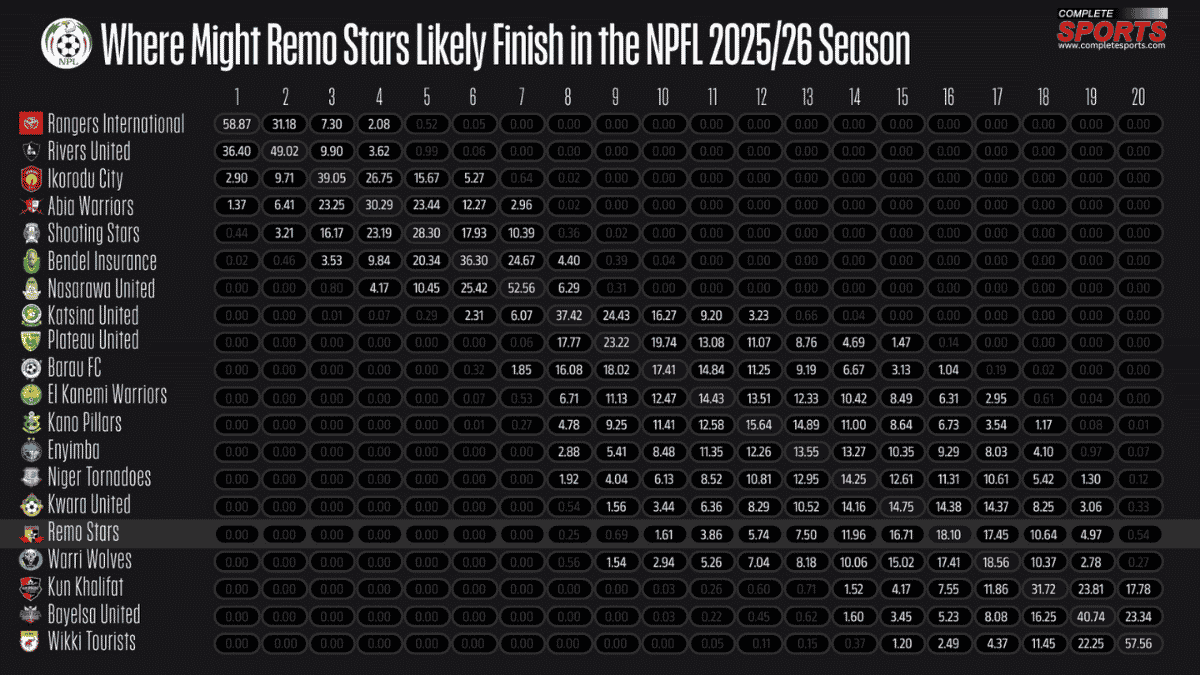
All of this has led them to their current position. With 43 points, they sit in the part of the table where outcomes become uncertain. Historical modelling suggests they have roughly a 51 per cent chance of survival. That is effectively a coin flip. They travel to Aba next and would hope their run there still holds.
The broader context of the NPFL makes this even more precarious. The league’s survival threshold tends to sit around 48 points. That number is not fixed, but it represents a zone where teams begin to feel safe. Remo Stars are still short of that mark, with limited games left to close the gap.
At the same time, the gap between mid-table and the relegation zone remains tight. Just a few points separate multiple teams, which means that results elsewhere will matter as much as their own.
In hindsight, parts of this collapse were clearly avoidable. A more measured transition after the title win, stronger recruitment to replace key departures, and greater continuity in coaching could have reduced the scale of the drop. What is clear is that this is not a random downturn. The data points consistently in the same direction.
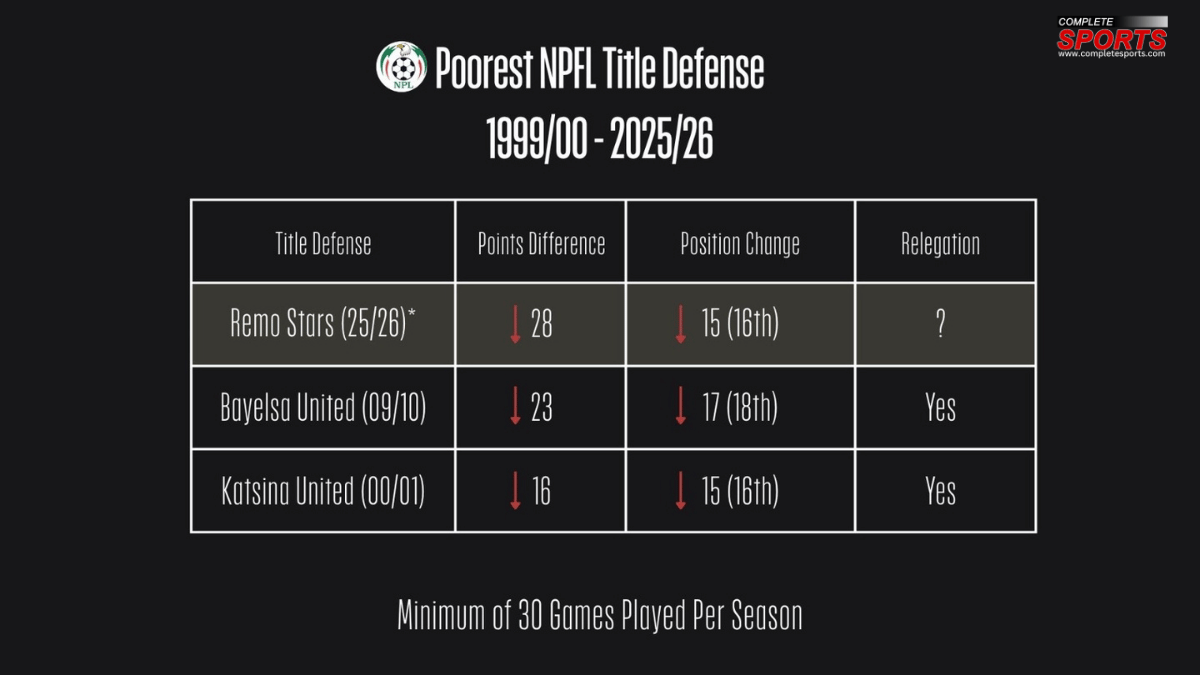
As mentioned earlier, Remo Stars are not the first champions to struggle the following season. But they join the few who have fallen so quickly. Katsina United in 2000/01 were also relegated after a title win in 1999/00 and Bayelsa United won the league in 2008/09 but finished in the relegation zone in 2009/10 per available data.
Whether they survive will likely depend on something much simpler than all the data suggests. On the league table currently, Remo Stars can still finish with 52 points but must earn maximum points in all remaining games. In a league known for “knife-edge” realities and at this stage of the season, it sure feels like that alone would be enough.