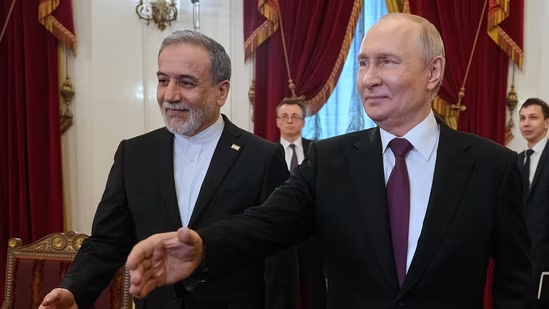
Iran’s Foreign Minister Abbas Araghchi traveled to Russia on Monday to meet President Vladimir Putin as talks with the United States continue to struggle.
Before reaching St Petersburg, Araghchi said earlier negotiations with the US failed because of what he called “excessive” demands, according to Russian state media cited by Newsweek.
Although US President Donald Trump extended a ceasefire agreed on April 7, a permanent deal is still far away. Araghchi’s visit to Russia comes after trips to Pakistan and Oman which shows that Iran is trying different countries to help move talks forward.
A major issue in the talks is Iran’s large supply of enriched uranium. Trump has called it “nuclear dust” and wants Iran to hand it over. Experts say Russia could help here. Hamidreza Azizi from SWP Berlin told Newsweek that a similar system was used in the 2015 nuclear deal, where Iran sent enriched uranium to Russia and received nuclear fuel in return.
“Russia has repeatedly signaled its willingness to play a similar role again, making Araghchi’s visit to Moscow particularly significant in the context of efforts to resolve one of the central sticking points in the negotiations,” Azizi said.
Also Read: Cole Allen’s first court appearance: 5 chilling things to know about WH dinner shooting suspect
What Russia brings to the table?
Russia is one of the few countries that talks to the US, Israel and Iran at the same time, making it an important middle player. But experts say Russia also has its own interests.
“Russia benefits from the fact that the US is stuck once again in the Middle East and that there is less attention and fewer resources dedicated to the Ukraine war,” Vuk Vuksanovic from LSE IDEAS told Newsweek.
He added that, “Russia also sees the economic benefits of higher energy prices and of US sanctions relief affecting Russia’s oil, and there is also a diplomatic boon: declining American prestige in the wider Islamic world and the global south, which always benefits Moscow and Beijing,”
Experts also say that if Russia helps, it may ask for something in return, possibly linked to Ukraine.
Iran and Russia already have close ties. They also signed a strategic partnership in January 2025.
According to The Independent, Russia has provided or agreed to provide advanced air defense systems like the S-300 and has helped Iran with missile and satellite technology. The two countries also work together on surveillance systems, while Russia has used Iranian drones in its war in Ukraine.
Iran’s ambassador to Russia, Kazem Jalali has described the relationship clearly, saying the two countries “are present in a united front in the campaign of the world’s totalitarian forces against independent and justice-seeking countries, as well as countries that seek a world free from unilateralism and Western domination,”
Also Follow: US-Iran war live updates
Can Russia actually save Iran?
According to Newsweek, Even though Iran is reaching out to Russia, experts say Moscow cannot fully help or save Iran.
Aurelien Colson from ESSEC Business School told Newsweek that Iran may want Russia’s support and global backing, but it is not enough.
“It can posture, obstruct and complicate Western diplomacy, yet it cannot provide the decisive military, economic or diplomatic support that would fundamentally change Iran’s situation,” he said.
He also pointed to past examples, saying Russia was not able to fully protect allies like Bashar al-Assad and Nicolas Maduro.
“In Iran’s case, too, it looks more like an overextended opportunist than a reliable protector,” Colson said.
“Russia still has a role to play, but it is a secondary, and essentially a negative one,” he added.
Trump’s response
As per Independent, Trump has downplayed concerns about Russia’s support for Iran. Speaking about reports of Moscow sharing intelligence, he said:
“I don’t know, look, they can give all the information that they want but people they’re sending to are overwhelmed. Russia would be overwhelmed too. Anybody would be overwhelmed.”
He also said that, “They’d say we do it against them. Wouldn’t they say that we do it against them?”
On negotiations with Iran, Trump said on The Sunday Briefing on Fox News that, “If they want to talk, they can come to us, or they can call us. You know, there is a telephone. We have nice, secure lines,”