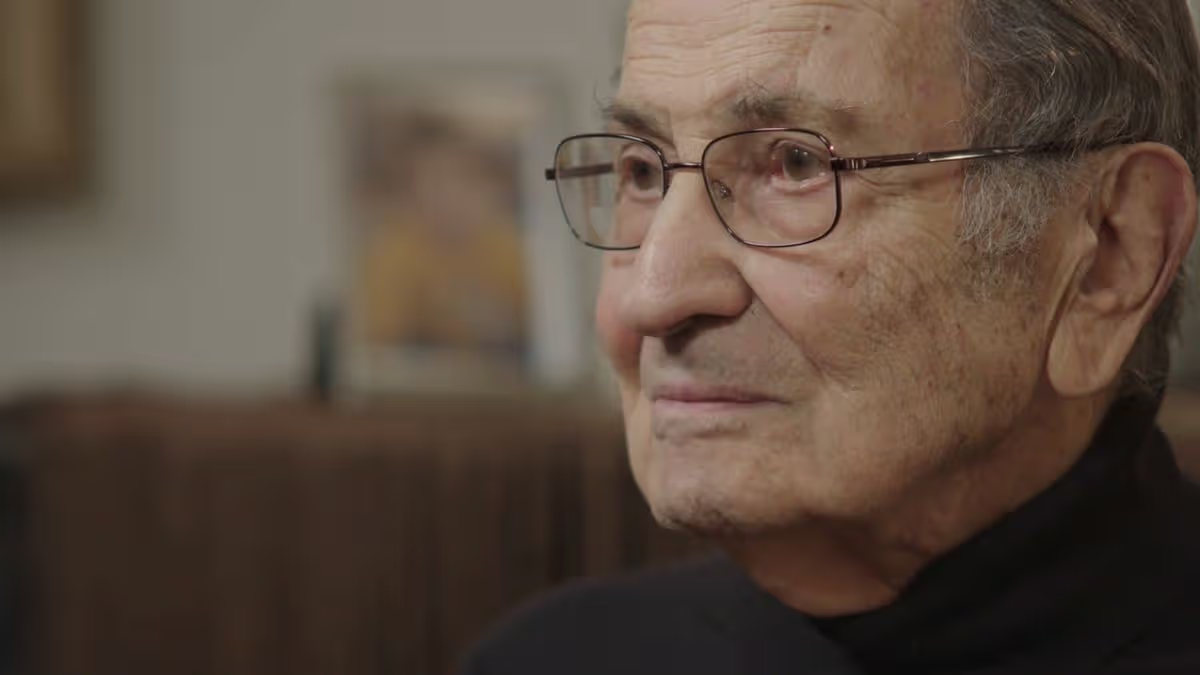
New film The Last Spy tells the incredible tale of Peter Sichel who changed the world not once but twice, escaping from the Nazis to become a wine merchant and master spy
Few people could legitimately subtitle their life story “vintner, prisoner, soldier, spy”. But when he died a year ago, aged 102, Peter Sichel had been all these things. Now his extraordinary life – in which he fled the Nazis, joined the army, spied for the CIA and made Blue Nun’s Liebfraumilch with its distinctive bottle a household name in the 1970s and 80s – has been made into a cinema film, The Last Spy.
His wine merchant daughter Bettina says: “He was definitely good at keeping secrets and he was also good at getting people to talk. He had a very charming way about him.” The Last Spy, made by German-US filmmaker and producer Katharina Otto-Bernstein, and told in Peter’s own words, premiered at the UK Jewish Film Festival last November and is launching in selected cinemas on Friday.
READ MORE: Trainspotting’s Irvine Welsh tells of ‘brutal’ drug-fuelled murders that inspired hit film
Growing up in a wealthy family in Mainz, Germany, Peter’s grandfather owned the H. Sichel Söhne winery – establishing branches in Bordeaux, France; London, and New York. Peter, who attended Stowe, the same public school in Buckinghamshire as Sir Richard Branson and actors David Niven and Henry Cavill, said: “We were one of the families in Mainz everybody knew.”
But when the Nazis took power in Germany in 1935, Jews were stripped of their civil rights, and Peter fled with his family to Bordeaux. When the Second World War started, the family were interned – Peter and his father in a men’s camp and his sister and mother in Gurs, in the Pyrenees.
Peter said: “When the Germans got within one or two days of the camp, we went to the commander and said, ‘If you don’t let us go, that’ll be the end of us.’ So he let us run.” His cousin refused to flee with them and was killed at a concentration camp. But Peter and the rest of his family made it to New York where, after Pearl Harbor, he joined the army and was approached by the new US intelligence service, the Office of Strategic Services.
Author and contributor to The Last Spy, Adam Lebor, said: “The Russians had an intelligence service. Britain had one. France had one. America needed one.” Trained in unconventional warfare – ranging from picking locks to killing someone with a knife – Peter was sent to Algiers on his first mission.
He said: “When the planning started for the invasion of Southern France, I was assigned to the OSS unit with the 7th Army. Whereas everybody spoke French, nobody spoke German and suddenly I was very much needed in recruiting German prisoners of war and finding out if they were willing to serve as American agents.”
The 1951 movie Decision Before Dawn was based on Peter’s experience. When the war ended, he was nine miles from Dachau concentration camp, unaware of its true horrors. Bettina says: “He never spoke about the Holocaust.” In The Last Spy, Peter said: “It was known at another level but not at my level. That Jewish families had been transported into labour camps, yes. That they were killed methodically, no.”
In 1945, he went to Berlin as one of the best OSS operatives. His first task was to address the post-war communist threat. The “Wunderkind” was instrumental in redirecting the OSS towards the Soviets, providing intelligence that rang in the Cold War. In 1947, the OSS became the Central Intelligence Agency and Peter was the top man in Berlin. He said: “Interfering in the politics of other countries can be both beneficial and counterproductive.
“Take Italy – if we had not interfered in those elections after the war, Italy would’ve become communist and destabilised the rest of Europe.” By 1953, Peter was Head of Eastern Europe operations for the CIA, before being deployed to Hong Kong. He said: “We did not recognise Communist China, and we regarded it as an unfriendly country.”
He ran an operation through a US air hostess working for Pan Am on a plane rented by Indonesia’s President Sukarno. They had heard he was very ill and needed to obtain a faeces sample to verify it – their fear being he would sell out to communists. The CIA also worked with colonels who were conspiring against him and sent a plane to assist.
Peter said: “The plane was shot down. The pilot admitted he worked for the CIA and, ultimately, we bought him out. Nobody found out about these things.” Peter left the CIA in 1960, partly because he thought its drinking culture was making him an alcoholic. It was ironic because his next chapter would be as a vintner.
Marrying real estate broker Stella Spanoudaki in 1961, they had three children – Bettina, Sylvia and Alexandra, 49, who died of breast cancer in 2014. Peter said of being a spy: “It is extremely difficult on your personal life – and it leads to frustration, and it leads to alcoholism or some other way of making up for the loneliness.
“It’s like being on a drug. It is a fascinating game and if you feel that that fascinating game is important to your country, it makes it doubly so.” Bettina, who lives in California, says of her father: “I had no idea how important he was within the CIA.” But she adds there were dinner-party CIA stories. Charged with helping to finance the French Resistance, she says: “He packed a spy off with a whole lot of gold for them. He was captured, but before he was, buried the gold in a field. My dad went back to find the gold… nothing.”
When Peter joined the family wine firm, he showed the same proficiency he had for espionage. Living mainly in the US, he appointed the Schieffelin Company, an importer and distributor, to take on the family’s portfolio. It included Blue Nun, a white wine released in 1921. Fifty years later, after radio adverts featuring comedy act Stiller and Meara, sales in the US leapt by 500%.
Also popular among celebrities, Peter positioned the drink as “wine that could be drunk throughout an entire meal” – leading to sales of 24 million bottles globally a year in the 1980s. Following a slump, the brand had a revival in the UK, selling nearly five million bottles in 2015. In a life filled with adventures, Peter, whose wife died in 2022, always spoke fondly of his time at Stowe and remained a major fundraiser for the school.
While tastes in wine change, the grandfather-of-five insisted there would always be an appetite for spying. He said: “People will always want to find out what the other people are doing.”
*The Last Spy is showing in selected cinemas and available on Apple TV from Friday. For more information, visit www.thelastspy.film
READ MORE: Daniel Radcliffe admits to being ‘sad and really scared’ in drink and drugs battle