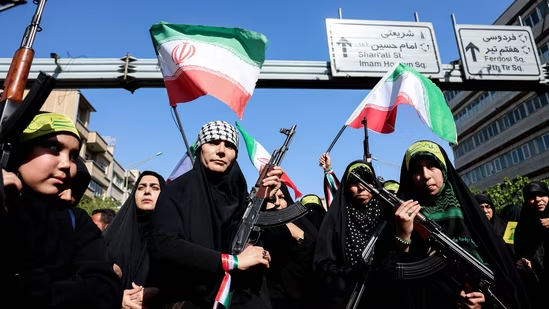
As the Strait of Hormuz reopens after weeks of stalemate, Iran warned the US against any military move, and said that only commercial ships will be allowed to pass through the key oil-transport waterway. This was yet another implication that it is Iran that calls the shots on Hormuz operations, and not the US. Track latest news on Iran US conflict
“The time has come to obey the new maritime system of the Strait of Hormuz. This system is determined by the Islamic Republic of Iran, not virtual posts,” Ibrahim Azizi, the head of the National Security Commission, was quoted as saying by Iran’s Tasnim News agency.
Also read: US-Iran talks may see short-term truce first, full peace deal in 60 days: Report
Azizi also said the commercial ships will be allowed to pass “with permission from the headquarters of the armed forces, especially the navy, through certain routes and after paying the fees of the Iranian people”.
There have been reports over the past two weeks that Iran has been charging some ships $2 million to cross the strategic Strait of Hormuz.
‘Great and brilliant day for world’
Earlier Trump said it was ‘great and brilliant day’ for the world as Iran announced to open Hormuz.
“This will be a great and brilliant day for the world because Iran has just announced that the Strait of Hormuz is fully open and ready for business and full passage. But the naval blockade with the greatest navy in the world, from the greatest military the world has ever seen, we built it. During my first term, we built it…We’ll remain in full force and effect as it pertains to Iran until such time as our transaction with Iran is 100 % complete and fully signed.”
Hormuz open to ‘friendly’ countries
It has allowed “friends” like India to pass through the strait since the war began with an American-Israeli attack on Tehran on February 28. But India has denied being asked to pay.
Also read:
New Delhi has taken a consistent stand calling for free and safe navigation through the waterway, which remained a sticking point in US-Iran talks that failed in Pakistan and are now set for a second round.
Alaeddin Boroujerdi, a member of the Iranian parliament’s national security committee, had told state broadcaster Islamic Republic of Iran Broadcasting (IRIB) last week that “collecting $2 million as transit fees from some vessels crossing the strait reflects Iran’s strength”.
The narrow waterway between Iran and Oman, which connects the Persian Gulf with the Arabian Sea, has become a critical maritime chokepoint for ships carrying oil, gas, and other commodities, ever since Tehran was attacked by the US and Israel on February 28. It usually carries a fifth of all the world’s global oil supplies from the oil-rich region around the Persian Gulf.