
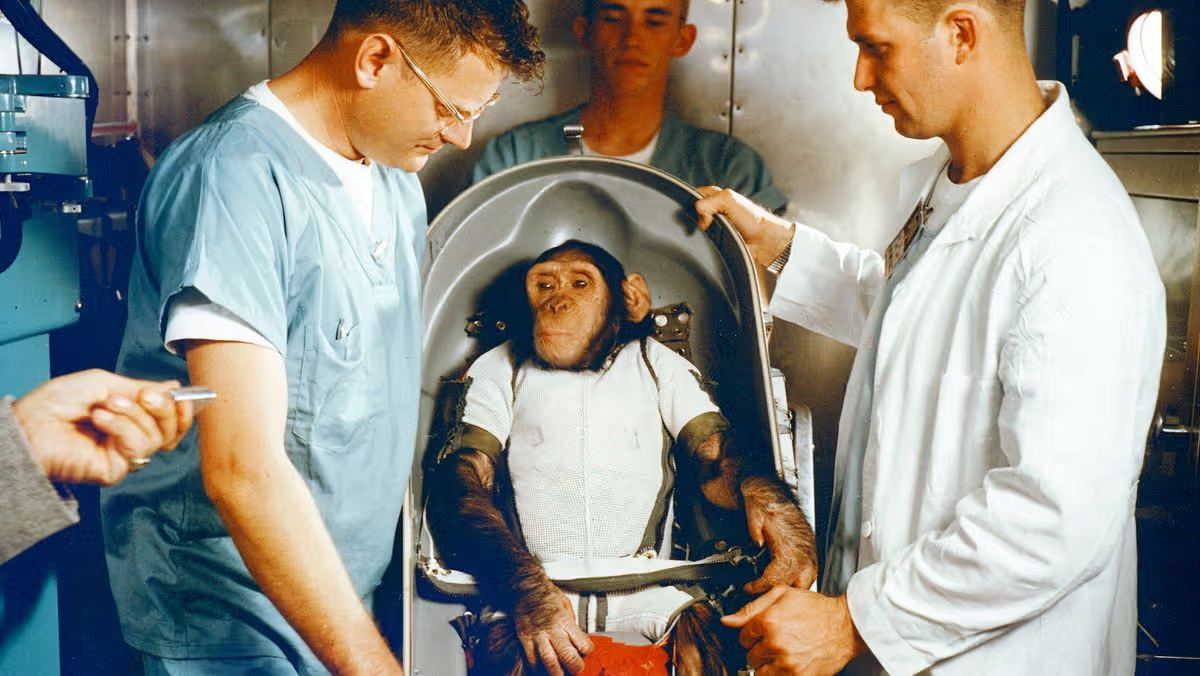
Before the astronauts of Artemis II could embark on their historic space mission, the impact and demands of spaceflight were tested on a series of animals – and a chimp named Ham went down in history
A chimp helped pave the way for human space exploration – and he survived. The Artemis II mission came to an end on April 10 as the astronauts safely returned to Earth following a historic 10 days of space travel.
But before humans ventured into space, scientists tested the impact and demands of spaceflight on a series of animals. On January 31, 1961, a chimpanzee, known as Ham the Chimp, went down in the history books as the first great ape launched into space. Ham flew aboard the Mercury-Redstone 2 mission, which was part of the US space program’s Project Mercury.
He had been referred to as “No 65” before his safe return back to Earth, where he was then given the name Ham as a nod to the laboratory that trained him for the mission; the Holloman Aerospace Medical Center. Ham doubles as an acronym for the facility.
It’s believed he wasn’t initially named in case the mission failed and he died – officials wanted to avoid the potential public outcry and bad press that would likely ensue if a named chimpanzee lost his life for humans’ pursuit of space exploration.
Before his mission, Ham received hundreds of hours of extensive training over the course of 15 months. He was taught to do simple, timed tasks in response to electric lights and sounds.
Throughout his pre-flight training, he was taught to push a lever within five seconds of seeing a flashing blue light. If he responded correctly, he was rewarded with a banana pellet but if he failed, he received a light electric shock to the soles of his feet.
Many animals were sent into space before him but the decision to send a chimpanzee was due to their similarities with humans. By observing Ham and the impact space travel had on him, scientists were able to deepen their understanding and research into the possibility of humans going into space.
Ham’s suborbital flight lasted 16 minutes and 39 seconds. While aboard, he was supposed to respond to visual stimuli but a valve malfunction led to the Redstone rocket delivering higher thrust than planned.
As on Earth, Ham’s failure to respond correctly to the visual light cues would result in him receiving an electric shock. Unfortunately, due to malfunctions, the chimp was subjected to an excessive 17 g-force of acceleration, as well as 14.7 g during re-entry.
This, in part, contributed to the two shocks Ham received in flight. His first shock came just after the launch but was because of an error in the testing apparatus; the second was due to the lack of response after he experienced 14 g deceleration.
The results of Ham’s test flight led to Alan Shepard’s suborbital flight on Freedom 7 on May 5, 1961.
After Ham returned to Earth, he was in good physical condition overall, but did suffer a small cut to the bridge of his nose, as well as dehydration and a loss of 5.37% of his body weight.
But the ordeal left him traumatised. He would get stressed and panic whenever his handler tried to put him back in a capsule for photos, and he was unsettled when the press approached him.
A picture of Ham holding the newspaper with the headline “Space Chimp Lives” after his safe return to Earth was shared on Reddit. In the image, Ham can be seen sitting on a long, thin desk in front of a mirror while holding the paper in both hands.
He dons a T-shirt and shorts and crossed one leg over the other, while opening his mouth widely.
Reddit users shared their thoughts in the comments section. One person said: “‘Space Chimp Lives’ is one of the greatest headlines ever.”
Another agreed: “They should use this every time an astronaut returns.”
A third shared: “I’m pretty sure I got to see him at the zoo not long before he passed.”
Not all animal space travel ended with their survival, though. The story of Laika, the dog who was sent into space to orbit the Earth and never return, regularly causes heartbreak across social media when her tragic story is re-shared online.
On November 3, 1957, the little mixed breed, who was found on the streets of Russia, was launched into low orbit on the Sputnik 2 spacecraft after weeks of training which included getting her used to smaller and smaller crates and cages.
She was never expected to survive the mission, being captured and trained before ultimately being sent to her death.
Around this time, little was known about the effects of spaceflight on living creatures, and animal flights were seen by engineers as a necessary and integral step before human missions could take place.