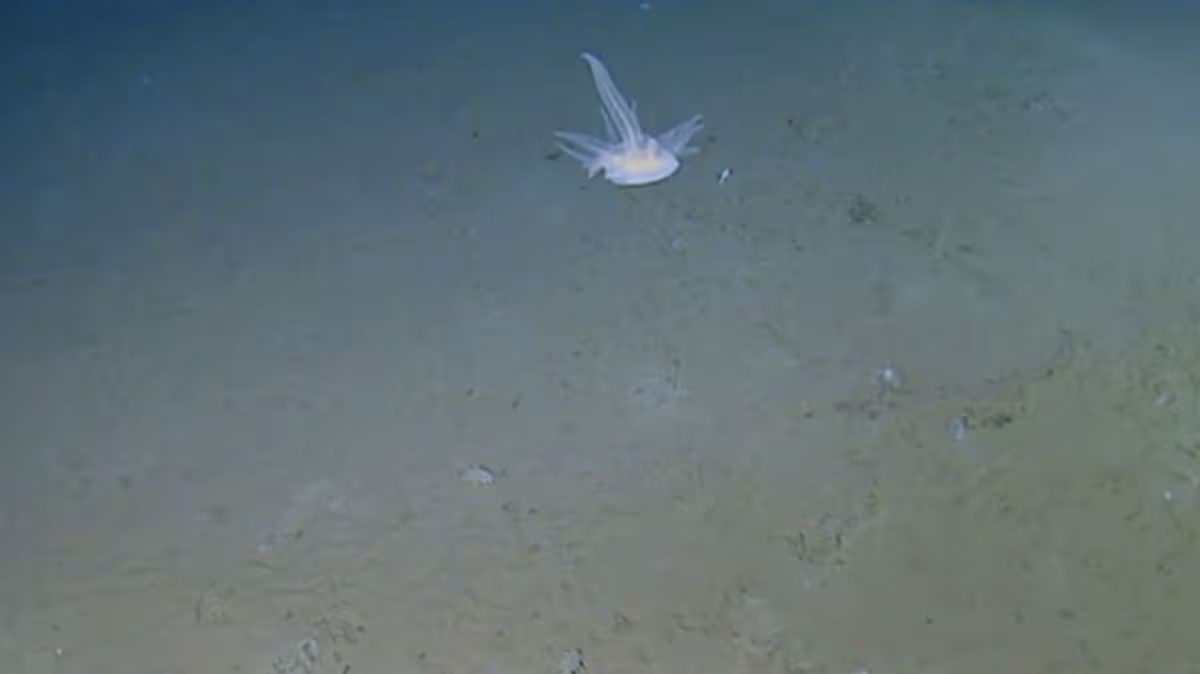
A bizarre animal filmed at the bottom of the Ryukyu Trench in the Philippine Sea has left scientists baffled – experts are currently unable to assign it to any known phylum
Scientists have been unable to classify a marine creature found lurking at the bottom of a deep sea trench.
The ghostly white organism was found at the bottom of the Ryukyu Trench in the Philippine Sea along the eastern edge of Japan’s Ryukyu Islands, where pressures are nearly 1,000 times greater than at sea level.
It resembles a translucent sea slug or nudibranch, but possesses distinct, unidentifiable lobes. Similar to sea slugs, its body can be divided into two symmetrical halves. It was filmed at a record-breaking depth of 29,977ft (9,137m).
A team led by the Minderoo-UWA Deep-Sea Research Centre at the University of Western Australia encountered the organism during a pioneering two-month expedition.
READ MORE: UK sends five-word warning to Putin as ‘secret’ Russian military mission exposedREAD MORE: Donald Trump issues nuclear warning to Pope Leo and REFUSES to meet him
Utilising the research vessel DSSV Pressure Drop, the team explored three of Japan’s deepest underwater canyons: the Japan, Izu-Ogasawara, and Ryukyu trenches. The creature was filmed twice using high-definition cameras on the crewed submersible Limiting Factor.
Designated as Animalia incerta sedis, the slow-gliding specimen has baffled experts, who are currently unable to assign it to any known phylum. Scientists also discovered more than 1,500 stalked crinoids anchored to rock terraces and carnivorous sponges of the family Cladorhizidae, reports Creatorzine.com.
Collaborating with the Tokyo University of Marine Science and Technology, researchers identified 108 distinct organism groups, including record-setting snailfish, within the trenches.
Professor Jamieson, chief scientist of the expedition, noted that the Japanese trenches are surprisingly teeming with life despite the crushing pressures. He emphasised that the team’s 15-year study of these deep-sea environments has revealed much more than just the record-setting depths.
Scientists surprisingly found evidence of human-derived debris, likely transported down the trench slopes. Professor Jamieson said that while the Japan Trench was rich in sea cucumbers, the Ryukyu Trench – which has less food – was dominated by brittle stars.
He added: “This study was not simply about observing deep-sea organisms, but also aimed to establish a foundation for future research at these depths. More than anything, the hadal zone remains one of Earth’s least explored and most intriguing frontiers.”