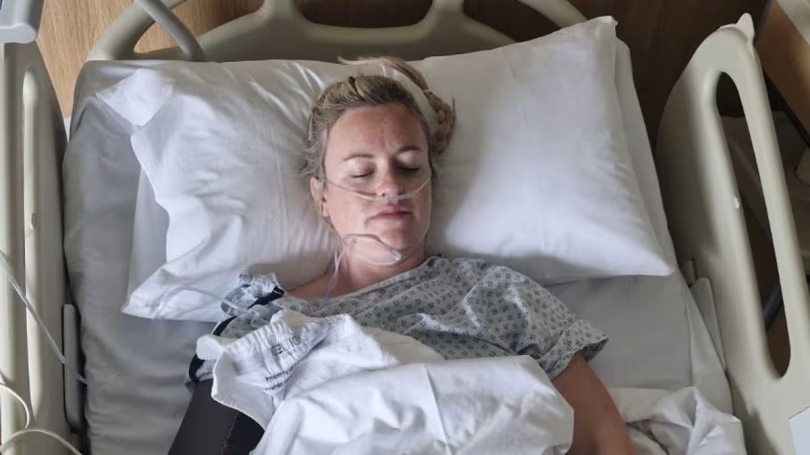
Sophie Cole said her ‘life changed as she knew it’ after an ‘assault’ at a school – the woman now suffers with a chronic condition that means she will ‘never be pain free’
A former teacher with the “one of the most painful conditions known to medicine” claimed her horror started after an assault while at school.
Sophie Cole, 32, said she has been told she’ll “never be pain free” due to her chronic condition. The woman, from Cork, Ireland, said she is often in so much pain that she thinks her hand is on fire and suffers from migraines from the agony.
She claimed her suffering stemmed from an 2022 assault when she leant down to the floor to clear up some spilled water while working as a Special Needs teacher.
The 32-year-old said: “I knelt beside a child, put my hand on the table to balance myself, and when I did that my hand was grabbed and slammed into a steel table. In that moment, my life changed as I knew it.”
READ MORE: ‘My husband had a Covid vaccine and died 11 days later’READ MORE: ‘I thought my symptoms were from a burger, but it was a tumour’
Following the incident, for which she does not hold the child responsible, Sophie was diagnosed with Complex Regional Pain Syndrome (CRPS), which is considered one of the most painful conditions known to medicine. It ranks higher than childbirth on the McGill pain scale.
Sophie was left permanently disabled and said she can no longer drive or work, and spends much of her time travelling around the country visiting different doctors and consultants in the hope of reducing the pain. She has been told the condition could spread throughout her body.
The 32-year-old said she has been left with intense pain in her hand, saying: “It feels like it is in flames at the same time as being torn with a cheese grater. I frequently check if it’s still there as it feels like it’s been burnt off me.
“Then there is a feeling of electric shocks shooting up the arm, as well as a heaviness and deadness. Being in that much agony constantly causes migraines too. I’ve been told I will never be free of pain.”
The financial impact has also been significant and Sophie had to give up work and now relies on benefit payments. Sophie said receiving confirmation that she is permanently unfit for work was heartbreaking.
She added: “To receive a letter in the post that states you are permanently unfit for work in your thirties is devastating. But I remain hopeful that new treatments will be developed that could help.”
The former-teacher said she had undergone several types of treatment, including nerve blocks, nerve burnings, surgeries, spinal cord stimulation and platelet-rich plasma transfusions.
She added: “There is no known cure, so everything is trial and error. I have had numerous treatments and nerve blocks, but so much just causes more agonising pain. Every surgery and procedure can cause it to flare further. It’s horrendous.”
Sophie revealed that she has contemplated amputation, but doctors say this may not end the constant physical pain. Sophie also experiences secondary symptoms including exhaustion, brain fog and post-traumatic stress disorder. She struggles to sleep due to both the pain and PTSD, adding to the daily toll of the condition.
Despite everything, Sophie is now preparing for a new chapter, as she and husband Shane expect their first baby, but also faces issues here.
Sophie had been taking ketamine and opioids regularly to manage her pain, but had to come off these medications in preparation for pregnancy – a process that required carefully balanced withdrawal with ongoing severe pain.
Now, she is calling for better support for teachers working with children with Special Educational Needs (SEND), so that others do not face similar life-altering consequences.
Sophie said: “It is really important that people understand I don’t blame the student for what happened to me. And while it was terrible, I am not the only one. Ninety six per cent of teachers in Special schools and classes have suffered an assault. It is prevalent.
“This is what they are facing on a daily basis. The resources aren’t there, the staffing isn’t there, the supports aren’t there for our students. And that’s why we’re seeing these behaviours. The only thing that will prevent these assaults is more funding and better resources.”