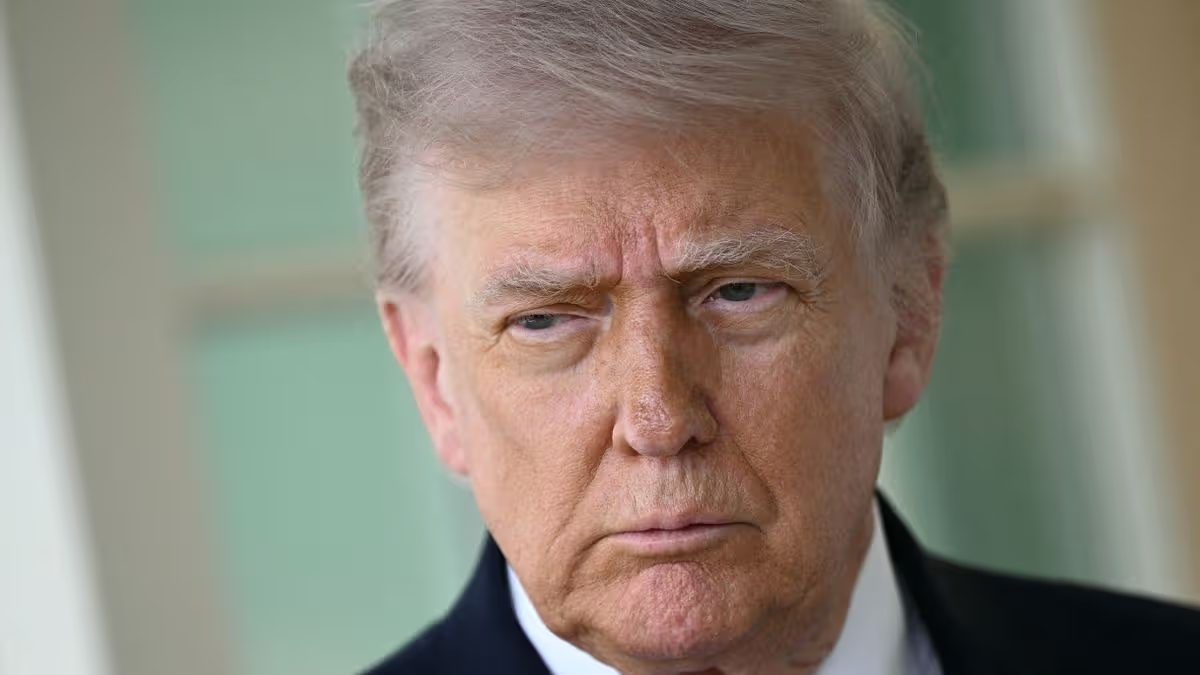
Donald Trump has sparked concern with his latest unfounded medical claim, with experts warning there’s no truth to his bold assertion about one particular type of drink
The US president’s bizarre claim has left medical experts reeling. Donald Trump has long been criticised for being secretive over his health while poking fun at others’ physical conditions. He’s also been challenged for questioning established medical science on the likes of painkillers, autism and vaccines.
And now specialists have dismissed his claim that fizzy drinks ‘kill cancer cells’. During a recent episode of Donald Trump Jr’s podcast, Triggered with Don Jr., Dr Mehmet Oz said: “Your dad argues that diet soda is good for him because it kills grass – if poured on grass – so, therefore, it must kill cancer cells inside the body.”
The former cardiothoracic surgeon continued: “You know, we were on Air Force One the other day, and I walk in there because he wants to talk about something, and he’s got an orange soft drink on his desk. He’s got a Fanta on the desk. And I say, ‘Are you kidding me?’ So he starts to, like, sheepishly grin. He says, ‘You know, this stuff’s good for me, it kills cancer cells.'”
READ MORE: Donald Trump’s most manic health rants as spokesman forced to deny death rumours
Coming to his dad’s defence, Don Jr., Trump’s eldest son, replied: “OK, OK, but then maybe he’s onto something. Because I will say this: I know a lot of guys pushing 80 — not a lot have his level of energy, recall, stamina.”
But while family members may think Trump is onto something, medical experts do not agree. Umar Razzaq told the Mirror: “As a registered UK pharmacist for over 20 years, I can say clearly that there is no scientific evidence to support the claim that diet or any soft drinks can kill cancer cells in the human body.
“Whilst some drinks are acidic and may damage surfaces like grass, this has no relevance to how cancer develops or is treated in people. Human biology is far more complex, and cancer treatments are based on rigorously tested medicines and therapies approved by the MHRA.
“Claims like this tend to arise from misunderstandings of basic chemistry and how the body works. While diet soft drinks are generally considered safe in moderation, they are not a treatment for cancer and should never be viewed as having any protective or curative effect.”
Meanwhhile, Dr Andy Gaya, a consultant oncologist from the Cromwell Hospital London, said that while the comments may have been “tongue in cheek,” there’s absolutely no truth to them. “Your body tightly controls its acid levels (called pH), and drinking soda does not make your body acidic enough to kill cancer cells – your body will regulate the acid levels to prevent this,” he explained.
This isn’t the first unfounded medical science claim Trump has made. Duing the COVID-19 pandemic, he falsely asserted that “99 per cent” of cases “are totally harmless.” To the dismay of health professionals worldwide, Trump publicly proposed a number of unsupported and dangerous treatments for the virus, including the suggestion that injecting disinfectant into a person’s body could be effective.
The president has also promoted the widely disproven notion that there is a link between autism and vaccines, even going as far as to suggest he would change the schedule for childhood vaccinations. Misleading comments about abortion healthcare have also caused concern, with POTUS previously claiming that babies were being killed after birth.
But where did this unfounded fizzy drink claim come from? Dr Gaya explained: “Very sugary or very acidic environments can damage or kill cells in the laboratory – including cancer cells. Fizzy drinks contain acids (like citric acid in Fanta, or phosphoric acid in Coke – which can dissolve away teeth) so some people (maybe POTUS) assume that it may have a similar effect in the body – but it’s just as likely to kill normal cells as cancer cells”.
Trump’s comments comes at a concerning time in the fight against harmful misinformation. According to news reliability website NewsGuard, almost half of Americans fell for false online claims in 2025, with AI-generated content playing a significant role in misleading people. A staggering 46 per cent believed in at least one false claim between June and December, with confusion soaring further at times thanks to fake viral clips.
But what sort of impact could Trump’s fizzy drink claim actually have, and should we be worried? Dr Tony Banerjee, GP and Founder of HarleyDoc, who has himself recovered from advanced bowel cancer, said: “This is the sort of claim that sounds amusing until you remember how easily misinformation spreads.”
“One of the problems with comments like this is that they can make dangerous myths sound plausible. When influential figures speak casually about health, some people will inevitably take those remarks seriously. Cancer is not something that should be trivialised with pub-science logic. If a substance genuinely killed cells indiscriminately in the body, that would raise concerns about toxicity, not prove it is a treatment.
“The public deserves clear, evidence-based health messaging. Soft drinks are not anticancer therapies, and suggesting otherwise risks feeding misinformation at a time when trust in medical advice is already fragile. Even when these comments are made jokingly, they matter. Powerful people shape public understanding, and that comes with a responsibility not to amplify myths that could confuse or mislead patients.”
Do you have a story to share? Email me at julia.banim@reachplc.com