DONAGHMORE ASHBOURNE GAA
Founded: 1923
Meath SFC titles: (3) 1927, 1928, 1942
Frank Reidy had a few days back in his native West Clare last week before heading to Mayo for a funeral.
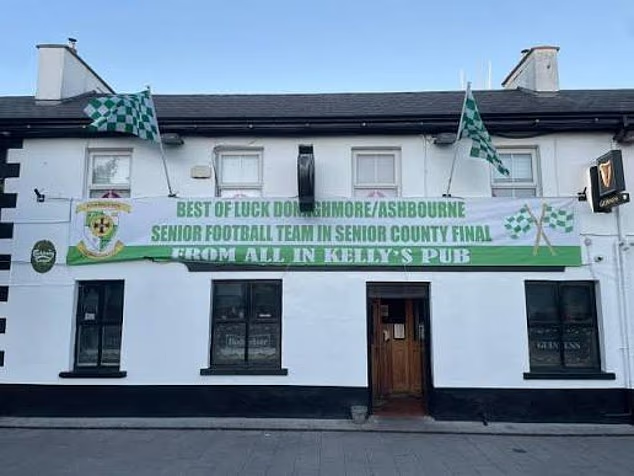
On his journey back to Ashbourne, it struck him how this is a special time of the year around the country, with small towns and villages everywhere festooned in colour and flags.
‘This time of the year is county final season, isn’t it? It was something that I really noticed last weekend, when I was coming back from the west,’ Reidy remarked earlier this week.
‘Going through all these small towns in Sligo, Roscommon, Westmeath. Every 10 or 15 miles, all the flags are out, bunting everywhere because they are in a county final, whether that’s junior, intermediate or senior. It’s the glue that holds communities together and we are experiencing it this week.’
There is huge excitement in the community about the local Donaghmore Ashbourne club
Donaghmore Ashbourne are back in their first Meath SFC final in a decade, hoping to win their first title since 1942. It means that the whole town has been covered in green and white this week.
And with Páirc Tailteann still undergoing its extensive €26 million facelift, the decider against Wolfe Tones will be hosted by Ashbourne, as its ground has one of the few seated stands in the county.
It means a busy afternoon for Reidy, who is chief steward as well as club historian.
‘You’ll take being busy if it means we win!’ Reidy laughs. ‘These are days that the younger generation will remember for their whole lives. I remember growing up in West Clare when Kilmihil reached a county final in the late 1940s.
‘We were too young to go to the match, so a few of us went to the end of a field where we could hear the noise from the match, just to find out what was going on.
‘There will be young people in Ashbourne with the same sort of memories of this day, especially as this will be such an unique occasion in that we are hosting the final we are playing in, which is never going to happen again because Páirc Tailteann will be re-opened next year.’

The club ground is highly regarded as one of the few seated stands in County Meath
‘TWO HOUSES’
There are records of Gaelic football played in Ashbourne as far back in 1798, with a report by an official at Dublin Castle observing that 300 to 400 people had gathered in the Milltown area to watch local men play the game.
The first official club was formed in the town in the early part of the last century. But, as happened at the time, it didn’t last very long.
‘It folded around 1916 or so, maybe just after it. Then, in 1923, this club was set up, in the townland of Donaghmore, right on the Dublin border and they got some success very quickly.
‘Shortly after being set up, they were in a junior final, in 1924 against Navan Harps, which they won,’ Reidy says.
‘After that, they reached six county senior finals in a row, five of them against Navan Gaels, and we won two of them in ’27 and ’28.
‘At the time, a lot of the team would have come from just two families, the Smiths and the Kearns. So much so that the chant at the time when the team was playing was “C’mon, the two families”.
And the club was jokingly referred to as the ‘two houses’.

A aerial view of Donaghmore Ashbourne GAA Club with the surrounding housing estates
But there were a lot more families involved than that, families that have a direct line to the club these days.
Former chairman Joe Synnott, who is the current county board representative, can trace his connection back to his own grandfather, Hugh, who was a founding member in 1923 and served as the club’s first secretary.
‘That’s the way it usually goes, that it goes down the family,’ Synnott observed this week. ‘But it is nice to have that connection, but I am not the only one.’
As much as the joke was that Donaghmore was ‘two families’ back in the early days, there were a lot more – with names now rooted in the club’s history. Like the Skelleys, Flanagans.
And of course, the Durnans. From Ned, a founding member, to Johnny and Paddy, who were key members of the team in the 30s and 40s and had a teammate who would be enshrined in Royal football folklore.

President of Ireland Mary McAleese chats Peter ‘The Man In The Cap’ McDermott in 2010
THE MAN IN THE CAP
On the night that Donaghmore Ashbourne celebrated its 75th year of existence, the party was in full swing by the time that the special guest arrived.
It was almost 11 o’clock when Peter McDermott started talking but even though spirits were high, he held the raucous crowd in the palm of his hand.
‘He had come with Mick O’Brien, another great Meath player, and there was just this aura about him, this presence,’ recalls Reidy.
‘The party was going strong, plenty of drinking and singing, but once he started talking, you could hear a pin drop. There was silence for the next half an hour, as Peter talked about his connection to the club and his own career.’
McDermott, christened ‘the man in the cap’ by legendary GAA commentator Micheal O’Hehir as he always played with a flat cap, had been born in Kinsale, Co Cork in 1918 to Meath parents, who moved back to their native county, settling in Cushentown, outside Ashbourne, when he was a small child.
His father played hurling for Meath and McDermott won a county minor with Rathfeigh in 1936 before moving to Donaghmore, where his great friend, and later brother-in-law, Jackie Maye was playing.
He won the county intermediate title in his first game for the club, beating Oldcastle in the 1938 final.
Four years later, McDermott captained the last Donaghmore team to win the Meath senior title, beating Skryne 1-8 to 0-2 in the final.
It was the last time that the club won the Meath crown – they reached the final, with McDermott as captain, the following year again but were beaten by Dunleek.
In 1950, he moved to Navan, where his egg merchant business was based, and became involved in the O’Mahony’s club, who became Meath champions in 1953, the first year that the Keegan Cup was awarded.

Donaghmore Ashbourne playing in the O’Neills All-Ireland Club 7s this year in Portmarnock
And it was while at O’Mahony’s that he became enshrined in GAA folklore. Having refereed the 1953 All-Ireland final between Kerry and Armagh, he was back in Croke Park a year later, captaining Meath as they beat raging hot favourites Kerry to lift Sam Maguire – remarkably, he also served as county secretary that same year.
The following year, he was the man in the middle for both All-Ireland semi-finals and refereed the 1956 All-Ireland final – the only person to have played in the final and taken charge of a decider both before and after it.
McDermott was a ground-breaker in so many ways, training the Down team who were the first to take Sam Maguire across the border in 1960 and then taking the first Irish selection to Australia to play a Compromise Rules game in 1967.
But that evening in 1998, he talked more about Donaghmore Ashbourne and why the club meant so much to him and he remembered the dances that used to take place in the original club hall and how everyone had to pass Tom Dreaper’s yard on the way back.
Trainer of the legendary Arkle. Dreaper was local to the area and had always been a keen supporter of the club.
‘As Peter recalled, when they were leaving the hall, they were asked to be quiet as they didn’t want to spook the horses, who were sleeping before they were to Cheltenham. And because of the respect that Dreaper had in the area, everyone did.’
Many of the workers in Dreaper’s yard played for the club while the famous trainer donated land to the club as it continued to grow. These days., his grandson Thomas, a trainer himself, has two kids playing in the clubs. The connection remains.

Flagbearers from Donaghmore Ashbourne GAA Club at a Meath-Roscommon League game
ONE CLUB
Donaghmore Ashbourne were one of the first GAA clubs in the country to adopt the ‘One Club’ model. Hurling started in the club in the early 1970s, as exiles from Tipperary, Clare and Kilkenny settled in the area, while Ladies Football, which has become fairly successful, began in the 1990s.
Camogie was in and around the club for longer than that, since the 1940s, and there was even a time when there were two camogie clubs in the town – one in Donaghmore and one in Ashbourne. ‘They wouldn’t have been the best of friends,’ Reidy says.
Facilities have become an issue as Ashbourne has exploded over the past two decades. Its position well within the Dublin commuter belt has meant it is one of the fastest-growing towns in the country.
An estate of 600 houses was constructed beside the clubhouse just a few years ago – one of many new estates in a town that has grown by 28 percent between the last two censuses.

Cheltenham Gold Cup winner Arkle, with jockey Pat Taaffe, and trainer Tom Dreaper (centre) who lived close to Donaghmore Ashbourne and was a devoted fan of the club
‘When I was teaching, there was one primary school and it was a six-class primary school, but now they are just six primary schools in the town, so it just shows you how much it has grown,’ Reidy points out.
The club now has more than 2,200 members, which creates its own challenges, something they are trying to address with a new development that includes three new pitches being built.
‘We are proud of our ‘One Club’ model, which we adopted 12 or 13 years ago,’ Synnott says.
‘It means that each of the four codes are treated equally and there is no special treatment for our senior men’s team when it comes to pitches and that, although they might have got a bit of special treatment this week.
‘But from our acorns programme, when kids join the club from four years of age, everyone has a chance to play either code.’
TIME IS NOW
The club have never won the Keegan Cup. When they were last Meath senior champions in 1942, Syddan had yet to donate the trophy which honours the memory of Tom Keegan, their midfielder who died during an intermediate championship match at Rathkenny.
‘We have never had the Keegan Cup here at the club,’ Joe Synnott points out. ‘It was only presented to the Meath champions for the first time in 1953, so this is a chance to make history.’
Donaghmore Ashoburne were last in the senior final in 2016, but lost to Simonstown Gaels. County midfielder Bryan Menton and former Meath forward Andy Tormey are two of half-a-dozen survivors from that decider, and perhaps the hurt from that defeat is driving them on.

Intercounty star Bryan Menton is a veteran presence in the Donaghmore Ashbourne side
The club shocked their near neighbours Rathoath in the semi-final at the Meath GAA training centre in Dunganny in a game that was christened the ‘El Crispico’ derby locally given that Tayto Park lies in proximity to the two towns.
Under Timmy O’Reagan and his management team, Donaghmore Ashbourne’s journey to the final is based on a hard-working defence – they are only conceding an average of just over 12 points a game – and the ability to get scores from all over the field – they had nine different scorers against Rathoath.
And they are proud that in an era of outside managers, which is a particular fashion in the Royal club scene, O’Regan is homegrown, having come up through the ranks in the club.
‘Not that there is anything wrong with outside managers, all clubs do it. But when you have someone who is from the club, has grown up there and is reared there, as were his management team, they have the passion.
It is part of who they are, they bleed green and white. They know how much this means,’ Synnott says.
And this weekend, like so many other towns and villages across the country, the flags are out in Ashbourne, experiencing the special feeling of a county final.