Two years on from his retirement, legendary sportswriter Peter King is picking up the pen once more to reveal some untold stories from his four decades covering the NFL.
As legendary quarterback Troy Aikman puts it, King has ‘stories no one else can tell,’ and he is now preparing to spill the beans in his new book on the colorful modern history of America’s most popular sport.
In this exclusive adapted extract from ‘The Game,’ published on October 13 by W.W. Norton & Company, the three-time National Sportswriter of the Year tells the Daily Mail about Trump’s failed bid to buy the Dallas Cowboys, how Bill Belichick was almost never hired as head coach of the New England Patriots, and plenty more…
My book is about the events and people that made pro football such a monstrous sporting and cultural success. Much like Doris Kearns Goodwin in ‘Team of Rivals’ and Erik Larson in ‘The Devil in the White City,’ I tried to transport the reader into the White House in the 1860s or Chicago in the 1890s, to feel what the world was like then.
One story involved a future president, another the greatest coach of the modern era, another the most anal player I ever covered, and the final one a coach trying to be one with players 35 years his junior.
You can learn a lot about people going back to their formative times – and to times when they’re trying to keep up with the changing world of the modern game.
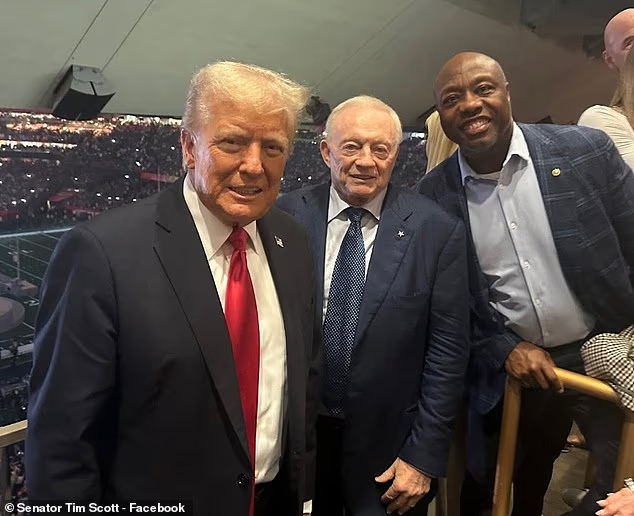
Jerry Jones (C) is the longtime owner of the Dallas Cowboys, but it could have been Trump
THE GAME – OUT TUESDAY, OCT 13

Peter King’s new book – ‘The Game’ – is out on Tuesday October 13 and available HERE
The Trumpian error
In March 1990, new commissioner Paul Tagliabue led the league to a boffo TV deal with CBS, NBC, ABC, ESPN, and TBS, averaging $32.1 million per team over four years. That nearly doubled the money from the previous TV deal, signed in 1987.
TV is what pushed franchise values out of sight. What no one could really see coming was that a league struggling with stalled ratings and two players’ strikes in the ’80s would enter the new decade on a TV tear.
And it was right about this time that NFL franchises became incredibly sought after. In a 10-year span, from 1989 to 1999, a premier franchise’s sale value went from $140 million (Dallas) to $750 million (Washington). Today, Forbes magazine values the Cowboys at north of $10 billion.
Which conjures this memory: In 1984, the 38-year-old owner of the USFL’s New Jersey Generals, Donald Trump, considered trying to buy the Cowboys for $50 million. But he felt $50 million was excessive.
Trump told The New York Times: ‘I feel sorry for the poor guy who is going to buy the Dallas Cowboys.’

Back in 1984, Trump (pictured on GMA) turned down the chance to buy the team for $50 million

At that time, Trump was owner of the NJ Generals. He pictured with star man Herschel Walker
Kraft and Belichick
In the first week of the new century, the Patriots needed a coach. Owner Robert Kraft had fired Pete Carroll after three seasons of good but not great football, feeling that having the best young quarterback in football (in Kraft’s eyes), Drew Bledsoe, should have translated into better results than five games over .500 over those three seasons.
His kitchen cabinet of sons, as well as many boldface names in the NFL executive branch, thought Kraft should hire the widely respected former Carolina coach Dom Capers. Kraft did his due diligence. He liked Bill Belichick, the former Browns head coach and New England assistant under Bill Parcells in the mid-’90s.
Kraft, 58, the sixth-year owner of the Patriots, knew there was much he didn’t know about the sport he loved. So, he asked for advice in the early days of 2000. The most obvious person to talk to about Belichick was the only man to that point who’d hired him as a head coach: former Browns owner Art Modell, who’d had a stormy parting with martinet-like Belichick in 1996.
Years later, Kraft and I sat in his New York City apartment – in the Plaza Hotel, overlooking Central Park-and he relayed the advice he got from Modell in January 2000. ‘I remember his exact words,’ Kraft said. ‘He said if I did it, I’d be making the biggest mistake of my life.’

Robert Kraft (right) was told that hiring Bill Belichick in 2000 would be his ‘biggest mistake’

Twenty-four years on, the pair said goodbye having won six Super Bowl titles together
Kraft saw videotapes of two Belichick press conferences from his ill-fated stint as Browns coach from 1991 to 1995. The coach was dour, terse, a mumbler. Seemingly a miserable person. Kraft watched those press conferences of a man getting root canals without Novocain. Doubt crept in.
‘Were you scared to hire him?’ I asked.
‘Of course!’ he said. ‘How could I not be?’
But Kraft remembered the very high regard his defensive backs had for Belichick when he was their position coach. Kraft took all the advice from NFL boldface names in January 2000, said thank you very much, and hired Belichick anyway – and paid the Jets a first-round pick to get him.
(It’s hilarious, by the way, to hear Belichick say now that it was he who took the big risk, in going to New England. The man, at that moment, had nowhere else to go.)
Point is, Kraft went with his gut feeling, and it’s the best football decision he ever made – and the best he ever will make.

Tom Brady pictured with Belichick – together, their partnership dominated the NFL
How a tanning bed explains Peyton Manning
For the Manning story, start with the combine in 1998 in Indianapolis, when he was in direct competition with Washington State quarterback Ryan Leaf to be the first pick in the draft.
‘Before the combine,’ Manning said years later, ‘I remember reading this stuff about me and Ryan, and one thing just really hit me. Somebody said I had no upside. I was like, Damn. Like, I haven’t finished going through puberty! Come on!
‘Ryan was a physical, bigger guy. And I was not a physical guy. I wanted to weigh 228 pounds at the combine. That just sounded physical to me. The weigh-in was my thing. That was my moment. Went to the tanning bed the day before. Helps the cut, the look. I was told this. In Indianapolis, I found a tanning bed.’
There was more: ‘I said, “What time’s the weigh-in?” It was 9:30. So at 8:15, I mean, I am pounding the water. I had to go to the bathroom so bad.’ He wanted to put on some water weight to get up to 228.
Then: ‘Here’s the one that’s kind of the next level. I’m in a group of like 30 players. And we have a coach assigned to the group. Leaf’s in my group. Coach is like, “Let’s go, we’re going to the weigh-in?” I said, “Coach, can I use the restroom?” He’s like, “All right, hurry up!” I go into the restroom.

Peyton Manning was drafted No 1 overall in 1998 – after impressing at that year’s Combine

Nowadays, Peyton – alongside his brother Eli (L) – are two of the biggest names in NFL history
‘There’s a couple scouts in there. I go in the stall and I rep 50 close-grip push-ups and dips on the toilet. No lie!’
He wanted to look ripped. Glistening a little, maybe, so that his torso didn’t have the pale, stick-figure look no NFL coach wanted to see. ‘Now I’m walking in. Shirt’s off. Short shorts on. It’s kind of a weird thing. I went in there, step on the scale.
‘Manning, Peyton, quarterback, Tennessee, 6-foot-5-one-quarter. Weight, 2…3…0.’ I weigh 230!’
He was thrilled. Manning met with the Colts, holders of the first pick in the draft, at the combine. The GM, Bill Polian, and head coach, Jim Mora, were as straitlaced and buttoned-up a combo as there was in the NFL, and Manning was their type.
Leaf, whether by intent or crossed lines or a scheduling conflict, missed his meeting with the Colts. Polian and Mora didn’t like that, at all. So, exiting the combine, Manning had a lead in the race for the top pick, even though many in the league thought he was inferior in tools to Leaf.
The tanning bed, the water weight, the secret pushups… Manning probably would have been the first pick if he did none of those imagey things, but combined, they illustrated the lengths to which he’d go to be the top pick – and to win.

Peter King is an acclaimed sportswriter who spent nearly three decades as a senior writer for Sports Illustrated
How a coach is like a second-grade teacher
In 2025, the Denver Broncos showed players a weekly team-produced variety show, ‘The Nosey Corner.’ Two Broncos defensive tackles, Malcolm Roach and D.J. Jones, recorded a weekly interview with a player, and it got played in the team’s Saturday meeting.
The chats were wry, edgy, challenging, with no softball questions. On the day I saw it, starting cornerback Riley Moss was on the griddle. Roach and Jones are Black. Moss is one of the few white corners in the league, and one of the most penalized overall.
One of the questions from Roach to Moss: ‘Do you think NFL officials are racially profiling you?’ The crowd howled, Moss took the bait and answered in anger. On the big screen, there were a few shots of the high-school Moss in Iowa – running track, at the prom, as a tot – and Roach did his best Kenan Thompson egging Moss into some non-politically correct answers. Two or three times Roach’s questions or Moss’s answers brought down the house. Thirteen minutes of fun.
I’d never seen anything like this in an NFL team meeting.
Roach told me: ‘When we got asked to do it, we got told to act like you’re talking in the barber shop, or like you’re in the locker room. The goal here is to create a brotherhood-type vibe. The closer you can get to your guys and the more you know their story, it helps bring you closer. Helps you go hard for each other.’

Sean Payton has opened up about his attempts to overhaul his team meetings with players

Riley Moss brought the house down in a team meeting with the Denver Broncos last season
Teaching is different today. Much of it is about holding players’ interest. Coach Sean Payton has become convinced that teaching players also involves knowing them and figuring out how to reach them.
‘I used to teach using a chalkboard and an overhead projector, then a Powerpoint,’ he said. ‘Now you have to make it more interactive. A little more fast-paced. Music. Video. Clips from movies.’
The Nosey Corner, and the team’s quirky approach to meetings and teaching are not, technically speaking, education. But letting players know when they walk into a team meeting or a position meeting that it’s going to be well thought-out, and it’s not going to be sleep-inducing, is creating an environment where learning gets optimized in a Gen Z world.
‘We’re constantly updating our methods of teaching,’ Payton said. ‘It’s like teaching in general. If you ask a second-grade teacher how much her lesson plans have changed in 20 years, I’m sure she’d say, “Quite a bit.”‘
Excerpted and adapted from THE GAME. Copyright (c) 2026 by Peter King. Used with permission of the publisher, W. W. Norton & Company, Inc. All rights reserved.