Nigeria has become remarkably good at celebrating sporting victories—and remarkably poor at building the system that makes those victories sustainable.
Every time Nigerian athletes win a continental trophy, qualify for a major tournament or stand on a podium wearing the green and white, we celebrate them as national heroes.
And rightly so.
But when the celebrations end and the cameras disappear, another reality begins.
A reality that is rarely discussed.
How does the Nigerian athlete survive?
Why must a Nigerian athlete leave Nigeria before his or her talent can become a genuine profession?
Why is it that a young Nigerian can spend years training, sacrificing, competing and representing the country, yet still be unable to say with confidence:
“I am a professional athlete, and this is how I make my living.”
That is the question Nigeria must answer.
Because this is no longer simply about qualification for international competitions.
It is about whether Nigeria has actually built a sports industry.
—
THE SUPER FALCONS PARADOX
Consider Nigerian women’s football.
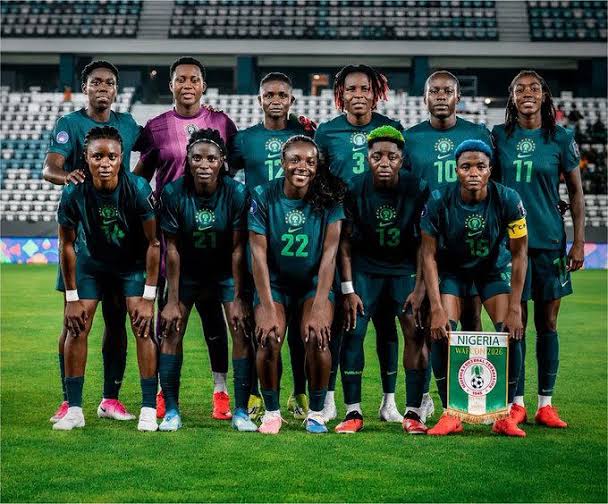
The Super Falcons are the most successful women’s national team in Africa.
Nigeria has won the Women’s Africa Cup of Nations 10 times, more than any other country. The Falcons reclaimed the continental title in 2025 after defeating Morocco 3–2 in the final.
That record should be the foundation of one of the strongest women’s football industries on the continent.
But the contradiction remains.
Nigeria can produce a national team capable of dominating Africa, yet many of the players who deliver those victories have had to build their professional careers outside Nigeria.
And before anybody misreads the argument, Nigerian clubs have made continental progress. Bayelsa Queens reached the CAF Women’s Champions League semi-final in 2022, while Edo Queens reached the semi-final in 2024.
The issue is not that Nigerian clubs are incapable of competing.
The issue is that the domestic system has not yet become strong enough, consistent enough and commercially viable enough to provide a professional career for the large pool of talent Nigeria produces.
That distinction is critical.
Because a country cannot claim to have built a football industry simply because it occasionally produces exceptional clubs or exceptional players.
The question is whether the average talented player can survive and progress through the system.
—
BOXING: WHEN A BOXER NEEDS A SECOND JOB TO SURVIVE
And this problem becomes even more disturbing when we leave football.
Listen to what Nigerian boxers themselves have been saying about the realities of the sport.
The message is painful:
If you want to become somebody through boxing in Nigeria, boxing alone may not be enough to feed you.
Some boxers have described a reality in which they have to take up additional work simply to survive.
Imagine that.
A boxer wakes up early, trains, sacrifices his body, competes and dreams of representing Nigeria—but still has to find another job because being a boxer does not provide a reliable livelihood.
At what point do we stop calling that a sporting career and start calling it a survival struggle?
Nigeria officially has institutions responsible for developing boxing. The Nigeria Boxing Federation says its mission includes athlete development, national competitions, professional standards and the creation of sustainable opportunities. It has also introduced professional licensing structures.
But the existence of a federation, a competition or a licence does not automatically create a professional industry.
A professional sport needs much more:
Regular competitions.
Reliable contracts.
Promoters.
Managers.
Broadcasting.
Sponsors.
Prize money.
Medical protection.
Insurance.
Athlete welfare.
Career pathways.
Retirement planning.
And a commercial audience.
Without those things, telling a boxer to “be professional” is almost meaningless.
—
VOLLEYBALL HAS THE SAME STORY
The same problem exists in volleyball.
You can find a talented Nigerian volleyball player who trains for years, represents a state or national side and competes when there is a championship.
But then what?
Where is the year-round professional structure?
Where is the league system that allows the player to wake up and know:
“I am employed as a volleyball player.”
Where is the reliable salary?
Where is the long-term contract?
Where is the sports insurance?
Where is the commercial sponsorship?
Where is the pathway from youth volleyball to professional volleyball?
Too often, the athlete’s economic existence becomes dependent on competition.
There is a tournament, so there is activity.
There is a national assignment, so there is attention.
There is an African championship, so everybody suddenly remembers the athletes.
Then the competition ends.
And the athlete returns to uncertainty.
That is not how a modern professional sporting industry should function.
—
SPORT SHOULD BE A PROFESSION—NOT A SEASONAL EMERGENCY
This may be the most important point in the entire debate.
Nobody tells a lawyer:
“Wait until there is a case before you can earn money.”
Nobody tells a teacher:
“You will only be paid when there is an examination.”
Nobody tells an engineer:
“You can only make money when there is a construction project.”
But Nigerian athletes are too often trapped in a system where their economic value becomes visible only when a competition arrives.
They are athletes during the championship.
They become invisible after it.
That is the structural problem.
Sport must become a profession in Nigeria.
Not merely something young people do until they get a scholarship abroad.
Not merely something athletes do for a state government.
Not merely something people participate in because they love their country.
A person should be able to say:
“I am a boxer.”
“I am a volleyball player.”
“I am a footballer.”
And that statement should have the same economic seriousness as saying:
“I am an accountant.”
“I am a lawyer.”
“I am an engineer.”
That is what professionalism means.
—
WHY ARE WE EXPORTING OUR BEST ATHLETES?
This is where the Nigerian situation becomes particularly painful.
Other countries have learned that sport can be an industry.
They build leagues.
They attract sponsors.
They sell broadcasting rights.
They develop academies.
They create professional contracts.
They attract foreign athletes.
They build sporting brands.
And when their athletes become successful, the country benefits economically from the ecosystem around them.
Nigeria, meanwhile, often develops the raw talent and then watches that talent leave.
The athlete goes abroad.
The professional development happens abroad.
The better facilities are abroad.
The better contracts are abroad.
The better exposure is abroad.
And sometimes, even the athlete’s sporting identity becomes stronger abroad than it ever was at home.
Then when Nigeria needs a national team, we call them back.
We are essentially asking other countries and foreign leagues to develop our athletes, while we celebrate the finished product when it returns to represent Nigeria.
There is something deeply wrong with that model.
—
AND THEN WE BLAME THE ATHLETE
When an athlete changes allegiance, refuses an invitation, chooses another country, or decides to pursue a career elsewhere, the immediate reaction is often anger.
“Why doesn’t he want to represent Nigeria?”
“Why did she choose another country?”
“Why are our athletes abandoning us?”
But perhaps we should ask a different question.
What did we build that would make them want to stay?
Patriotism is powerful.
But patriotism cannot pay rent.
Patriotism cannot replace medical insurance.
Patriotism cannot feed an athlete’s family.
Patriotism cannot build a career.
Patriotism can inspire an athlete to wear the green and white.
Professionalism is what makes it possible to build a life around wearing it.
—
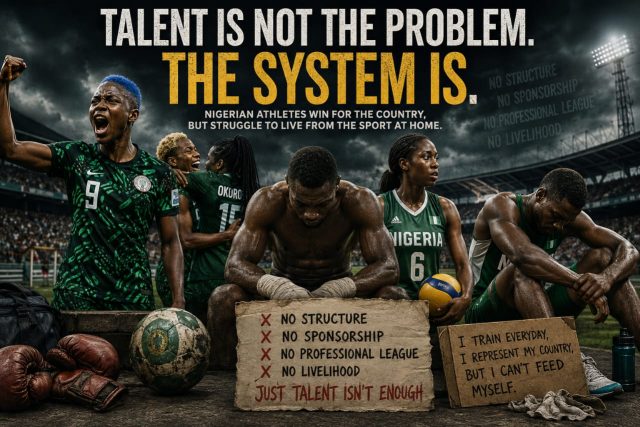
NIGERIA HAS THE TALENT. THAT IS NOT THE PROBLEM.
For decades, Nigerians have been told that the problem is lack of talent.
That argument is becoming increasingly difficult to defend.
Nigeria has produced Olympic champions, world champions, African champions and elite footballers.
Our athletes continue to perform despite the weaknesses around them.
Sometimes, they succeed in spite of the system rather than because of it.
And that distinction matters.
A country should not have to depend on extraordinary individuals to compensate for ordinary institutional failure.
We should be asking:
How many talented children never become elite athletes because their families cannot afford the journey?
How many promising footballers abandon the sport because they cannot earn enough to survive?
How many boxers work additional jobs because boxing cannot support them?
How many volleyball players wait for competitions because there is no reliable professional league?
How many athletes leave Nigeria because there is no credible career pathway at home?
How many coaches, physiotherapists, scouts, analysts, agents and sports administrators could build careers if Nigeria developed a real sports economy?
And perhaps the biggest question:
How much sporting wealth is Nigeria exporting because it has failed to build a sports economy at home?
—
GOVERNMENT CANNOT DO EVERYTHING—BUT IT CANNOT DO NOTHING
This should not become another simplistic exercise in blaming government for everything.
Government is not a football club.
Government cannot personally run every boxing gym, volleyball club or football academy.
Private investors, sponsors, broadcasters, clubs, federations, promoters, agents and sports entrepreneurs all have responsibilities.
But government has an enormous responsibility to create the environment in which those people can operate.
That means:
Functional facilities.
Reliable competition calendars.
Transparent sports administration.
Youth development.
Grassroots programmes.
Professional league structures.
Athlete contracts.
Medical and insurance systems.
Commercial sponsorship.
Broadcasting opportunities.
Proper sports governance.
And, most importantly, a system in which athletes are treated as professionals rather than people who should simply be grateful for the opportunity to represent Nigeria.
The National Sports Commission and other government bodies have increasingly spoken about turning sports into an economic sector.
That is the right direction.
But Nigerians have heard promises before.
The real test is not another policy document.
The real test is simple:
Can an 18-year-old Nigerian athlete enter the sporting system today and see a credible economic future?
—
THE LEAGUES SHOULD BE THE FACTORIES
Nigeria often focuses on national teams because national teams are politically and emotionally convenient.
When the Super Falcons win, everyone celebrates.
When the Super Eagles qualify, everyone celebrates.
When D’Tigress dominate Africa, everyone celebrates.
When an athlete wins a medal, politicians rush to take photographs.
But national teams should not be the beginning and end of sports development.
They should be the product of a healthy domestic system.
The league should discover the player.
The academy should develop the player.
The club should employ the player.
The federation should regulate and grow the sport.
The sponsor should see commercial value.
The broadcaster should see an audience.
The fan should see quality.
And the athlete should see a career.
If that chain is broken, national-team success becomes a temporary miracle rather than evidence of a functioning industry.
—
STOP CELEBRATING THE SYMPTOM AND START FIXING THE SYSTEM
There is something deeply contradictory about a country that can produce the most successful women’s national team in African football history while struggling to create a domestic environment where many of those players can build sustainable careers.
There is something wrong when a boxer has to consider another job simply to survive.
There is something wrong when a volleyball player can represent the country but cannot confidently build a livelihood from volleyball at home.
There is something wrong when athletes are celebrated as heroes after winning medals but become invisible when they need training, salaries, facilities, insurance and career development.
There is something wrong when the country proudly says:
“Our athletes are the best in Africa.”
But cannot confidently say:
“Our athletes can make a good living in Nigeria.”
That is the conversation Nigeria needs.
Not another blame game.
Not another award ceremony.
Not another promise after a tournament.
Not another photograph with a trophy.
WE NEED TO BUILD THE INDUSTRY.
Because the ultimate measure of sporting development should not be how loudly a country celebrates its champions.
It should be whether the next generation can look at those champions and believe:
“I can do this too.”
And more importantly:
“I can build my entire life around this career without having to leave Nigeria.”
Until that becomes true, every trophy Nigeria wins should come with an uncomfortable question:
IF NIGERIA HAS THE TALENT TO CONQUER AFRICA, WHY CAN’T NIGERIA BUILD A SPORTS INDUSTRY STRONG ENOUGH TO KEEP ITS ATHLETES AT HOME?