The best vantage point at Royal Birkdale is also the one with the worst view. But here we are, crowded under the wooden roof and squinting in the darkness through a single, tiny mesh window for a glimpse of the 18th green.
Bob MacIntyre looks up from down below, and they all will, because this is one of the two giant yellow leaderboards that tell their story from opposing sides of the final hole.
Where times change and golf moves with it, those leaderboards stay the same and have done since 1979. Hand-operated and fallible to errors, they stand as icons of analogue resistance to a digital world; slow, occasionally unsteady, but still there, keeping score.
And so a squadron of eight local sixth-formers and three teachers do their work in each of the boards. I’m in the one on the right, if you were looking down the hole from the tee, 18R it’s called, and Charlie Boddington is supervising, as he has done for the better part of 11 years.
He’s the deputy headteacher of Cranleigh School in Surrey, but this is an unpaid gig. He loves the golf, loves being part of the Open, and hates the rain. When it rains, the roof leaks.
‘My first one, St Andrews in 2015, it went on to the Monday because of the weather,’ he says. ‘The water gets in. I remember we were all camping and our tents were washed out. Colin Montgomerie’s son went to Cranleigh, so next thing we had this invite to stay the night in Monty’s house nearby, 10 or 11 of us.
The Open leaderboards stay the same and have done since 1979, hand-operated by teachers and students

It’s open to errors, which can leave spectators shocked, but they are quickly fixed
‘The Open is wonderful. It’s about tradition, right? And these leaderboards are part of that tradition.’
They are. And tradition mandates there will be mistakes.
On Friday morning, that meant spelling Nicolai Hojgaard’s surname with three As, and that was a slip from the downstairs crew, because this operation is conducted across two floors separated by a wooden ladder.
Those upstairs do positions one to six, and the pupils down below handle seven to 12, which is the easy work — the names of 156 golfers are pre-printed on long, plastic yellow boards and inserted when they become relevant. But the harder bit concerns naming the players who are approaching the 18th green, because those need to be spelled out and inserted from the blindside of the wall. When an error happens, as it did with Hojgaard, it is followed by a hasty radio call from those manning the opposite leaderboard.
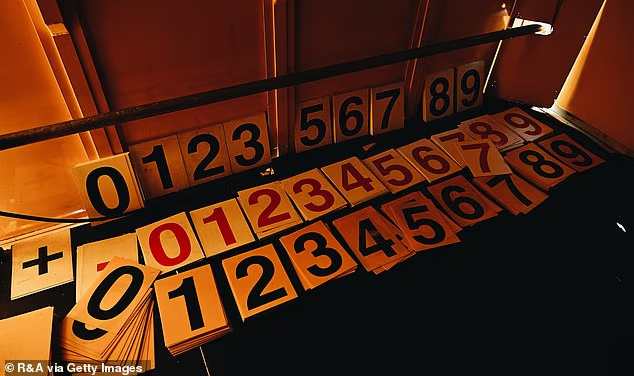
‘We keep an eye on each other,’ says Boddington. ‘You get a fair amount wrong, especially in the early rounds, when the team is learning the ropes. It is usually with the numbers rather than the names — it is very easy to put in a six or a nine upside down.
‘We had that with Xander Schauffele at Troon (in 2024).’
The story follows that when Schauffele reached nine under par with a birdie on the 16th hole of his final round, the nine went in the wrong way and appeared as a six. To those in the 18th grandstand, there was a gasp — they had momentarily been led to believe the American had shot a double bogey and his procession was now a capitulation.
Boddington laughs. ‘That can cause a panic but you get it corrected quickly.’

It’s hard to see the golf through a small mesh window inside the two leaderboards

Those patrolling the boards await information before making it known to spectators
While he talks, the sixth formers are buzzing around in the dark, waiting for instruction on how to update the names and numbers, which arrive via internal radio and app from ‘scoring central’. As a line of trivia, Jonathan Edwards, the triple jump world record-holder and single-figure handicapper, is one of the scoring team, another link in the chain.
‘The pupils all want to handle the name boards for the bigger names,’ says Boddington. ‘When Tiger Woods was playing, they’d obviously want to be the one who puts his name out there if he reached the top 12 — you’d hear the roar from outside when it appears. Same with Rory McIlroy now.’
Ironically, it’s almost impossible to see any of the golf from up here. That mesh window really is very small. But those yellow leaderboards are part of the Open furniture, part of every visitor’s picture gallery, and those who operate them are an unseen part of the show itself.
One of the supervisors, Carolyn Moir, a PE teacher at the neighbouring Greenbank High, has been around the Open for years. She tells me about a brush with the stars that dates back to 1991, when Ian Baker-Finch won at Royal Birkdale.
‘I was actually a driver for the players and their families that week,’ she says. ‘When Ian won, I drove his wife to their rental home while he was finishing up with whatever he had to do at the course, and she wanted to stop at the local Spar to grab some frozen pizzas and champagne. She then invited me in and I stayed there to celebrate with them, eating frozen pizzas from the Spar.
‘I love being around this tournament. These leaderboards are part of the tradition. I hope they stay.’
For now, there is no indication of a change, even if the creep of the modern world has been noticed at this tournament in recent years and caused some consternation.
It is conspicuous how, in the past decade, Open merchandising and hospitality has grown exponentially, swallowing more of the footprint; ticket prices have risen and so have the grumbles. Something has felt a little lost in the sprawl.
But there are two yellow consistencies around the 18th green, imperfect and quirkily reassuring all the same.