Trying to impress your own children is never easy, even when you’re a six-time Olympic champion. The Sir Chris Hoy velodrome will be pressed once more into hosting duties this week as the sporting world shifts its focus from the World Cup and on to the Commonwealth Games about to unfold in the Glasgow sunshine.
Joining Hoy at the facility that bears his name will be 11-year-old son, Callum, and daughter Chloe, 8, who on their last visit didn’t seem all that starstruck at the notion that their dad might be something of a big deal in this world.
‘My family are going to be here so I’ll take my kids to as many events as possible and hope that they are going to be inspired,’ said the man widely considered to be Scotland’s and possibly also Britain’s greatest ever athlete.
‘They went to Paris in 2024 (for the Olympics) and they went to the World Championships in Glasgow three years ago. So, it’ll be nice to bring them back to the velodrome. They weren’t that impressed last time by the fact that their dad’s name was on the side of the building. But they’re now eight and eleven so hopefully they’ll appreciate it a little bit more now.’
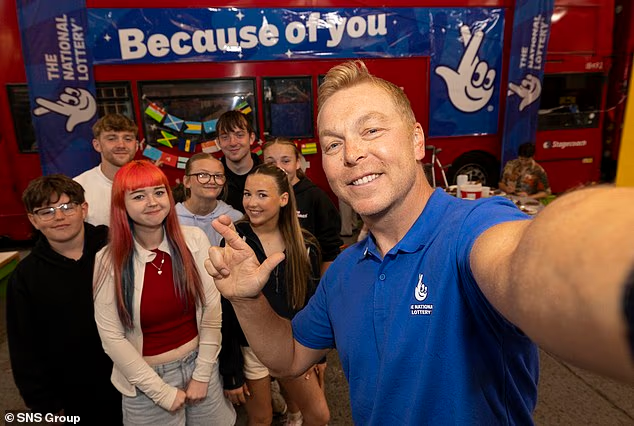
Sir Chris Hoy promotes the National Lottery funding for Glasgow 2026
Self-deprecating modesty has long been one of Hoy’s most admirable traits. And while he might have a bit to do to wow his own kids, there is no shortage elsewhere of respect and appreciation for the 50-year-old.
Hoy’s revelation two ago that he had been diagnosed with stage 4 prostate cancer brought him back into the spotlight in a way that neither he nor anybody else would have wanted but there remains so much energy and positivity about him that his public appearances are never a pity party.
His latest stop was to ‘Glasgow The Caring City’, a charity housed in a converted industrial unit in Govan, to celebrate the news that National Lottery funding for community projects in the city since 1994 had broken through the £1billion barrier.
On one of the walls of this vibrant space has been added a new mural featuring Hoy in race mode on the track, with space at the top for people to add their comments and signatures.
It is 13 years now since he retired from competitive cycling but even among the throng that excitedly encircled him in Govan – some of whom probably weren’t even born when he was at his peak – he remains a hugely popular and beloved figure, judging by the clamour for selfies or even just a few seconds of his time.

Sir Chris Hoy admires a mural designed by youngsters
A round of media interviews adds to a chaotic early morning schedule that would prove draining to most people, never mind one burdened by a terminal illness. Hoy, though, does it all with good grace, humility and a seemingly endless vat of patience.
He looks well, too, his outward appearance and demeanour betraying little sign of what his body is enduring underneath. It would be understandable in the circumstances had Hoy opted to retreat from public life, eschewing the spotlight for a quieter life amid the rounds of chemotherapy, but it is not in his nature.
He has not long returned from a week cycling coast to coast across Spain, a charity ride alongside Tour de France legend Miguel Indurain that saw him in – and out of- the saddle for more than six hours a day. It was a gruelling experience – barely six months after breaking his leg in a nasty mountain bike crash – but this is how he chooses to live his life, cancer or no cancer.
‘I think part of the appeal of sport is the suffering or the challenge, certainly, and cycling is no different to that,’ he reveals. ‘As Greg LeMond, one of my heroes, once said, “it never gets easier, you just go faster”. Or the opposite with me now, “it never gets easier, you just go slower”.
‘But if it was easy, I think it would be boring. The challenge is that it’s difficult. And now it’s a real sense of achievement when you do something like that coast to coast challenge, particularly with my broken leg and a torn meniscus in my other leg. But when you get through it, you recognise that you’ve done something significant.
‘Of course you get tired all the time. And, like in sport, you use your energy when you need it. In terms of inspiring people, I don’t know. One of the outcomes of my cancer diagnosis was that I thought, “I have a public platform that I can use to help other people”. And it makes sense for me to try to find a positive in a very difficult situation. It’s what drives me on now and hopefully I can raise a lot of money for cancer charities. But I’m doing well, enjoying myself, the weather’s good and there’s plenty to celebrate.’

Sir Chris Hoy with the three gold medals he won at the Beijing Olympics
He is already eagerly looking forward to the Commonwealth Games, an event that wouldn’t have happened at all had Glasgow not stepped in with a late rescue package after Victoria, Australia withdrew due to concerns over rising costs.
These, then, will be a slimmed-down version with fewer events and no free-to-watch road disciplines in either athletics or cycling that doesn’t seem to have, as yet, caught the imagination of the wider public.
Comparisons with the booming success that were the 2014 Games would seem unfair given the vast difference in resources. But Hoy is adamant that any pre-event concerns will be washed away by the time these Games get underway.
‘Glasgow, I believe, put on the greatest Commonwealth Games that I’ve ever seen,’ he reflects on 2014, the first major sporting event following his retirement the year before. ‘Everything about it was fantastic.
‘And there are always doubts, worries and concerns before the start of any Games. But that evaporated as soon as it started in 2014 and the opening ceremony was underway.
‘Everybody got behind it, the athletes performed, and the weather was good – well, most of the time. But mainly the thing I remember was the way that the public got behind it. Glaswegians are so proud of their city. They’re so welcoming and they will do anything it takes to make people who are visiting Glasgow feel that they’re having a good time. So, I think the public will get behind this. And even though it’s maybe not quite on the same scale as 2014, I think it’ll still be fantastic.’
Hoy will look to take in as many events as possible at these Games but has his eye on one discipline in particular once he’s finished with his own commitments.
‘I’ve a role in the opening ceremony which I can’t say too much about but which should be fun,’ he teases. ‘And I’m doing some of the broadcasting for the track cycling. Then hopefully, if I have enough time, I’ll be able to duck around and see some of the other sports events that are happening.
‘I’d love to see the weightlifting. It’s one of these things that I’ve always been massively impressed by but I’ve never seen it live. And because I used to do a lot of that lifting for my training for cycling, I’ve got a little understanding of what these weights actually mean. So, I’ve got a huge respect for that. But that’s the beauty of the Commonwealth Games. You can turn up at any venue and just enjoy it.’
Thanks to National Lottery players, more than £1 billion has been invested in Glasgow through over 14,000 grants since 1994. It’s because of you sport, arts, heritage and community projects are supported across the city. As Glasgow prepares to host the Commonwealth Games, the impact of National Lottery players’ support is visible everywhere – from the Games venues, to the museums and galleries visitors will enjoy and to the local projects bringing communities together to celebrate.