A bipartisan group of US senators on Tuesday unveiled a new sanctions bill that proposes tariffs of up to 100% on exports from India, China, Slovakia, Hungary and Azerbaijan for purchasing Russian oil, in the latest effort to throttle Moscow’s energy revenues and force an end to the war in Ukraine.
The bill — a softened version of the Sanctioning Russia Act introduced in the Senate in April 2025, which proposed tariffs as high as 500% but failed to advance to a vote — could be passed before August, according to its backers. The US Trade Representative (USTR) would determine the exact tariff rate imposed on each country.
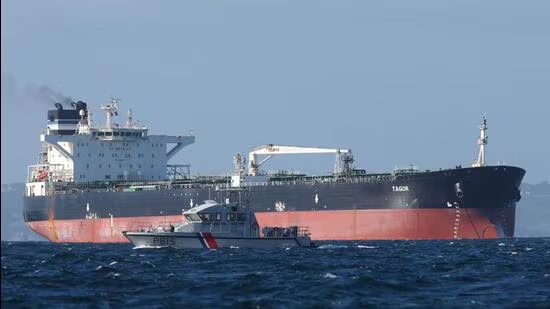
The threat of renewed tariffs comes at a time when India’s purchases of Russian crude have surged — primarily because the disruption of shipping through the Strait of Hormuz after Iran retaliated against US-Israeli military strikes choked off Gulf crude supplies that previously accounted for roughly 40% of India’s oil imports, forcing refiners to turn to Russian crude as the main alternative source.
Washington itself facilitated this pivot through a series of OFAC general licences — the last of which expired on June 17 — that temporarily waived sanctions on Russian oil transactions to stabilise global energy markets during the crisis.
Indian imports of Russian crude oil rose 34% in June 2026 to record levels, according to the Centre for Research on Energy and Clean Air, and were valued at €4.5 billion, accounting for roughly 36% of Russia’s crude oil export revenues. India was the second largest buyer behind China.
The new bill also lands at a time both sides are engaged in trade talks. A framework in February had settled on an 18% rate for Indian goods, but that arrangement was overtaken when the Supreme Court ruled later the same month that President Donald Trump’s use of emergency powers under IEEPA to impose tariffs was unlawful. Indian goods currently enter the US under a flat 15% tariff imposed under Section 122 of the Trade Act of 1974 — a temporary authority due to expire on July 24, with the broader bilateral trade agreement between the two countries still unfinished.
“It imposes tariffs that are targeted, narrowly limited to the five major purchasers, up to 100%, with waiver authority that is narrowly tailored and constricted. And those five major purchasers right now of oil are China, India, Slovakia, Hungary, Azerbaijan,” Senator Richard Blumenthal said at a press conference in Washington on Tuesday.
The bill makes an exception for countries purchasing Russian natural gas if they are buying less than 15% of total Russian gas imports and are taking significant steps to reduce their purchases. It includes additional sanctions against Russia’s energy, defence, financial and industrial sectors.
Blumenthal said the USTR would set tariff levels appropriate to discourage purchases by the five targeted nations. “The decision about the exact rate will be determined by the United States Trade Representative. We’ve had extensive discussions with him. I think it will be set at an appropriate level to discourage China, India and other major purchases of Russian oil and gas. Remember that there are reporting and certification requirements from the US Trade Representative to the Congress if the rate is lowered,” he said.
Democratic Senator Jeanne Shaheen, who is also backing the bill, said it would have “much narrower” tariff provisions than the original Sanctioning Russia Act, which stalled in the Senate owing to concerns over its extreme provisions and a lack of support from President Donald Trump.
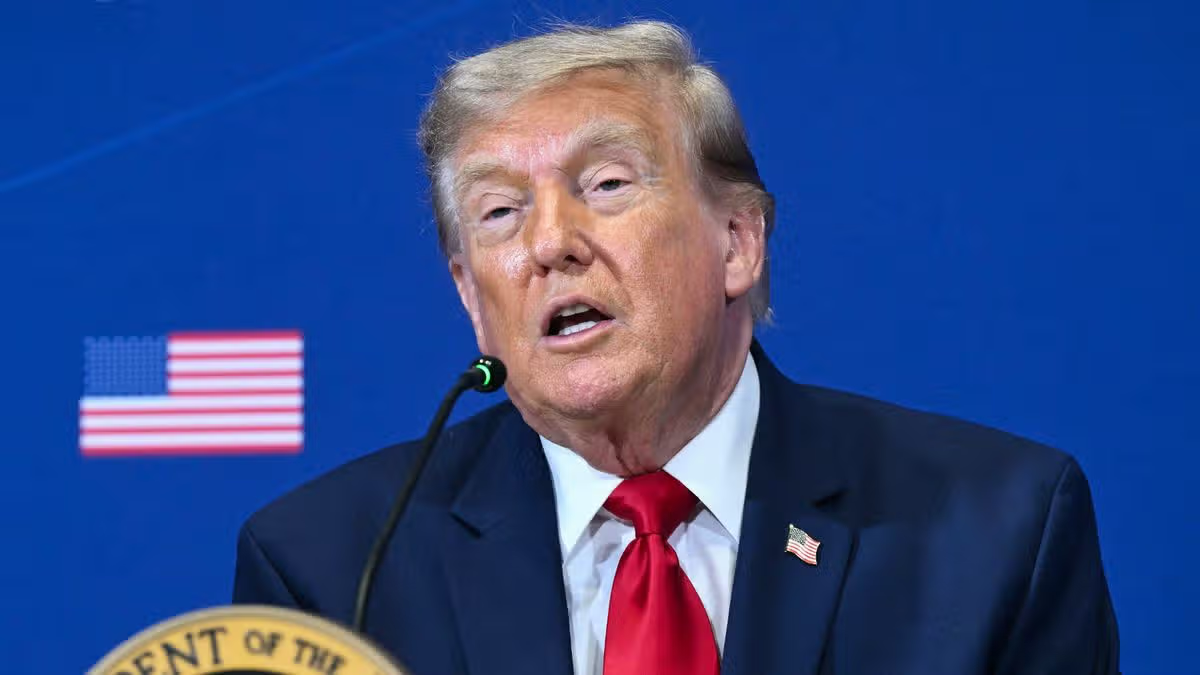
The original bill was spearheaded by Senator Lindsey Graham, who died suddenly on Saturday after an aortic dissection. Legislators at Tuesday’s press conference paid tribute to Graham’s role in advancing the legislation. Trump said the bill had been brought forward in Graham’s honour and hinted that sanctions against Iran could also be included.
However, the bill has drawn sharp criticism from some legislators who argue it gives excessive tariff authority to the president. Congressman Gregory Meeks, the ranking Democratic member on the House Foreign Affairs Committee, said the bill “missed the moment”.
“This is not so much a sanctions bill as it is a massive backdoor authority for President Trump to impose more tariffs, including on our European allies, that hurt American families. The sanctions the bill does contain are entirely at Donald Trump’s discretion, and he has made clear repeatedly that he would rather waive sanctions on Russia than impose new ones,” Meeks said in a statement.
Meeks urged his colleagues to instead build on the Ukraine Support Act, which passed the House in June on a bipartisan basis. “What I won’t support is handing President Trump a Trojan horse for tariff authorities he has repeatedly abused. That does nothing to help Ukrainians under Russian attack, and nothing to help the American families who pay the price for Trump’s tariffs,” he said.