It was the home to the Shipping Forecast, Test Match Special and, according to Cold War legend, one of the signals submarine commanders used to check Britain had not been wiped out.
For the last time this week, listeners could tune their radios to long wave, for the final broadcasts before the transmitters sighed out of life forever. With them went the familiar crackle of the long wave (LW) frequency, that back in the day was the only sign of Britain that long-distance lorry drivers and holidaymakers could pick up on the continent.
Developed by Guglielmo Marconi around the beginning of the 20th century and transmitting at a low frequency, the LW signal clung to the earth and could cover vast distances, which easily allowed for national broadcasting.
Founded in 1922, the BBC’s first experiments with the technology took place in 1925, the same year as the first Shipping Forecast. Then, in 1934 a dedicated site with increased power was built and began broadcasting at Droitwich, Worcestershire. Westerglen was already in use, but a second Scottish site at Burghead was opened in 1936.
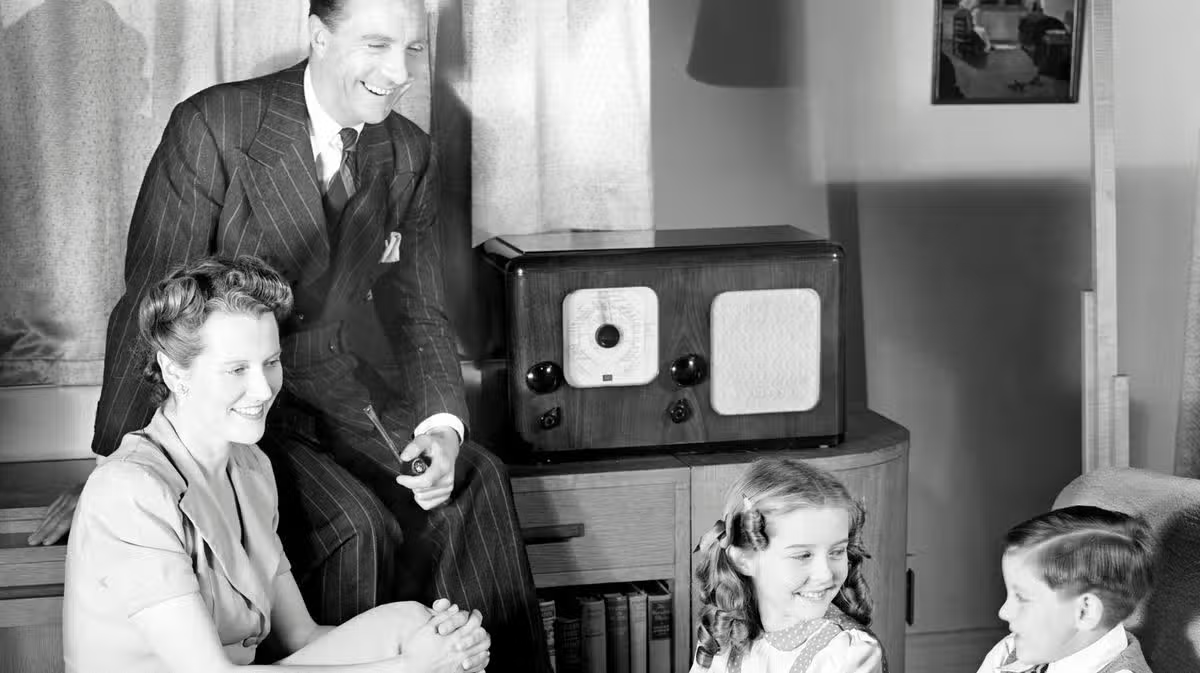
At first LW was used for the National Programme. This became the Home Service – the first broadcast from which was on September 1, 1939, which was the day Adolf Hitler invaded Poland. During World War II, families would gather around the wireless to listen to Winston Churchill’s speeches on the BBC Home Service. A major national event, they drew more than 20 million listeners.
For Bournemouth University media specialist Dr Graham Majin, the death of LW is not really about a redundant transmitter. Graham, who worked in broadcast for 20 years, including a 14 year stint at the BBC said: “It marks the fading of a philosophy that sought to unite a nation through shared listening. It’s not just nostalgia for some old museum pieces. It represents something that’s passed.”
He continues: “When I was a kid, my brother and I would listen to the radio. We ended up listening quite a lot to the old Radio 2 which was on 1500m long wave. David Hamilton and people like that, Terry Wogan, Jimmy Young. It does have a nostalgic childhood thing to it.”
When LW radio arrived, it was the most advanced broadcasting technology in the land. Graham said: “When the BBC started in 1922 it was really a regional or local service. We think of it as some sort of ancient, fuddy-duddy thing that belongs in a museum. But when it was this incredible new technology.
“And when the BBC built this massive great thing, the long wave transmitter, at Droitwich – which I think you can still see from the M5 – it was a fantastic thing. Because until then, the technology didn’t really exist for them to cover the whole country. The ambition was one service that would cover the whole country, so everyone could hear the same thing at the same time.”
Graham added: “The announcer said: “This is the National Programme from London, radiated by the new long wave transmitter at Droitwich. Everyone could hear the same thing at the same time. That had never happened before. People would gather around the radio set in the living room. The children, the adults, the grandparents, and they’d all listen to the same thing.”
It even forced people to sit through opinions they hated. Graham pointed to “a famous debate on communism, which was very controversial,” when listeners wrote in demanding such voices be kept off air. He said: “It taught tolerance for views which are not familiar, tolerance for strange voices. And it was built on the idea that Reith had about ‘nation shall speak peace unto nation.’”
For decades, LW carried the nation’s routines. It was the home of the Shipping Forecast, Test Match Special, the Daily Service and Yesterday in Parliament. It carried Radio 4’s timekeeping too – the pips and the chimes of Big Ben that still open the news.
Its reach made it a lifeline far from home. The signal travelled so far that drivers picked up Radio 4 across France, Spain and Italy. Leisure sailors leaned on it as well, tuning in for the forecast as they judged the weather window home from across the Channel.
Even nuclear submarine commanders relied on it – checking whether Radio 4 was still broadcasting on LW was a sign of whether Britain had survived a nuclear strike. “That is probably a bit of an urban myth,” said Graham, “It sounds like a scene from Dr Strangelove.”
Yet none of it was enough to save the service. Radio enthusiasts and campaigners fought the closure, with the Campaign to Keep Longwave calling it “a vital piece of national infrastructure”
Age UK joined them, warning that older listeners on analogue sets would be left behind. Its charity director, Caroline Abrahams, said they would “no doubt mourn the closure of broadcasting via long wave.”
Sadly, the BBC turned it off anyway, on cost grounds, saying the platform was “now coming to the end of its life as a technology,” and that keeping it going would mean heavy investment for a service used by very few.
Graham said: “You can’t stop technology, can’t stop progress. If only a handful of people are listening, it makes no sense to keep it going. The technology it runs on – the valves – are hardly being made any more and they are very expensive.”
The last Shipping Forecast on long wave drifted out in the small hours of Saturday 27 June, and an announcer marked “the end of an era” The service closed at 1am, and the Droitwich transmitter fell silent for good just after midday on 30 June, ending 92 years on air.
Its going leaves listeners a step closer to a digital future, with FM now the main fallback, reaching 99.5 per cent of homes, and digital radio more popular than ever..
For Graham, that is where the real loss lies. “We have unlimited choice,” he said. “But there’s a downside to that, which is that we’re all just in our bubbles. The algorithms serve us up more and more of what we want and that breeds a form of tribalism. They’re designed to grab our attention and to inflame our emotions.”
The masts themselves may yet be saved. A campaign has begun to have the Droitwich transmitters protected and listed on the heritage register. But the end of LW has been on the cards for years.
The BBC first announced in 2022 that it expected it to close, and in March 2024 ended separate scheduling on Radio 4 LW in anticipation of this change. A spokesman said: “No programmes will be lost as a result of the closure. Radio 4’s programmes and services previously associated with long wave will continue to be available across other BBC platforms.
“Radio 4 remains widely available on FM, DAB, BBC Sounds, smart speakers and television platforms, including Freeview, satellite and connected TV. FM remains the main fallback option and is available to 99.5% of UK households.”
But Graham is not sure the appetite for LW has died, saying: “It’s about the aesthetic of AM analogue radio. People just like the aesthetic of it. And the crackles. After vinyl we were told that was obsolete and it was all CDs and then streaming, but vinyl has made a huge resurgence, hasn’t it?
“People like me study it, write papers about that phenomenon, the resurgence of vinyl and physical books rather than e-readers. “Media archaeology,” Graham said. “It’s a thing.”