
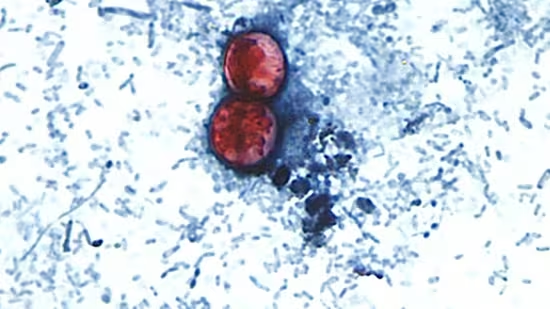
An intestinal parasite has sickened close to 7,000 people across the US since May, in an outbreak that health officials say is on course to surpass the country’s worst cyclospora tally recorded in 2019.
The US Centers for Disease Control and Prevention (CDC) said on Tuesday it had recorded 1,645 confirmed domestic cases of cyclosporiasis since May 1 and was analysing more than 5,100 reports across 34 states, with no deaths so far.
Michigan is the epicentre, reporting 3,309 cases on Tuesday — against the 40 to 50 the state normally records in a full year, according to its department of health.
State officials there believe lettuce or salad greens are the likely carriers. Michigan’s chief medical executive Natasha Bagdasarian said Tuesday early information from more than 1,000 patient interviews had “shown lettuce as a common product” that recurred through the investigation. Residents have been advised to buy whole heads of lettuce, discard outer leaves, wash the rest thoroughly, and avoid bagged salads and pre-mixed kits.
Fast-food chain Taco Bell said it had “voluntarily and temporarily removed limited ingredients at select restaurants as a precautionary measure”, without publicly specifying which. Notices at outlets in the Detroit area last week said lettuce, cilantro, onions, pico de gallo and guacamole had been withdrawn, according to The Washington Post, which reported that investigators were examining whether fresh produce served at the chain contributed to the outbreak. No link to Taco Bell has been established, and multiple food items remain under investigation.
Also read: Cyclospora in the US: Gastroenterologist Dr Salhab shares foods to avoid in parasite outbreak
What cyclospora is, and what it does
Cyclosporiasis is caused by cyclospora cayetanensis, a microscopic single-celled parasite that infects only humans. Nineteen other cyclospora species are known to infect animals but not people, according to a 2020 review in the journal Foods.
The first documented human cases were diagnosed in Papua New Guinea in 1977 and 1978, and reported by parasitologist Ashford in 1979. Researchers at the Universidad Peruana Cayetano Heredia in Peru classified the organism in the genus cyclospora in 1993 and named it C. cayetanensis in 1994, after their institution.
Once ingested, the parasite lodges in the small intestine. Symptoms typically appear about a week later, though the incubation period ranges from one to 11 days. Diarrhoea, described as “explosive” by the CDC”, is a common symptom, alongside loss of appetite, weight loss, stomach cramps, nausea and low-grade fever. Symptoms can disappear and flare back up over weeks or months if untreated, the American Medical Association has warned.
The standard treatment is trimethoprim-sulfamethoxazole, though many recover over time on their own due to lack of a diagnosis.
Also read: Train the cell, then deploy: Science behind the new HIV study, and why it’s a foothold, not a finish line
Previous outbreaks
Cyclosporiasis is endemic across tropical and subtropical regions, including parts of south and southeast Asia.
For decades, non-endemic countries assumed outbreaks were either travel-related or traceable to imported produce. But that assumption has since weakened. In July 2019, the US Food and Drug Administration (FDA) reported the first confirmed detection of C. cayetanensis in domestically grown US produce — two samples of cilantro. Romaine lettuce grown in the country was later implicated too.
Raspberries traced to Guatemala caused three successive north American outbreaks between 1996 and 1998, infecting more than 2,200 people. Basil, snow peas, cilantro and bagged salads drove separate outbreaks in the years after.
In 2013, mixed salad supplied to restaurants in Iowa and Nebraska, and Mexico-grown cilantro served at a restaurant in Texas, steered an outbreak that reached 643 cases across 25 American states. In 2020, bagged salads sold under multiple retail brands sickened 1,241 people across 35 states.
How it spreads — and why not person to person
The parasite is shed in the faeces of infected people. But the oocysts — the egg-like transmission stage — are unsporulated when they leave the body, so they are not yet infectious.
Under experimental conditions cited by the FDA, oocysts require between seven and 15 days at temperatures of 23-25 degrees Celsius to become infectious. That means direct person-to-person transmission is extremely unlikely, because a newly contaminated meal handed to another person carries oocysts that have not yet matured.
Because the parasite needs time to develop spores and mature, food and water contaminated by faeces become its carriers, eventually causing infections.
Chlorine and the other antimicrobial chemicals commonly used in food processing are not considered effective against C. cayetanensis, the FDA has said. Reliable inactivation requires either freezing at very low temperatures (research cited in the 2020 Foods review found sporulation was inactivated at -70°C) or cooking to at least 70°C and higher.
Room and typical refrigeration temperatures do not affect sporulation. In endemic regions, effective treatment of irrigation water requires microfiltration, ozone or ultraviolet exposure, the FDA said.
Fresh produce as a carrier
Cyclosporiasis outbreaks in non-endemic countries have almost always been traced to raw, unpeeled produce. Cooking inactivates the parasite. Freezing does the same, and peeling can physically remove it.
Raw leafy greens, herbs and soft fruits have none of these defences.
The 2020 review said cooked food, commercially frozen produce or peeled fruit has not been associated with a cyclosporiasis outbreak to date.
Another 2023 review in Microorganisms referred to field surveys that showed how easily the parasite reaches farm produce at the point of sale in countries where it is endemic.
In southern Ethiopia, a study of 347 vegetable samples found cyclospora in tomatoes, green peppers and salad greens. Vegetables supplied directly by farmers to vendors were more prone to contamination than those handled by large-scale vendors, it said.
A separate study in the country’s Dire Dawa city found that fruits and vegetables not washed before display were almost three times more likely to be contaminated with foodborne parasites than washed produce. Produce displayed on the floor or ground was also five times more likely to test positive for foodborne parasites than produce set out on tables or shelves.
The findings, it said, pointed to post-harvest floor contact as a contamination pathway.
Egyptian surveys quoted in the review found cyclospora on watercress, parsley, radish and green onion sampled from local markets, and on arugula and radish samples in El-Kharga Oasis. These showed that contamination was not confined to a single crop family and could occur anywhere along the chain from irrigation to display.
Water, too, was a documented carrier. C. cayetanensis oocysts have been detected in several water types, including chlorinated water and wastewater in both endemic and non-endemic areas, the 2023 review noted. Whether municipal wastewater treatment reliably inactivates the parasite remains unresolved, the FDA said, with conflicting evidence on both sides.
The review further noted that cyclospora was found in invasive Atlantic blue crabs sampled from the Lesina Lagoon in the Mediterranean, in some rats in Iraq’s Baghdad and cattle in China’s Yunnan province. It cautioned that this didn’t mean animals were infected by the parasite or that they were carriers, although it raised the possibility of a zoonotic disease.