
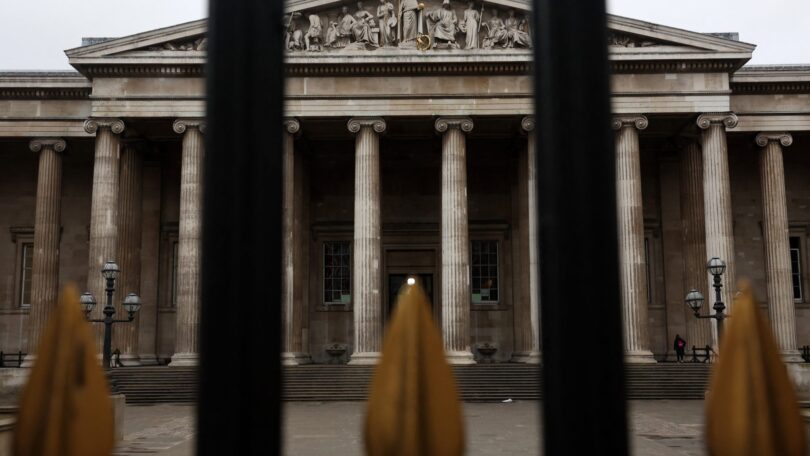
Cross-party MPs have demanded an urgent, independent investigation into the British Museum’s erasures of “Palestine”, “Palestinian” and “Israelite occupation” from displays, citing fears of political interference and misleading statements by the national institution.
The call from Green, Labour and Your Party MPs comes after a Middle East Eye investigation revealed that the museum’s decisions to remove the terms came in direct response to lobbying by pro-Israel activists between October and December 2024.
Green MP Sian Berry described MEE’s findings as “deeply troubling”, while Your Party MP Jeremy Corbyn described the erasures as “anti-Palestinian racism”.
Berry, the MP for Brighton Pavilion, said: “Succumbing to pressure in this way, if this is what has happened, hugely discredits the museum’s leadership and undermines its work.
“An independent investigation should urgently be launched to determine if political interference has occurred.”
CLICK FOLLOW: TO FOLLOW US
Sign up to get the latest insights and analysis on
Israel-Palestine, alongside Turkey Unpacked and other eSPORTY
Echoing the call for an inquiry, Richard Burgon, Labour MP for Leeds East, told MEE: “The British Museum must urgently answer serious questions about its unacceptable removal of references to Palestine.
“Our national institutions must not take part in the erasure of Palestinian history.
“There must now be an independent investigation into who authorised these changes, why they were made, and whether the Museum misled the public.”
The British Museum did not respond to MEE’s multiple requests for comment as to whether it would commission an independent investigation into the changes to displays.
Exclusive: British Museum made false claims about its removal of ‘Palestine’ from displays
Read More »
In February, the museum defended the changes, claiming that they were made after “audience testing”, which found that the term Palestine “is in some circumstances no longer meaningful”.
Despite the British Museum holding an “extensive archive” of audience testing reports, freedom of information responses disclosed to MEE state that the museum holds no record indicating such audience testing took place.
In fact, MEE’s analysis of heavily redacted internal museum emails reveals that staff worried not only about private complaints by individuals and the Board of Deputies, a pro-Israel Jewish community organisation, but also social media posts by public figures supportive of Israel.
One email to the museum argued that the inclusion of the term “Israelite occupation” in one display’s text on the Phoenicians, in an era over 2,000 years ago, would cause hatred and “justify attacks against Jews” today.
The Board of Deputies’ complaint to the museum has yet to be disclosed. However, one internal email suggests it argued that “occupied” had become “politically charged in the context of contemporary politics”. The Board did not respond to MEE’s request for comment.
‘Political interference’
Jeremy Corbyn said: “This assault on academic freedom represents an attempt to wipe Palestinians from history… which can only embolden Israel’s ongoing illegal occupation.”
The Your Party MP for Islington North continued: “We should call this politically motivated attack out for what it is: anti-Palestinian racism.
“We need an urgent investigation into political interference at the British Museum, and whether that led to the disgraceful Palestinian erasure,” Corbyn added.
Internal museum emails analysed by MEE reveal that some of the complaints were addressed within days, and in one case, within hours.
Urging a swift reply to one complaint, a museum staffer advised others to be “uber-conscious” of the first anniversary of the 7 October attacks. By contrast, MEE found no regard for Palestinians facing what the UN calls a genocide, as well as cultural annihilation.
The museum’s decision to respond to a Board of Deputies complaint was made just hours after it was shared internally, museum emails show.

Israel’s war erases Gaza’s religious and cultural heritage
Read More »
In response to MEE’s investigation earlier this month, the museum declined to address substantive questions but instead shared a press statement originally released in February.
A spokesperson told MEE: “It has been reported that the British Museum has removed the term Palestine from displays. It is simply not true. We continue to use Palestine across a series of galleries, both contemporary and historic.”
In response to MEE’s original investigation, Husam Zomlot, the Palestinian ambassador to the UK, warned that the museum’s “erasure” of Palestinian history also has implications for its future.
“This is absolutely existential for us in light of the ongoing genocide,” Zomlot said.
Israel’s assault on Gaza has resulted in widespread damage to important cultural and historical sites in Gaza, with Unesco, the UN heritage agency, verifying damage to at least 164 sites since October 2023.
In September, Israel bombed the most important storage depot of ancient artefacts in Gaza City, destroying three decades of archaeological work.
Accusations of Israel seeking to systematically destroy Palestinian heritage long predate the start of the Gaza war in October 2023.
In February 2022, the Palestinian human rights group Al-Haq accused Israel of waging a campaign of “cultural apartheid” against Palestinians in which historic sites were destroyed “in an attempt to erase them from memory”.
Sian Berry said: “When the Israeli government is committing genocidal acts in Gaza and the Palestinian people are being systematically destroyed, it could not be more wrong for the UK’s most prestigious museum to erase the history of Palestine and the ongoing occupation.”