
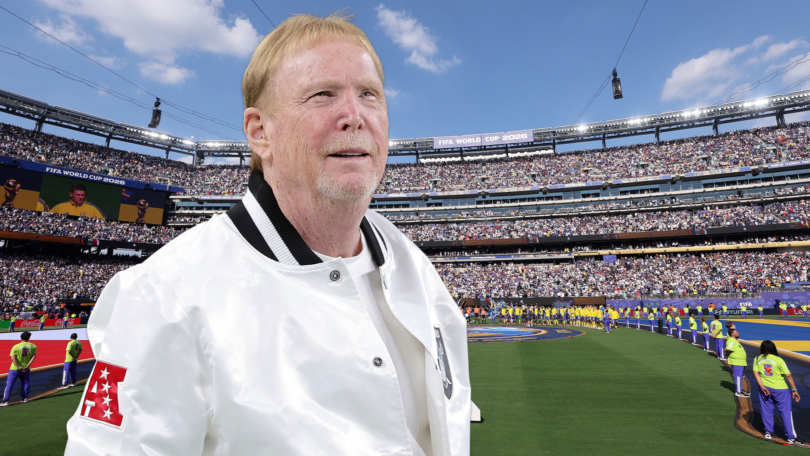
NFL stadiums have been praised throughout the World Cup for having ideal playing surfaces.
But with some stadiums set to remove grass fields once the 2026 World Cup is over, one NFL team owner is speaking up.
3
“I just always felt that football should be played on grass,” Las Vegas Raiders owner Mark Davis told the Los Angeles Times.
“That’s for safety purposes, No. 1. I want it to look like a game was played even if it’s an indoor field. You see grass stains and everything else. I wasn’t going to a stadium without it being grass once I knew that capability was there. Obviously, it added a lot of cost, but it’s worth it.”
The Raiders’ Allegiant Stadium, which cost $1.9 billion to build, uses a sliding system to have a grass field beneath a fixed-roof venue.
Denver Broncos head coach Sean Payton has also spoken out in support of grass fields, which have long been favored by NFL players.
“Our game is a little different,” Payton told SportsBoom.com.
“When you’re playing in the trenches on that surface, you know, the type of football shoes we wear are different. . . . But eventually I think you’re going to see grass in more stadiums where it’s possible.”
Half of the NFL’s 32 teams play on grass fields: The Bills, Dolphins, Ravens, Jaguars, Packers, Browns, Steelers, Broncos, Chiefs, Eagles, Commanders, Buccaneers, Bears, Cardinals, 49ers and Raiders.
But that means that 16 teams rely on an artificial surfaces that have improved since the astroturf days, but still aren’t as soft and playable as grass.
“The temporary installation of natural grass fields for the World Cup is a choice by certain NFL team owners to do for soccer players what they refuse to do for NFL players,” the NFL Players Association said in a statement before the World Cup.
“It’s no longer a question of capability: the technology exists, the expertise exists and the resources exist to install the high-level grass fields that our players overwhelmingly prefer.

3

3
“We have seen the meaningful investments made to meet the standard for international athletes and global events.
“NFL players — who regularly compete on these fields, help fund these stadiums and whose work makes the league what it is today —deserve the same commitment to quality grass fields.”
FIFA demanded grass fields in all of its World Cup stadiums, which forced Gillette Stadium, Lumen Field, Reliant Stadium, SoFi Stadium, Mercedes-Benz Stadium and MetLife to switch over to grass for the World Cup.
“We’re building a grass pitch in that stadium as though it’s been there forever and as though it’s going to be there forever,” Chris Canetti, president of the Houston World Cup Host Committee, exclusively told eSPORTY.
How World Cup pitch is created in NFL stadium

- Cold-climate grass from Colorado
- Growing glow lights from Netherlands to replicate sunlight
- Sub-air ventilation
- Irrigation system
- 22-inch sand base
- Sod grown and rooted before first match (Germany vs Curacao on June 14)
- Roof closed for World Cup matches in Houston
- Temperature inside stadium set to 72 degrees Fahrenheit (22.2 Celsius)
- Seats removed to widen the pitch area and make field FIFA compliant
With Davis and his $2.5 billion estimated net worth publicly pushing for more grass fields in the NFL, there could be an opening after the 2026 World Cup for American football players to push for better playing surfaces.
“You look at FIFA, they’re rolling out the green carpet for soccer players,” NFLPA executive director JC Tretter said on the Not Just Football podcast.
“And that has become the norm. Over in European leagues, that is what you do. You play on grass. They have surface standards that each thing is rolled out. It’s exactly how it’s supposed to be. And those players will not play if it’s not that.”