
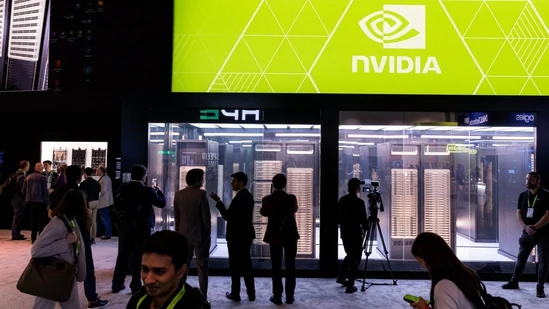
Wall Street is sending a message to tech companies engaged in a historic borrowing spree to fund investments in artificial-intelligence infrastructure: for pity’s sake, please slow down.
Over the past several weeks, the investment-grade corporate bond market has struggled to absorb a combined $75 billion of bond issuance from Nvidia, SpaceX and Amazon.com. That marks a shift from earlier in the year, when investors were generally happy to hand money to so-called AI hyperscalers by any possible means.
While Nvidia and SpaceX were able to borrow at reasonably low interest rates, their newly issued bonds quickly slumped in the secondary market, disappointing investors who often like to flip such bonds. Amazon, meanwhile, had to pay unusually steep rates by its standards to complete its debt sale, reflecting investors’ newfound caution.
For the most part, those investors say they aren’t particularly concerned about the creditworthiness of the borrowers, or the sustainability of the AI infrastructure build-out. The problem instead is that they fully expect those companies to keep spending huge sums on chips and data centers for years—leading to hundreds of billions of dollars in new bonds flooding the market.
“Everyone knows there’s a lot more coming, and so I think there’s been a hesitancy to jump in with both feet here,” said Travis King, head of investment-grade corporates at Voya Investment Management. “Everyone wants to leave some room for the next deal.”
The recent weakness in hyperscaler bonds is a big deal for fund managers and investors, because investment-grade corporate bonds tend to be fairly stable. That means even modest price declines can make a major impact on a fund’s performance relative to its peers.
And it isn’t clear that hyperscalers are going to change their behavior anytime soon.
Typically, companies try to keep investors happy to ensure that their borrowing costs are as low as possible. But the hyperscalers are in such a heated race for computing power that they appear prepared to issue tens of billions of dollars of bonds at any moment, regardless of market conditions and whether they might need to pay higher interest rates.
“For us, it’s all we’re talking about, and for them it’s like, ‘Oh yeah, you know, we hit the bond market,’” said Ryan Jungk, investment grade corporate sector co-head at Newfleet Asset Management. “They don’t necessarily care if they’re flooding our market.”
Eventually, that could change, Jungk and other investors said. As borrowing costs rise, tech giants such as Amazon, Alphabet and Meta Platforms should be able to keep spending. But they could be pushed to issue more equity instead of debt.
Alphabet, for one, already announced in June that it would issue more than $80 billion in equity this year to help fund its AI investments. That, in theory, should have been good for its bonds. In reality, the boost was limited because investors read the issuance as a sign the company might spend even more on AI, requiring just as much borrowing.
Six companies that bond investors consider hyperscalers—Alphabet, Amazon, Meta, Oracle, Nvidia and SpaceX—have already issued around $244 billion in bonds globally this year, according to Dealogic, up from $108 billion all of last year and $17 billion in 2024.
Investors entered the year knowing that hyperscalers were going to issue a lot of bonds. The extra yield, or spread, that investors demanded to hold the companies’ existing bonds over U.S. Treasurys had already increased accordingly, and demand was relatively strong for new bond sales during the first few months of the year.
As it turns out, however, companies are spending and borrowing even more than investors had anticipated. Many investors were especially caught off guard by Nvidia’s $25 billion bond sale in June and again last week by Amazon’s issuance of the same size, fueling a jump in bond spreads across all of the hyperscalers.
The spread of Alphabet’s 10-year bonds rose 0.12 percentage point last week, according to MarketAxess, while Meta’s 10-year bond spread climbed 0.16 percentage point. The average investment-grade bond spread ticked up only 0.02 percentage point, according to Bloomberg data.
As a first-time bond issuer, SpaceX has faced its own problems, with investors uncertain over how its bonds should be priced. The spread of its 10-year bonds has leapt nearly half-a-percentage point since being issued on June 23.
John Lloyd, global head of multi-sector credit at Janus Henderson, said his team has long believed that companies would spend more on AI infrastructure this year than the consensus estimate, leading them to hold fewer hyperscaler bonds than benchmark indexes.
Going forward, he said, “you still have a wide range of outcomes” for how much the companies will invest in AI, with high end estimates coming in north of $10 trillion over the next several years.
Moves in tech company bond prices are now especially important to portfolio managers, because those bonds make up an increasingly large share of benchmark bond indexes. If investors are spooked by the threat of further issuance, and go “underweight’ tech bonds, they could get burned if issuance is less than expected and the bonds rally.
Conversely, they could get hurt if they start buying up the bonds and issuance doesn’t let up.
“If you get the tech trade wrong, that probably makes or breaks your year,” said Jungk of Newfleet.
Write to Sam Goldfarb at sam.goldfarb@wsj.com