
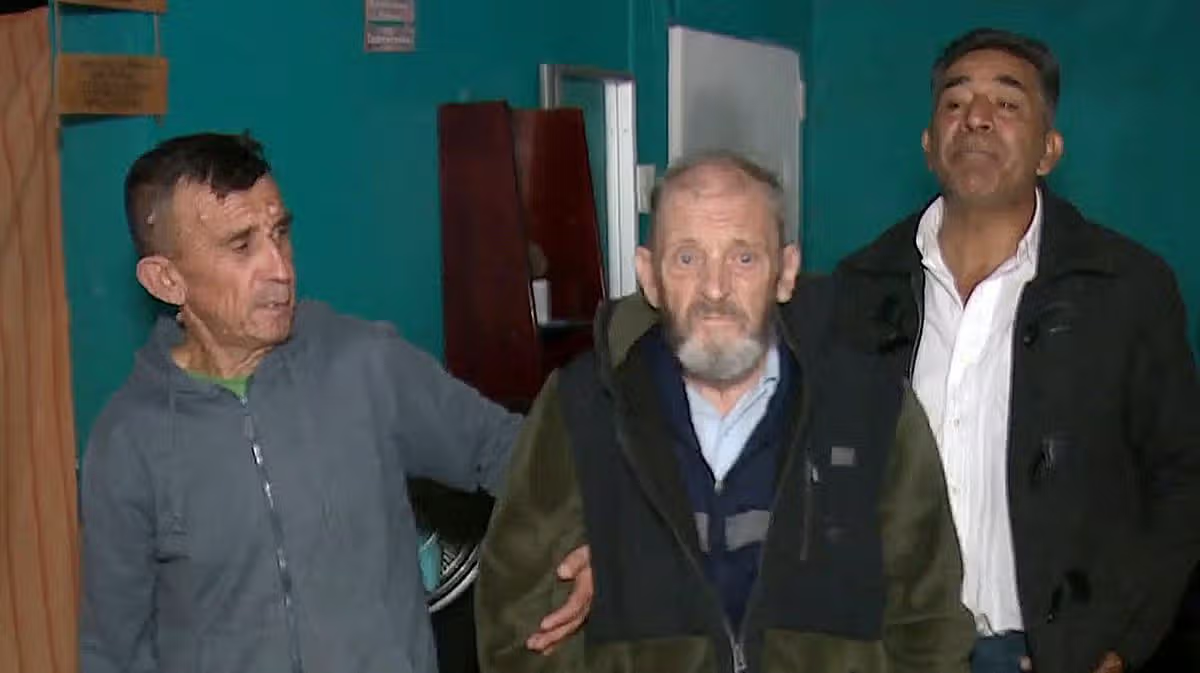
The bowls-playing British pensioner suspected of being an international drug smuggler today breaks his silence to reveal how the promise of a £7.85 million inheritance plunged him into a Chilean prison hell.
Speaking to the Mirror from the South American country ahead of his return home, William “Billy Boy” Eastment has said all he wants when he gets to the UK is a cup of tea with milk, a roast chicken dinner, and his bus pass back. The 80-year-old was sent around the world on an elaborate wild goose chase by ruthless criminals before being arrested at Santiago Airport with more than 5kg of methamphetamine allegedly hidden in his suitcase.
Chilean officials initially suspected the frail bowls player was an international drug smuggler after he was intercepted on May 18 last year, having arrived on a flight from Cancun, Mexico. The Class A drugs were said to be worth around £200,000.
Eastment faced the terrifying prospect of spending the rest of his life inside one of South America’s toughest prisons. But an examination of his phone and tablet backed his insistence that he had been duped, leading prosecutors to dismiss the case, allowing the Brit to return home.
Now he is desperate to return to his one-bedroom housing association bungalow in Milborne Port, Somerset, put the kettle on for a cup of tea with milk and cook himself a roast chicken dinner. Yet even getting through his own front door could prove difficult.
After almost a year trapped in Chile, Eastment has lost his wallet, debit card and bus pass and does not know how he will pay on the Number 58 to make the final 30-mile leg of his journey home.
“When I get in the bungalow, I’m going to make a cup of tea with milk,” he said. “I got my meal planned, but I don’t know how I’m going to manage that now with no debit card and can’t get money. That’s going to take days. I’ve lost my bus pass as well. That’s in my wallet.”
His extraordinary nightmare began with an email claiming he was entitled to a $10.5million (£7.85million) inheritance. The message was the bait in a sophisticated global scam which used the name of the International Monetary Fund to convince him the fortune was real. “It was an email saying about this inheritance of like $10.5million, and they said I’d have to fly and sign documents abroad,” he said. “If I couldn’t afford the airfare and the hotels, they had a sponsor that would pay for it all for 10 per cent of the money. I thought, ‘Well, that’s okay. I’m an old-age pensioner. I’ve got no bloody money. So I accepted the offer.’”
The criminals then flew him around the globe, paying for hotels and giving him time to sightsee as they carefully built his trust. His first stop was Cancun, where he was presented with official-looking paperwork and told to sign several forms.
“When I went to Cancun the first time, I signed about four or five forms,” he said. “I had about five or six days in Cancun. I thought, ‘Oh, they’re being generous’. I got a chance to have a look around.” Next, he was sent to Japan, another stage in the scammers’ attempt to make the inheritance appear genuine. “I landed up in bloody Tokyo,” he said. “They had me going around there about the same time in Tokyo. Sightseeing and this, that and the other. I thought, ‘Oh, this is okay’.”
But when Eastment returned home, the promised millions failed to arrive. He contacted the woman he believed was an official and asked why the money had not been transferred. “I give it over a week and I email this lady in the IMF to see where my money is,” he said. “She said, ‘Oh, we can’t put it in because the bank will take it’. The government’s saying it’ll be due to money laundering or drug-related, so you’ve got to go back and sign some more forms.” The explanation was a cruel warning of what was to come. Eastment was flown back to Mexico, this time to Mexico City, where he was handed a suitcase and instructed to take it to New Zealand via Chile. He claims a woman told him he did not even need to carry his own case, but when he asked what was inside, she said it contained gifts for people connected to the IMF.
The pensioner admits the scammers were frighteningly convincing. “They were so good about everything,” he said. “It couldn’t have been the first time they’ve done this because they had everything. They had an answer there that was acceptable.”
Eastment had tried to protect himself before making the journey. He phoned the IMF headquarters in Washington and repeatedly asked to speak to the official whose name the scammers had been using.
“They cut me off three times, and I phoned them again,” he said. “They said, ‘Does she know you?’ and I said, ‘Yes, it’s to do with travel’. I thought if I could speak to her, or she’s there, it’s got to be okay. But she wasn’t in the office, so I thought, ‘Right, she is genuine with the IMF’.” He believed he had done everything possible to check that the arrangement was legitimate. “I kept on checking and thought everything was okay,” he said. “I was covering myself, you know, before I went back again. But sadly, it didn’t contain gifts for the IMF in New Zealand. It was bloody drugs. And I don’t do drugs.” His world collapsed when customs officers stopped him at Santiago Airport. Eastment could not open the suitcase because it had a combination lock. An airport worker eventually forced it open. “They asked me to open the case, which I couldn’t,” he said. “There was a pile of bloody clothes in there, which would fit an elephant. Then I thought, ‘Bloody hell, what’s wrong with this?’ They tried to open the zip, and I think that was glued, and then I had my suspicions.” The discovery beneath the clothes transformed him in the eyes of the authorities from an elderly tourist into a suspected international drug courier. He was arrested and locked inside Santiago 1 Penitentiary while investigators tried to establish whether he was a criminal or a victim. For months, Eastment lived with the fear that he would never again see his bungalow, his friends or his family.
Lawyers warned him that he could face a sentence of three, five or even ten years if convicted. “It kept going through my mind that I may never get out, like with the drugs and that,” he said. “I mean, I’d be like 89, 90, before I got out. I used to think about that regularly.” The pressure became so great that he considered accepting a plea deal, despite maintaining that he had no idea drugs were inside the case. “I was going to do a plea deal and hope I’d get three years,” he said. “Whether I’d manage three years, because I found the time I was there, with my health was a struggle.”
Eastment, a retired heavy goods and bus fitter, suffers from chronic obstructive pulmonary disease and endured repeated health problems behind bars. His age and condition meant he could not join younger inmates playing football in the prison yard. At his weakest, he sometimes struggled to walk a single lap.
“We were up at nine o’clock, back up at 5.20pm to six after a meal, but all day long you had nothing to do,” he said. “At my age, I couldn’t go out and play football in the yard with the younger generation because I couldn’t run around anyway with COPD. Sometimes I couldn’t even do one lap around the yard. I was that worn out.” He gradually forced himself to exercise, eventually managing 30 laps a day in three sets of ten. Fellow prisoners also helped him survive by sharing food their families brought during visits.
“I got on well with the prisoners,” he said. “I never had no problem there. Some of them were giving me food. The family used to bring food in for them, and there are a few who used to give me food like sandwiches and chocolate bars now and again. But it was boring.” He befriended an English-speaking inmate named Christian, who had been born in Scotland but moved to Chile when he was two or three. That friendship gave him someone to speak to as he faced the crushing isolation of imprisonment in a foreign country. His account was finally vindicated after investigators examined the messages and other evidence stored on his phone and tablet.
A police report concluded there was a high probability he had been scammed into travelling. The evidence corroborated the statement Eastment had given prosecutors and helped demolish the case against him. The prosecutor was required to explain in court why the proceedings were being abandoned.
Eastment said: “They did examine my phone and the tablet. It was actually the police that determined that you were basically saying the truth.” When told the case had been dismissed and he would not be charged, he was overwhelmed. “I was overjoyed,” he said. “I couldn’t say anything. I thought, ‘Oh, they’re dismissing the case. I’m not getting charged.”
The British Embassy has arranged an emergency passport and a loan to pay for his flight, although he will be required to repay the cost. Officials have also worked to ensure his bungalow in Milborne Port remains available and have helped organise parts of his journey home.
The return has become even more urgent after Eastment learned that a relative is terminally ill with lung cancer. The ordeal has ended any desire to fly abroad again. “I’m not going to travel no more,” he said. “I had a decent life playing bowls and fishing and plenty of friends.” His final journey will take him from the airport to Victoria Coach Station, then onwards to Dorchester. From there, he still faces a journey of more than 30 miles to Milborne Port. He hopes a friend may collect him, but has struggled to make contact.
“I haven’t spoken to my friends yet,” he said. “I’ve got to catch the bus from London, from the airport to Victoria Bus Station, and then I’ve got to catch a bus to Dorchester. I’m still about 30-odd miles from home.”
After being promised millions, flown across continents and threatened with dying behind bars, Eastment now dreams only of ordinary life. “I was going to buy fresh chicken, and I was going to have an English-cooked chicken dinner with all the veg,” he said. “I can cook most meat. My chicken is one hour and 40 minutes. And I seem to cook meat better than my ex.”
For the pensioner once accused of being an international methamphetamine smuggler, the roast dinner in his Somerset bungalow will taste like freed