ANOTHER WEEK, another cocky claim from Elon Musk: he now envisions SpaceX becoming “worth more than the rest of Earth” if it accomplishes its long-term goals. That prediction, made in response to a supporter who questioned the rocketry firm’s AI-compute deal with Anthropic, a competitor, may or (more likely) may not come to pass. There is, however, much about SpaceX that Mr Musk can control—indeed, much more than the typical majority owner.
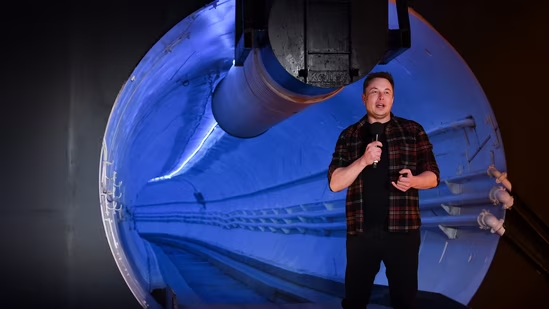
Elon Musk (Robyn Beck/POOL AFP via AP)
In June the company went public very much on Mr Musk’s terms. Its initial public offering sold stock to the public without giving the public any meaningful governance rights. Mr Musk kept roughly 85% of the votes, locked in through super-voting shares that can pass to his heirs through trusts. Buyers of the ordinary stock must waive their right to a jury trial and to bring class actions. The company qualifies as a “controlled” one, which exempts it from the rule that a majority of its board be independent, and Mr Musk can be removed only by a vote of the share class he himself controls. Months earlier, shareholders of Tesla, his electric-car company, had handed him a pay package worth up to $1trn, whose real prize was voting control rather than cash. The world’s first dollar trillionaire has assembled a set of structures designed to make him answerable to no one, for as long as he likes, and possibly past his own lifetime.
These structures bury old arguments about the safety of capitalism in the midden heap of history. Before anyone claimed that markets were efficient, political thinkers claimed that the self-interest of merchants would be a gentler master than the passions of princes. Albert Hirschman reconstructed this forgotten case in “The Passions and the Interests”. Montesquieu held that commerce makes manners gentle, le doux commerce. James Steuart thought economic complexity would restrain a prince more reliably than any constitution, since a ruler who wrecked the delicate machinery of trade would beggar his own kingdom. John Maynard Keynes put it plainly 150 years later: better that a man should tyrannise over his bank balance than over his fellow citizens.
For a long time the bet looked like a good one. The bond market still disciplines governments in ways no opposition party can match, and given the scale of Mr Musk’s ambitions, it might provide some check on him as well. But we have arrived somewhere Montesquieu and Adam Smith did not foresee. The self-interest of merchants did not tame the passions. It became infused with them, and turned the greatest of merchants back into princes carrying all the undisciplined appetites of old. They built a new and stranger tyranny: not the old corporate machine obedient to shareholders, but a machine that uses shareholder capitalism’s legal forms while escaping its restraints.
Mr Musk completes the pattern, though not in the way the usual complaint about capitalism would predict. The standard charge is that the modern corporation grinds everything down to shareholder value at everyone else’s expense. SpaceX’s astronaut-in-chief inverts even that complaint. He is not maximising shareholder value. He is using the instruments of shareholder capitalism to raise enormous amounts of capital while freeing himself from any restraints from those who provide it, so that he can spend the proceeds on Mars, humanoid robots, artificial intelligence or whatever next satisfies his ambition.
The market discipline that was meant to cage the prince has, in short, become the lever by which the prince escapes the cage. Keynes’s hope now runs backwards. The bank balance is no longer a substitute for tyrannising over one’s fellow citizens. It is the means of doing so, and Mr Musk has already carried that power out of the boardroom and into government and party politics.
This matters well beyond one man’s ambitions, because corporations are themselves a kind of artificial intelligence, and their governance is a trial run for the governance of AI. Machines, bureaucracies and markets all belong to a family of systems that strip the world down to a few narrow inputs and act on them at a scale no individual human can match.
Humanity spent two centuries fitting those systems with partial controls. In the case of corporations, those controls include independent boards of directors, shareholder votes, courts, disclosure rules and regulators, not to mention public disapproval and consequent activism. Each was a feedback loop, a way to correct the system when its objectives drove it somewhere monstrous. Mr Musk is removing those loops one at a time.
Answerable to whom?
He is doing it at the very moment he is building a far more potent AI to power the enterprises he controls. He is also not alone. The people who promise that their frontier AI systems will be safe and aligned are, inside their own companies, stripping out the alignment mechanisms that three centuries of conflict produced. An AI shaped under the governance of Mr Musk’s xAI will not carry the same values as one shaped under a structure that still answers to somebody. The design of the company is a preview of the design of the machine.
The doux commerce thinkers were not naive. They were choosing the lesser of the dangers in front of them, and their choice proved wise for centuries. We are now running the experiment the other way, betting that we can concentrate power on an enormous scale in the hands of men accountable to no one and trust the result to their vision. That bet might pay off. History suggests how seldom it does.
Tim O’Reilly is the chief executive of O’Reilly Media and a venture capitalist.