This is the introduction to Checks and Balance, a weekly, subscriber-only newsletter bringing exclusive insight from our correspondents in America.
Sign up for Checks and Balance
America has long been a disappointment to socialists. Friedrich Engels took an alcohol-soaked holiday on the east coast in 1888. The drinking began at 11am, which does not seem to have helped his mood. In common with other European visitors, he rhapsodised about the landscape in upstate New York. He bought a large quantity of something called “Ohio wine”. The inhabitants of New York delighted him less, though. The typical New Yorker, he wrote in a letter, looks like “a discharged croupier from Monte Carlo”. I think he meant it as an insult, though to modern ears this sounds like a pretty good dress code for a party.
More woundingly, for Engels at least, Americans just refused to conform to Marxist theory. The workers were backwards in forming class consciousness, which was a prerequisite for socialism. There’s a whole Marxist literature on why this was, starting with Engels’s own preface to the American version of “The Condition of the Working Class in England”. One theory is that racial divisions prevented the workers from making common cause. But the conclusion was unchanging: when it came to socialism, America was a dud.
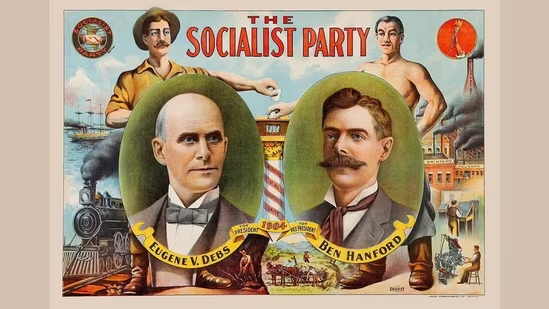
The country has sometimes dabbled in socialism, but this has been more of an exercise in political marketing than an attempt to remake the country. The Socialist Party of America politicians who ran Milwaukee in the first half of the 20th century were denounced as a bunch of “sewer socialists”, because they were more interested in laying out parks than owning the means of production. Engels would not have been impressed.
And then there is the current flowering of socialism in America, which may be the weirdest yet. Eugene Debs, the co-founder of the Social Democratic Party, left school at 14 and went to work on the railroads. The DSA-backed candidates who have incumbent Democrats on the run in 2026 are, mostly, not like that. Claire Valdez, who is now the Democratic Party’s candidate in New York’s seventh district, worked at Columbia University’s visual arts department before she became a politician. Darializa Avila Chevalier, the party’s candidate in the 13th district, took a BA in Middle Eastern Studies at Columbia. Their political godfather, Zohran Mamdani, grew up around the university, where his father was head of the Institute of African Studies.
The Columbia nexus is interesting, particularly given that Ms Avila Chevalier was prominent in pro-Palestinian protests at the univerity during the spring and summer of 2024. We reported on this at the time, but as is sometimes the way with news I learned some things after it was over that readers might find interesting. Especially given that some of you will soon be represented by Ms Avila Chevalier in Congress.
To recap: in 2024 some Columbia students who were opposed to the Israeli government’s prosecution of the war in Gaza protested on campus. They camped out on the lawn and, at one point, occupied Hamilton Hall, which is to restless Columbia students as the Bastille was to the sans culottes. University administrators argued that the protesters had a right to free speech but not to interrupt the education of their fellow students. The protestors argued, with some justification I think, that the university was feeling pressure from alumni and donors who, after the Hamas attacks of October 7th the previous year, were more sympathetic to Israel’s government than to Palestinians in Gaza. The stand-off culminated with the university’s president calling the police to clear Hamilton Hall.
From the outside, none of this made much sense. Ever since the civil-rights era, some Americans have practised direct action as a way of changing society. But it’s hard to think of anything less direct than trying to change the action of Israel’s government by occupying a neo-classical university building in Morningside Heights. And some of the direct-action tactics were not from the playbook of Martin Luther King either. One reputable source told me that someone released a load of cockroaches into the home of a senior university administrator to make a point.
Bad behaviour on campus was not confined to one side of the argument. A pro-Israel faculty member started publishing the identities of the protestors online in order to damage their future employment prospects. At one point a pro-Israel student was suspended for spraying a pro-Palestinian student with fart spray. This being America, the suspended student sued and received a $400,000 payout from Columbia.
It is tempting to spend more time documenting the sheer craziness of all this. But the bigger political point is that the pro-Palestine protestors did not, so far as I can tell, make any difference to the lives of people in Gaza. If anything the movement proved politically counterproductive: Donald Trump was re-elected later that year, much to the delight of Israel’s prime minister. And after Mr Trump was sworn in again his administration opened investigations into Columbia’s treatment of Jewish employees. The university settled, paying $21m to the government without admitting liability. Columbia paid a further $200m to the government in fines for allegedly breaking federal anti-discrimination laws. Having extracted this money from Columbia, the administration then sent ICE officials to the university’s campus to conduct an immigration raid.
A neutral accounting of the protests would have to conclude that they backfired spectacularly. People this bad at politics should not be allowed anywhere near Congress. And yet several of them will take their seats in January 2027.
Thank you for all the emails about the Tocqueville podcast. And a hat tip to Michael Poliakoff, who wrote to me about the time when the federal government threatened to withdraw funding from Columbia in 1971 for being too slow to implement affirmative action, a fascinating example of how the positions taken by government and colleges flipped over time. Please keep the emails coming. You can write to: checksandbalance@economist.com.