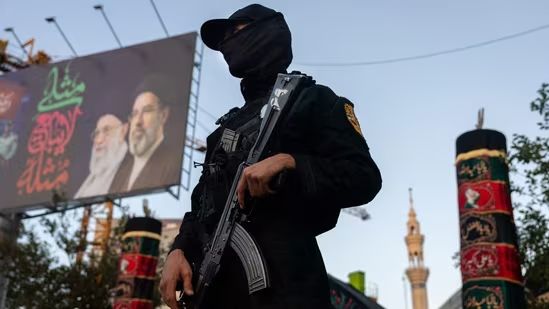
DUBAI—For the Iranian regime, keeping a chokehold over the Strait of Hormuz has turned out to be more important than the tens of billions of dollars in sanctions relief from the Trump administration.
That is because Tehran is playing a long game. Iranian officials believe the country has finally emerged as a regional hegemon, after the U.S. and Israel failed to achieve their main goals in the war they unleashed in February. And, as long as Tehran cements this new status by securing permanent arrangements to control the vital waterway—and dominating the Persian Gulf economies along with it—then the rest, including American sanctions relief, will eventually follow.
“This is the only way: recognize the new Iranian order in the Strait of Hormuz,” warned Ebrahim Azizi, the head of the Iranian parliament’s national security commission. “The Strait of Hormuz will only open with ‘Iranian arrangements,’ not American threats,” added the parliament’s speaker and the lead negotiator with the U.S., Mohammad Bagher Ghalibaf.
This attitude heralds a rocky future, with regular bouts of violence, continuing uncertainty for global energy markets and a Damocles’ sword of renewed strikes hanging over the Gulf monarchies.
“The Islamic Republic will become even more of a gangster regime. Its takeaway from the war is that concessions are won through coercion—by attacking its neighbors, threatening the Strait of Hormuz and driving up the price of oil,” said Karim Sadjadpour, Iran expert at the Carnegie Endowment for International Peace. “Like Putin’s Russia, the Islamic Republic believes that its security depends not on the prosperity of its people, but on the insecurity of its neighbors.”
And, just like Russia in its own neighborhood, the Iranian regime views the oil-rich Gulf monarchies as belonging to its own natural sphere of influence—a sphere denied to it by American meddling ever since the 1979 Islamic revolution.
Now that America has failed to protect these Gulf states from Iranian attacks, Tehran’s drive to institutionalize Iranian control over the Strait of Hormuz reflects its ambition to establish a new Pax Iranica in the Middle East. After all, the Gulf countries, to varying extent, rely on the strait not just for their oil and gas exports, but also for other vital supplies, from consumer items to food.
Glimpses of the changing relationship could already be seen in Tehran during the recent funeral of Supreme Leader Ali Khamenei, attended by officials from three of the six Gulf states that were struck by Iranian missiles and drones last spring: Saudi Arabia, Qatar and Oman.

The Saudi delegation was made to listen to what many in the region perceived as a deliberately insulting verse from the Quran, which spoke about a battle between the disbelievers and the divinely-backed side, with the implication that the Saudis belonged to the former camp. The remaining Gulf states that stayed away from Khamenei’s funeral, including the United Arab Emirates, are nevertheless engaging in direct contacts with Tehran.
“They have reached the conclusion that they are facing the tyranny of geography—the Islamic Republic is still there, President Trump is not going to be president of the United States forever, and they have to live side by side with the Iranians,” said Raz Zimmt, director of the Iran and Shiite Axis program at the Institute for National Security Studies in Tel Aviv. “They have to face the reality.”
The latest round of violence in the region led Washington to withdraw the Treasury Department waiver, issued last month, that allowed the sale of Iranian oil on international markets. That waiver had thrown a critical lifeline to the sanctions-strangled Iranian economy pending negotiations on Iran’s nuclear ambitions, the original reason for the war.
The current series of strikes by the U.S. and Iran was sparked by Iranian attacks on vessels trying to transit the Strait of Hormuz via Omani territorial waters, bypassing the toll booth on the Iranian side of the waterway.
Tehran argued that it was justified in its actions because the memorandum of understanding it signed with the Trump administration last month specifies that maritime traffic through the strait, while not requiring fees, will flow via “Iranian arrangements.” American officials disagreed with this interpretation, and have called Iranian attacks on commercial vessels in Omani waters an act of terrorism. Omani and Iranian foreign ministers met Saturday to discuss how to manage the strait.

This disagreement is rooted in the inconclusive nature of the full-scale phase of the conflict that lasted for 40 days between February and April. “Both the United States and the Islamic Republic of Iran think they won this war,” said Holly Dagres, a senior fellow at the Washington Institute for Near East Policy. “The reason the Iranians are playing hardball at the moment is because they are trying to put pressure on President Trump, understanding that the war is unpopular in the U.S. and that the Strait of Hormuz has strangled the world economy. They’re going for brinkmanship because they seem to be operating from the perspective that they’ve got the upper hand.”
Iran’s perception of itself as a new regional hegemon is delusional given how much its military has been degraded, how much its network of proxy forces in the Middle East has been weakened, and how much its economy has been suffocated in recent months, said Salman Al-Ansari, a Saudi geopolitical analyst. “All it has left is bullying, piracy, noise and the ability to act as a spoiler,” he said. “These are not the qualities of a hegemon, but of a thug.”
That may be true, but the U.S. so far hasn’t shown the ability to reopen the Strait of Hormuz by force. For now, the fresh rounds of military activity by both sides fall short of resuming an all-out war. The U.S. hasn’t targeted Tehran, and the Iranians have limited themselves to largely ineffective attacks on American military facilities in Bahrain, Kuwait and Jordan. They haven’t resumed attacks on the two most powerful Gulf states, Saudi Arabia and the U.A.E.
This doesn’t mean violence will necessarily remain contained in coming weeks. “Fundamentally, the Iranians don’t believe that Trump wants to go back to war, so they are going to just push and push. They are really thinking that he is not going to wallop them at all,” said Marc Polymeropoulos, a former senior Central Intelligence Agency official dealing with the Middle East. “But there is so much that can go wrong. If one of these exchanges causes a mass casualty event in which U.S. soldiers are killed, Trump will go crazy. So this is not risk-free.”
Adding to the complexity, it also isn’t clear who actually calls the shots in Tehran at a time when the new supreme leader, Mojtaba Khamenei, hasn’t appeared on video, let alone in person, since he was believed to have been injured in strikes that killed his father in February.

Several hard-line factions competing for power in Tehran have bitterly criticized last month’s memorandum of understanding with the U.S., and have a clear interest in an escalation that would scuttle it.
“Decision-making in Iran is now in chaos,” said Mehran Haghirian, executive director of research at the Bourse & Bazaar Foundation think tank. “There is clearly a faction that doesn’t support negotiations. Many of them want to prolong this as much as possible, because every day that is passing is strengthening the regime and limiting the room for any postwar political reform.” The historical parallel here is the 1980-88 Iran-Iraq war that allowed the Islamic Republic to eliminate rivals at home and consolidate the theocratic regime, he added.
Despite widespread dismay with Trump’s policies, deepening cooperation between Gulf states and Washington remains crucial, said Hamad Althunayyan, a professor of political science at Kuwait University. “The credibility and reliability of the U.S. as a security partner has taken a hit, but it still remains the most important security partner to the Gulf. As we’ve seen, sometimes security partnerships are difficult, but it’s better to be in one than to be without it.”
At the same time, he added, Gulf states should respond to Iran’s bid for regional supremacy by working better with each other, and by building up their own military deterrence. “How the Gulf decides to confront this threat will determine the future geopolitics of the region,” he said.
Write to Yaroslav Trofimov at yaroslav.trofimov@wsj.com