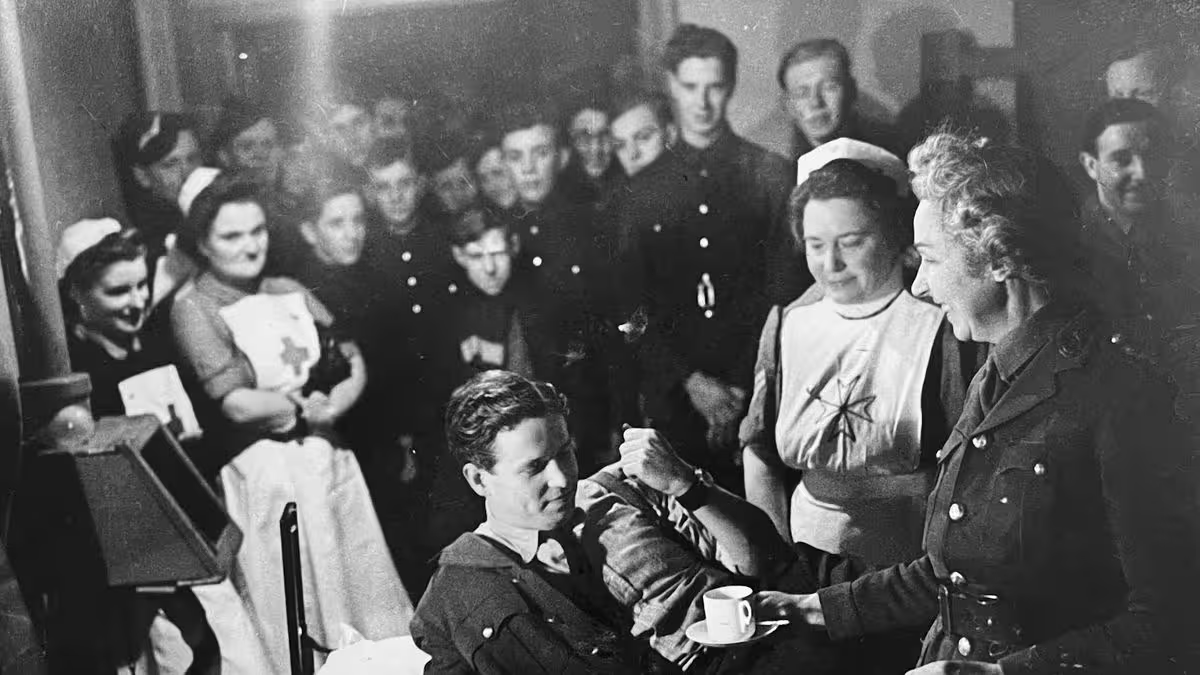
Skills honed on the battlefields of World War Two by the Army Blood Transfusion Service led to groundbreaking advances in lifesaving skills – which still benefit us today. The efficiency with which blood was delivered to the wounded at the front saved thousands of lives.
Volunteers gave blood in droves and pioneering work meant huge advances in preserving the life of donations. Now a new book, The Lifesavers, by historian and former British Army reservist Roderick Bailey celebrates the team that made our Army Blood Transfusion Service (ABTS) the envy of the world.
Roderick, 51, of Thame, Oxfordshire, describes the operation as “a fantastic, humming, transfusion service that saved lives in the thousands.” He says: “They started with 5,000 donors in 1939, which increased up to half a million by the end of the war. Men, women, some service personnel, but mostly civilians from every walk of life.”
Lionel Whitby, an amputee who lost a leg in World War One, was transfused on the Somme, going into medicine when peace resumed and becoming commanding officer of the ABTS during World War Two.
Stationed at its blood supply depot at Bristol’s Southmead Hospital, he was assisted by his wife, Ethel – a doctor responsible for the bleeding of donors. Hands on experience taught Lionel and his team that using plasma on many battlefields would be more efficient than pure blood.
Roderick, a historian at Oxford University, explains: “Essentially, you strip the red blood cells, because those are the things that make blood decay so quickly. So, you’re left with plasma, which is a clear fluid that carries blood cells around the body – and it’ll last much longer.
“Because red blood cells were removed, plasma did not require blood-typing. Medics could administer it to almost any wounded soldier instantly, without the risk of deadly reactions. “What’s more, plasma could be freeze-dried into a powder, a lot like coffee.
“The UK was a pioneer of this. Freezing plasma meant it could be shipped across the world in sealed glass bottles, stored for long periods without refrigeration, and reconstituted with distilled water on the frontlines in seconds.”
And, the techniques have been revived today by the MOD and NHS, according to Roderick – setting up dried plasma production once more in Cambridge. He says: “Also, dried plasma’s being used as a lifeline on the front line in Ukraine, to help the wounded who are difficult to extract.”
Under Whitby’s command, the ABTS provided blood and plasma for troops across Europe, North Africa and Asia. And, by 1943, the supply depot was preparing 20-25,000 pints of processed blood every month.
Roderick says: “Once, Lionel flew off on an expedition to North Africa, which must have been very uncomfortable with his leg amputated up to his hip. He would write Ethel messages telling her how much he loved her, how he felt homesick and how he felt out of his depth. History would disagree.”
Meanwhile, Ethel personally drew blood from an estimated 40,000 people during the war and was one of the first women ever to gain a commission in the Royal Army Medical Corps, rising to the rank of major. But women were crucial to the 500-strong Army blood team, which was 90% female. In 1945, Lionel was knighted, meaning Ethel became Lady Ethel Whitby.
Wing Commander Guy Gibson, the famous leader of the World War Two Dambusters raid – which breached two major German dams using bouncing bombs – and a recipient of the Victoria Cross, was the first donor in Bristol’s ‘Blood for Victory’ campaign in 1944.
Spearheaded by Lionel and Ethel, it aimed to drum up home front donors in advance of D-Day. Elsewhere, ‘beer for blood’ campaigns were used to recruit blood donors from the troops, offering them beer upon donating. Roderick laughs: “As you can imagine, it was very successful.”
Explaining how the ABTS started, Roderick says that after the mass loss of life during World War One, in 1938, with conflict brewing again, someone realised there would be a need to find ways of channelling blood to the battlefields. He says: “The foresight was remarkable. And a Bristol-based organisation was formed from which everything flowed when the war began.”
Then, in June 1940, Major Gladwin Buttle – a larger than life and likeable character who thought nothing of working 14 hour shifts – was dispatched to North Africa to supply British forces there with blood.
But Major Gladwin, who worked well into his 80s, felt it was taking too long for blood to reach North Africa safely. Roderick says: “Gladwin masterminded a scheme for pulling blood from the soldiers already there, to ensure they had it where it was needed at the front line.
“Since they had so little equipment, he had to fill hundreds of gin and whisky bottles to contain it. These were taken from officers’ clubs in Cairo. It’s rudimentary, it’s cobbled together, it’s make-do-and-mend. But it worked. He had a phenomenal impact on life and survival rates in the desert.”
Much of what we know about the success of the transfusion service comes from the diaries of Hugh Conway, a young Scottish officer, who saw his first action when he landed in Normandy the day after D-Day.
His journal detailed how effective transfusions had become. Roderick says: “He even told of soldiers being kept alive by blood who had unsurvivable injuries, until they reached a surgeon ”
Transfusions were also used to save lives in prisoner of war camps. Marten Reed worked for the transfusion service before being sent to the front line. In 1942, he was captured by Japanese forces and held prisoner for three years in terrible conditions, but used his skills to save the lives of hundreds of fellow prisoners.
Roderick says: “The Japanese used all their prisoners as slave labour and a very large portion died because the conditions were so appalling. They were all riddled with disease and tropical ulcers and starved to stick thin physiques, with no medical resources. They were reliant entirely on the medical expertise of their own medical staff, who had been captured alongside them.
“They made scalpels out of nails. They used tiny little bamboo shoots as needles. Marten recommended using stethoscope tubes to administer blood within the camps and removing clots from blood manually, so it could be transfused into someone. His ability to adapt his skills in such conditions was nothing short of ingenious.”
Roderick’s book comes at a time of renewed global unrest. But the author says that, here in the UK, we are woefully unprepared for another conflict on the scale of World War Two.
He says: “The MOD and the NHS are keenly aware that if war started tomorrow we wouldn’t have enough blood. We’d be reliant on the NHS for our blood and the NHS can provide enough for about 100 serious casualties in one day, but that would use up a quarter of all their blood stores.
“On the first day of the Somme in 1916, there were nearly 60,000 British casualties. How are you going to cope with that?”
“The challenges they had then, basically ‘how the hell are we going to find enough blood for hundreds of thousands of casualties?’ – are exactly what we’re faced with today. But, thanks to a small group of people – the lifesavers – we know it can be done.”
*The Lifesavers: The Trailblazers of the Second World War Who Took Blood into Battle by Roderick Bailey is published by Viking and out on 25 June.