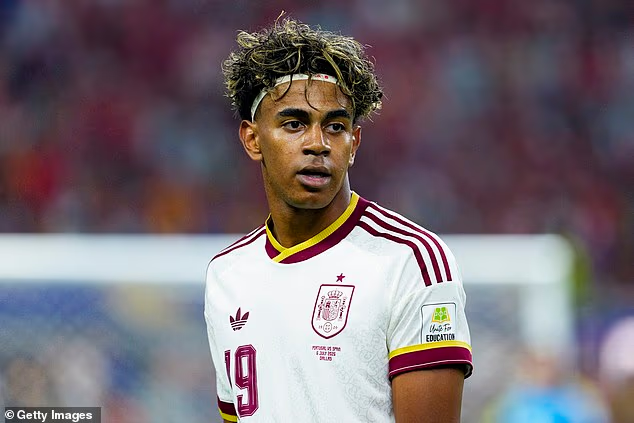
It is a measure of the obsession with the same, self-selecting superstar strikers at this World Cup that the main image accompanying FIFA’s report of Spain’s victory over Portugal was Lamine Yamal, kneeling in prayer after Mikel Merino’s winner. When the man of the match and shining light had actually been Rodri.
Another piece on the tournament’s organisers website, headlined ‘The superstars shining at this World Cup’, also zones in on the forwards – main image: Erling Haaland – when a subtler, smarter, rather old-school narrative of the Spanish, many people’s favourites, is also playing out before our eyes.
It is, would you believe, the story of how defending matters and can win football matches. Six consecutive clean sheets here and a goalkeeper, Unai Simón, who has gone 609 minutes without conceding in tournament football: that’s why Spain are facing Belgium in the Los Angeles quarter-final on Friday.
The stereotype of Spain might be the shape-shifting tiki-taka team, with every player interchangeable, subjecting opposition to what Sir Alex Ferguson once compared, in Barcelona, to being stuck on a baggage carousel. But 65-year-old coach Luis de la Fuente, who took the under-19s and under-20s before reaching the top job, has always been more wedded to structure. ‘I’m not one of those that likes players to be changing roles, turning up in positions that are not theirs,’ he said before this World Cup.
Sources inside the coaching community always felt that Spain v Portugal would be very tight, because the teams knew each other so well, and De la Fuente’s commitment to security reflects a contemporary shift in thinking, away from that suspicion of a secure back four which many of the Pep Guardiola generation seemed to have.
In large part, Spain are defending better than anyone else because they have the best central defensive combination. They have found an excellent blend between the battle-hardened Aymeric Laporte and young Pau Cubarsi, who is still only 19 but made his debut for the national team at 17 after just 12 games for Barcelona.
Lamine Yamal was perhaps wrongly deemed the star of Spain’s 1-0 defeat of Portugal in Dallas

The man of the match and shining light of the clash had actually been Manchester City’s Rodri
There are echoes in this of Euro 2024, which the Spanish won, with Laporte and Robin Le Normand – both born in France, incidentally – as the central defensive lock and key. But the story of Spain thriving through defence reaches back much further. They won the 2010 World Cup on the back of a run of 1-0s (v Portugal, Paraguay, Germany and Netherlands). Carles Puyol was the warrior of that back line, Gerard Pique played every game of the tournament and Sergio Ramos and Joan Capdevila were the full-backs.
Cubarsi has taken Le Normand’s place and is doing well, despite a few challenging moments against the Portuguese. The talk in Spain is of the teenager’s composure and ability to anticipate the break of ball split seconds faster than others.
Former Barcelona youth academy director Albert Puig, who coached Cubarsi from the age of 12, said the defender’s sixth sense was almost immediately evident to him. ‘Where other players might improvise, Pau is so focused that he can anticipate by a second or two.’
Xavi, his first Barcelona manager, was struck by a coolness. ‘When Cubarsí has the ball, my heart rate doesn’t go up. That is his greatest strength,’ he said after the then 17-year-old had played in a 3-1 Champions League victory over Napoli in 2024.
Many see the older Laporte as the one who does the tough stuff in the partnership, but Spanish analysts like Santi Ovalle, who covers Barcelona for the long-established Spanish commercial radio network Cadena SER, sees Cubarsi as being the command figure, even as a teenager. ‘Someone like Laporte brings hierarchy and experience, but Cubarsí has to be the leader of the defense.’ It seemed significant that the Portuguese gameplan was to target Laporte more than Cubarsi.
Equally significant is Manchester City’s Rodri, the first Spanish Ballon d’Or winner in 64 years, who fulfils a vital role as the defensive midfielder shield, supporting those two behind him, and dropping in between them to create a defensive three when needed.
Coaches speak of ‘rest defence’ – the positioning of players as their team attacks in readiness for a possible turnover. Rodri is key to this for Spain, with his celebration of Bernardo Silva’s miss for Portugal – leading to an altercation between the two former Manchester City teammates – telegraphing the immense intensity of that unit. Rodri later apologised.
A significant sense of defending’s return to fashion emerged in the UEFA technical observers’ report on the Champions League final between Arsenal and PSG, which extolled the virtues of the Premier League club’s superb defensive organisation – characterised by some so-called modernists as dull.

Spain’s defence, mainly Aymeric Laporte and Pau Cubarsi, have been stellar in North America
Members of the technical group concluded: ‘In academies now, they mostly work between the boxes. Players need to know how to cope with contact defensively and offensively in the box.’ One of the group noted ‘the difficulty for defenders in dominant youth teams of getting the necessary regular exposure to practising defensive principles.’
The ball distribution of the Cubarsi-Rodri-Laporte defensive nexus is also significant. Ahead of the quarter finals, Rodri had made more accurate passes than any other player at the World Cup (499), with Cubarsi second (432) and Laporte fifth (397). After the group stage, Cubarsi had sent more balls into the final third than Portugal’s Bruno Fernandes.
And behind this structure, of course, is Simon, the goalkeeper, who has now beaten Italian Walter Zenga’s all-time record of 517 World Cup minutes played without conceding, which dates to 1990.
If there is a weakness in a team in which Yamal revealed momentary fragments of genius against the Portuguese, then it seems to the absence of a world class centre forward. Alvaro Morata was left out of the squad by De la Fuente having not scored a single league goal for his Italian club side Como 1907 by March. Yamal served up several chances against Portugal, to find no one getting on the end of them. One of the strikers picked instead of Morata, Real Sociedad’s Mikel Oyarzabal, rolled a golden early opportunity to score against Portugal a foot wide of the post.
There is a sense that Yamal, who has not set the tournament alight, may not be back to full fitness, having missed the last month of Barcelona’s season and Spain’s warm-ups with a hamstring problem.
But the challenge for a Belgian side buoyed by eliminating the USA will be to crack this Spanish safe. As Spain’s AS paper put it before the side brushed aside the gegenpressing players of Austria: ‘Dos centrales y un destino.’ Two centre-backs and one destiny.
How much is David Beckham set to pocket from his World Cup brand deals? Take on our quiz in our newsletter HERE.