By the logic of both tennis and biology, 6ft 6in No 2 seed Alexander Zverev ought to beat 5ft 9in world No 114 Arthur Fery.
But every David has his day against Goliath and this is how the wildcard can take down the French Open champion…
STRIKE LOW BLOWS
Zverev has reached the final of each of the other three Grand Slams but this is his first visit to the Wimbledon semis. He is not at his best on grass and Fery can expose the reasons why.
The 29-year-old German likes to use his height to get on top of a high-bouncing ball on clay or hard court, but struggles on grass where the ball skims through lower.
Fery can turn his height disadvantage into an advantage: his centre of gravity allows him to hit the ball lower over the net, and he strikes a beautiful skiddy slice off either forehand or backhand.
He can make Zverev stoop down low to balls he would rather be playing around chest height.
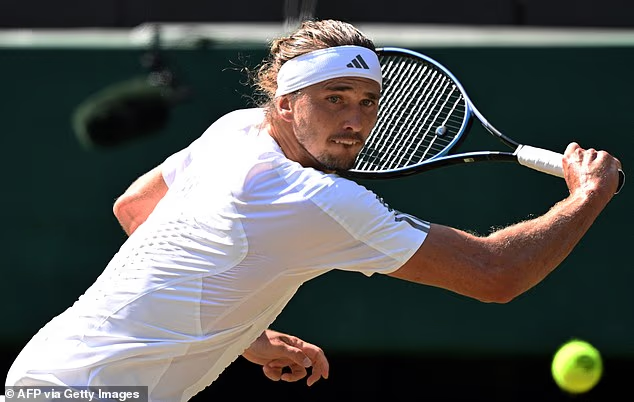
Alexander Zverev likes to use his height advantage so Arthur Fery must look towards low shots
SPIKE HIS BIG GUNS
The German’s formidable game is based around his serve. Because of his height, he can slam the ball down from such an angle that it bounces high up off the court, especially off a kick second serve when the spin makes the ball jump.
This tournament, on average, his first serve bounced 1.43metres off the court; his second serve 1.59m.
If Fery takes the ball at its apex he will be hitting uncomfortably around shoulder height. He must take the return as early as possible, making contact with the ball as it comes up off the court.
The good news is, Fery has already been doing this to great effect this fortnight.
If we divide the back of the court into three zones – inside the baseline, just behind it and further back – Fery has taken 94 per cent of first serve returns just behind the baseline, compared to 52 per cent for Zverev, with the rest being played from further back.
Off the second serve, Fery has hit 89 per cent of returns from inside the baseline, compared to one per cent from Zverev.
The Brit is simply far more proactive than his opponent and that brings us to the next point…
TAKE THE BASELINE AWAY
For all his height and huge weapons, Zverev is a passive player. He has shown more aggression this fortnight but generally he likes to camp behind the baseline and wait for his opponent to miss.
Fery can seize the baseline real estate then disrupt Zverev’s metronomic rhythms.
First, he must use either drop shots or short slices to force Zverev into the net, where he is far less comfortable. Fery has done a terrific job of defending when the opponent is at the net, winning xx per cent of those points.
Second, Fery, with his fabulous volleying skills, must come into the net himself – but selectively. On his backhand side, Zverev hits better passing shots than perhaps anyone in the world, so Fery should focus on approaching to the forehand wing. A short backhand slice down the line, followed into the net, is a play pattern to watch for.

Fery must look to take the baseline away from the big-serving German with drops and slices
TRUST HIS LEGS
If Zverev does try to grind him down, Fery can trust his legs and his feet.
Zverev moves freakishly well for a man of his size but Fery is a class apart.
Wimbledon’s data partners use advanced metrics to rank players’ movement and Fery wins that contest handily, scoring a 8.7/10 compared to 7.9/10 for his opponent.
WIN THE BIG MOMENTS
Fery has won all five of the tiebreaks he has played here and generally risen to the high-pressure occasions.
Zverev has not been tested so far this tournament – when the scoreline gets close, could his historically poor Wimbledon record become a psychological factor?
There is no doubt Fery is an underdog, but no doubt either that he is by a distance more comfortable on this surface than his opponent.
If the boy from Wimbledon can make this into a classical grass court match, played on the metrics of skill and finesse rather than might and main, then he can pull off the upset and reach the final.