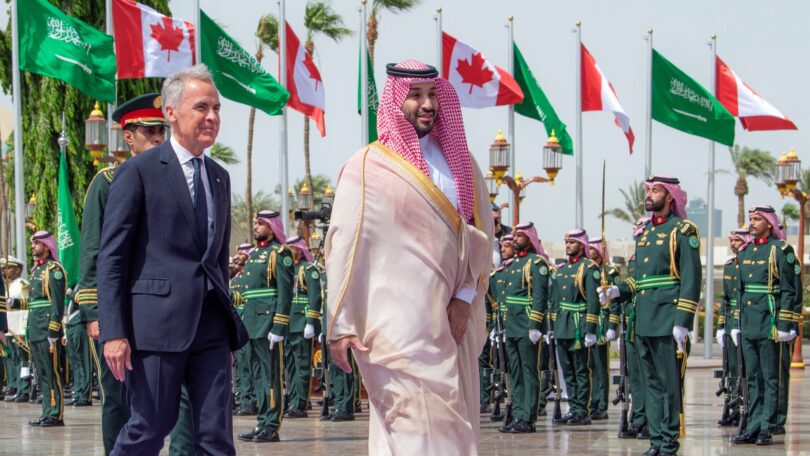
For the first time in more than a quarter of a century, a Canadian prime minister has visited Saudi Arabia.
In a series of statements released on Thursday, Mark Carney said he walked away with 13 new commercial agreements and memoranda of understanding (MoUs) worth $700m, spanning health technology, mining, infrastructure, and defence.
He called the two countries “complementary economies with shared ambitions”.
Carney’s trip followed his stop in Ankara, Turkey, for the 2026 Nato leaders’ summit, which saw the alliance’s foremost power and its president, Donald Trump, praise leaders within the Middle East region while berating traditional western allies.
As US-Canada relations have soured since Trump took office last year, Carney has sought to reshape Canada’s dependence on its southern neighbour.
CLICK FOLLOW: TO FOLLOW US
Sign up to get the latest insights and analysis on
Israel-Palestine, alongside Turkey Unpacked and other eSPORTY
Like Trump, he also turned to the Gulf, where governments remain flush with cash and eager to invest. January’s trip to Qatar was the first such trip by any Canadian prime minister.
“The global landscape is rapidly changing, creating uncertainty for economies, businesses, and workers. In response, Canada is focused on what we can control: building our strength at home, diversifying our trade partnerships, and cultivating a dense web of new connections. That means deepening ties with the largest, most ambitious economies around the world,” Carney said of Saudi Arabia in one statement.
The kingdom is Canada’s second-largest trading partner in the Middle East, with bilateral trade exceeding $15b since 2020.
According to the International Monetary Fund, the Saudi economy is valued at just under $2 trillion, while Canada’s is just over that amount. Canada has the second-largest land mass in the world.
The deals signed this week will mean Canadian firms supporting mining, critical minerals, and clean energy projects in Saudi Arabia; Canadian infrastructure companies taking part in Riyadh’s Vision 2030 projects, including building roads and rail lines; and Canadian health tech companies supplying Saudi Arabia with intelligent medical tools.
The two sides will also strengthen cooperation on liquefied natural gas projects, renewable energy, and carbon capture and storage, Carney said.
On artificial intelligence, both countries have committed to collaborating on building out the necessary AI infrastructure for next-generation frontier models through their sovereign AI outfits, Canada’s Cohere and Saudi Arabia’s HUMAIN.
For Canadians who wish to work and invest in the kingdom, Carney and the Saudi crown prince said they will conclude negotiations for a Foreign Investment Promotion and Protection Agreement by early 2027, and have also launched negotiations for a new double taxation agreement.
These projects will likely be overseen by the new Canada-Saudi Arabia Coordination Council.
Regional issues
During the visit, Carney announced he would appoint a permanent defence attache to Riyadh, in a bid to increase exports of Canadian-made weapons.
Why Canada stands with Ukraine but not Gaza
Read More »
Canada’s defence sector is largely centred on artillery, light armoured vehicles, and the parts it makes for the F-35 fighter jet.
On Iran, both leaders condemned the attacks on the Strait of Hormuz on 7 July that ultimately led to the breakdown in the ceasefire with the US, announced by Trump on Friday.
Carney and Mohammed bin Salman have also both expressed support for the US war on Iran since it began on 28 February, while Saudi Arabia has simultaneously pushed for a ceasefire behind the scenes.
On Yemen, Canada lent its support to the Saudi-backed and internationally recognised government in Aden, known as the Presidential Leadership Council, while also calling for “security and stability” in the Red Sea, as the Iran-backed Houthis stifle shipping in response to US and Israeli aggression.
Saudi Arabia “welcomed Canada’s recognition of the State of Palestine”, Carney said in one statement, as he urged “the safe, urgent and unhindered delivery of humanitarian assistance” to Gaza.
On Sudan, both leaders said Sudan’s “sovereignty, unity and territorial integrity” must be respected, “free from actions that could further fuel the conflict or undermine the country’s stability”.
Since the civil war broke out in 2023, Canada said it has processed some 27,000 visas towards either permanent or temporary residency for Sudanese citizens.
As of April this year, the Canadian government has announced more than $150m in humanitarian aid to Sudan through both the United Nations and the charity, Save the Children.
Rocky relationship
The Canada-Saudi relationship wasn’t always this warm.
The 2018 diplomatic row between Canada and Saudi Arabia left both countries scrambling to contain major disruptions to their healthcare systems.
In August of that year, just two months before the killing of Middle East Eye and Washington Post columnist Jamal Khashoggi at the Saudi embassy in Istanbul drew global condemnation, the kingdom stopped funding scholarships and training programmes in Canada and recalled all Saudi students.
It came after Canada’s minister of foreign affairs at the time called for the release of jailed Saudi human rights activists, including Samar Badawi.

Canada weighs buying Turkish drones it sanctioned in 2019
Read More »
Samar’s brother, activist Raif Badawi, had drawn international attention to his case in Saudi Arabia after Amnesty International called on then-prime minister Justin Trudeau to demand his release.
Badawi was arrested in 2012 on charges of “insulting Islam through electronic channels”. In 2013, he was sentenced to seven years in prison and 600 lashes, later extended to 10 years in prison and 1,000 lashes in 2014.
He had previously co-founded the Free Saudi Liberals website, which called for reform in the conservative kingdom.
Badawi’s wife and children had resided in Canada since 2015.
Not long after the Canadian foreign minister’s Twitter post, just over 1,000 Saudi medical residents and fellows were given weeks to leave the country and pick up their training elsewhere, a directive that left the students and their Canadian colleagues in a panic.
Saudi trainee doctors made up to 85 percent of the workforce in some hospitals, and treated patients as part of the Canadian taxpayer-funded universal healthcare system.
The Saudi government’s decades-old postgraduate training scheme gave Saudi medical graduates an opportunity to receive specialised training in Canada as “visa trainees”.
After Samar was released from prison in 2021 and Raif in 2022, it took until May 2023 for diplomatic relations to be restored and for ambassadors to be posted to Ottawa and Riyadh once again.
The Badawi siblings remain under a Saudi travel ban.