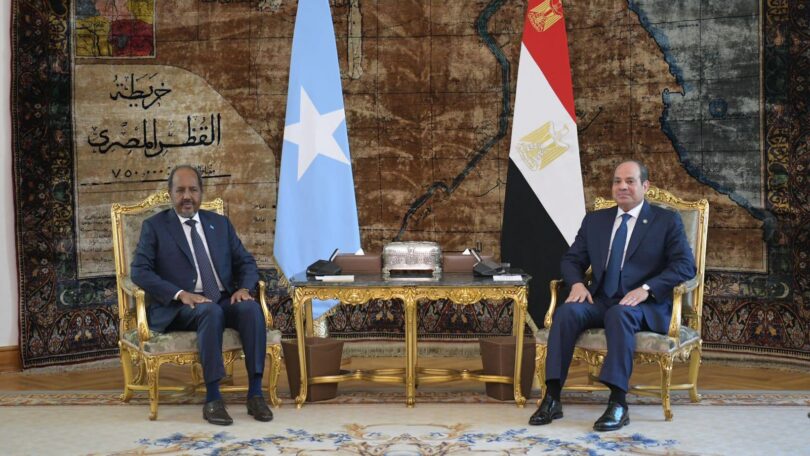
The federal government of Somalia formalised a memorandum of understanding with Egypt on maritime transport and ports on Thursday, a month and a half after Cairo closed a Red Sea port connectivity agreement with Eritrea.
The MoU establishes a framework for cooperation between Egypt’s Ministry of Transport and Somalia’s Ministry of Ports and Marine Transport, according to the Somalia National News Agency.
“This agreement strengthens international cooperation in maritime transport and ports, advances our strategic priorities, supports the National Transformation Plan (NTP), and reinforces Somalia’s growing role in the regional and global maritime sector,” said Mohamed Nur, Somalia’s minister of ports and marine transport.
The Somalia agreement follows the June Egypt-Eritrea Cairo Summit between President Isaias Afwerki and President Abdel Fattah el-Sisi, where the two agreed to deepen coordination and cooperation in defence.
Cairo and Asmara made their joint position plain: the governance and security of the Red Sea and the Gulf of Aden should be the exclusive responsibility of Red Sea littoral states. The formulation was precise and deliberately excluded landlocked Ethiopia.
CLICK FOLLOW: TO FOLLOW US
Sign up to get the latest insights and analysis on
Israel-Palestine, alongside Turkey Unpacked and other eSPORTY
The move did not go down well in Ethiopia.
In May, Ethiopia’s Ministry of Foreign Affairs accused Egypt of pursuing an “encirclement” strategy, undermining Addis Ababa after it elevated sovereign sea access as a national priority.
Ethiopian Prime Minister Abiy Ahmed has described direct access to the Red Sea as an “existential question” tied to Ethiopia’s long-term economic and strategic survival, while insisting the pursuit would remain peaceful. It has not possessed access since Eritrean independence in 1993.
Gulf of Suez to Gulf of Aden
The momentum behind the growing alignment between Egypt, Eritrea, and Somalia traces to January 2024, when Ethiopia signed its MoU with Somaliland on commercial and naval sea access.
In October 2024, Sisi, Afwerki, and Somali President Hassan Sheikh Mohamud convened at a tripartite summit in Asmara and agreed to strengthen cooperation on border protection. The summit stressed “unequivocal respect for sovereignty”, language that read as a direct rebuke to Ethiopia’s Somaliland deal.
African nations seek security ties with Turkey through ‘Somalia model’
Read More »
The alignment between Sisi and Afwerki developed steadily on a bilateral basis. In October 2025, Sisi received Afwerki in Cairo for talks in which they described their governments as holding converging views on Sudan and Somalia.
The two presidents affirmed their commitment to the territorial integrity of states, declared their support for the Sudanese Armed Forces and opposition to the establishment of parallel governing entities.
The Somalia MoU suggests that what is taking shape is an alignment that now stretches from the Gulf of Suez to the Gulf of Aden.
The Egypt-Eritrea-Somalia partnership has recently been deemed as an emerging “axis of power” capable of exerting diplomatic, military, and economic pressure on Ethiopia from multiple fronts, compounding the difficulties already brought by the unresolved dispute over the Grand Ethiopian Renaissance Dam.
Egypt has also been expanding its military footprint in Somalia under the African Union Support and Stabilisation Mission in Somalia, including deploying troops, conducting training programmes, shipping arms, and planning joint military exercises with Somali forces.