CARABALLEDA, Venezuela—They were just 30 minutes from Venezuela.
After twin earthquakes ripped through the country on June 24, seven Americans with the U.S. company Strategic Response Partners were flying in from Miami to rescue survivors. They came with saws strong enough to break through concrete and steel and decades of combined experience saving lives after natural disasters.
Then their pilot got a message from Venezuelan air-traffic control. Their landing permit had been revoked. No explanation.
The team was stunned. They had already waited four agonizing days for Venezuela’s bureaucracy to approve permits for them to enter. Now they turned around for the Dominican Republic, where they waited for 15 hours for diplomatic contacts to get them clearance to try again.
By the time they arrived at a military base outside the coastal quake epicenter on June 30, they had missed the last crucial hours to find survivors in the rubble.
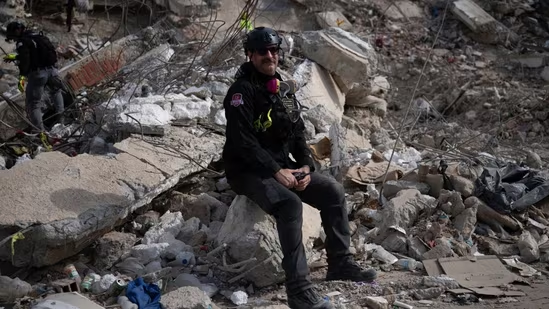
“If they had let us in sooner, we could have really helped save lives,” said Michael Saavedra, a strapping 6-foot-5-inch Miami Beach firefighter who is the team’s director. “Imagine getting in the game when there’s four minutes left. No plans, no coaching, no help whatsoever. Just boom, go!”
He recalled pulling out the dust-covered body of a woman who had shown signs of having clung to life for days in an air pocket under debris before dying.
“It’s heartbreaking,” said Saavedra.
Strategic Response Partners Chief Executive Steve Slepcevic has dealt with natural disasters in Haiti, Chile and Mexico. He was shocked by the Venezuelan government’s response, as well as the substandard construction that led buildings to collapse.
“In 35 plus years, this is by far the worst I’ve ever experienced,” said Slepcevic, who had traveled here from his home in San Diego.
The delays reflect the bureaucratic and political hurdles that rescue groups from Venezuela and around the world say they have faced after the country’s most powerful earthquakes in more than a century. Venezuela’s government said on Thursday that at least 3,811 people died and nearly 17,000 were injured. But 30,000 are missing and the death toll is expected to rise as rescuers arrive with machinery to lift concrete slabs and twisted steel.
The disaster has exposed what critics say is the enduring dysfunction of the authoritarian and unelected government of acting President Delcy Rodríguez, who is backed by the Trump administration. She was vice president until the U.S. ousted former leader Nicolás Maduro in a Jan. 3 military raid.
Since then, Trump has repeatedly lauded Rodríguez for her cooperation and has said the U.S. is ready to help the beleaguered oil-rich country. John Barrett, who leads the U.S. Embassy in Caracas, told reporters this week that Rodríguez’s government “has been fully compliant in terms of our requests to advance this massive humanitarian response.”
Most Venezuelans disagree.
An AtlasIntel/Bloomberg poll released Friday found that two-thirds of Venezuelans rejected the government’s handling of the disaster. Rodríguez’s disapproval rating climbed 5 percentage points to 63%.
Venezuelans and foreign-rescue teams said the earthquake response has been marred by poor coordination, political meddling and chaotic rescue efforts that cost lives.
“My country isn’t prepared for this. We have no one other than this government to blame,” said Junior Figueredo, a 23-year-old detective, who on a recent day waited to enter an outdoor morgue on a port in La Guaira state to examine a row of decomposing bodies. Figueredo hoped to identify the bodies of four women in his family, including his mother and sister, who had died when a 12-story state housing complex collapsed.
Rescue teams say they squandered hours waiting to receive their equipment and luggage at the overwhelmed airport in Valencia, a two-hour drive from the disaster. Some said they were forced to take photos with Rodríguez, which were then posted on her social-media accounts.
Héctor Méndez, a veteran of Mexico’s Topos Azteca International Rescue Brigade, was outraged when a state news reporter asked him to offer kind words to Rodríguez.
“I’m not a politician, I’m a rescue worker,” Méndez said in comments that went viral on social media. Méndez said he told the reporter “to go to hell.”
Some Venezuelan volunteer rescue workers said police and military officers tried shaking them down for bribes to pass checkpoints. At the disaster sites, hundreds of national guardsmen and police stood idly by clutching their rifles and manning checkpoints, leaving residents to wonder why they weren’t grabbing shovels to help find survivors.
In one flattened community, angry Venezuelans left homeless had beaten up an officer accused of stealing money from survivors. “All they do is rob us, even in the midst of a tragedy,” said retiree Vayamin Delgado, who said police looted her damaged home.
With no centralized coordination, the rescue teams from the U.K., France, Netherlands and the U.S. that were able to enter in the early days found themselves scrambling from neighborhood to neighborhood with no phone service or translators.
Roads around the devastated Caribbean coastal towns were clogged with bumper-to-bumper traffic, impeding first responders and the heavy machinery needed to move rubble.
In a rare news conference, Rodríguez rebuffed criticism of her government’s earthquake response as “media narratives to generate chaos.” She said her government acted swiftly and welcomed aid from more than 30 countries. And on Saturday, she gave out medals to more than 300 American rescue workers and thanked them in an event broadcast on national television. Barrett said the American teams were able to help save six survivors.
“Every time a plane landed with rescuers, it gave hope to the people of Venezuela,” Rodríguez said. She added that American rescue workers and Venezuelan armed forces members “were seen as one team.”
Strategic Response Partners was made up of towering firefighters, a former U.S. soldier, an expert lockpicker and a nurse from Boston, a team Saavedra calls the Magnificent Seven. After hearing about the quakes, they met in Miami, collecting first aid kits and rescue equipment. When their flight was rerouted to Santo Domingo, one of the members visited his ailing father, who died a day later.
Emergency responses in troubled countries are always chaotic. But Saavedra said he was surprised his team was treated as an obstacle when finding survivors quickly was central to success.
“We’re trying to come in and help,” he said. “We’re searchmen. We belong on the ground. It was almost surreal.”
The delays were costly in lives, time and money, with the flight detour costing another $20,000 in fuel for the jet that a private donor had lent them.
Once in Venezuela, Saavedra said he and his colleagues rushed to make up for lost time, working for more than two days without sleep and popping stimulant pills to keep going. They faced new hurdles.
Saavedra said a National Guard soldier tried to impede the team’s vehicle on the outskirts of the disaster epicenter. The guard demanded “a donation” as he inspected their belongings, which Saavedra viewed as a request for a bribe. The team placated him with a bottle of water.
Here in Caraballeda, a once-picturesque beach town of apartment towers now in ruins, Slepcevic stood outside of a collapsed building waiting for a crane to lift concrete slabs to access a food store that had been on the first floor. Neighbors hoped those trapped survived by eating the food there. No one was found alive.
Slepcevic, who comes from a family of builders and has three decades of experience working in areas hit hard by hurricanes and tornadoes, said he was aghast by the lack of coordination. Crowds of onlookers stood near buildings teetering on collapse with police officials doing little to cordon off the area.