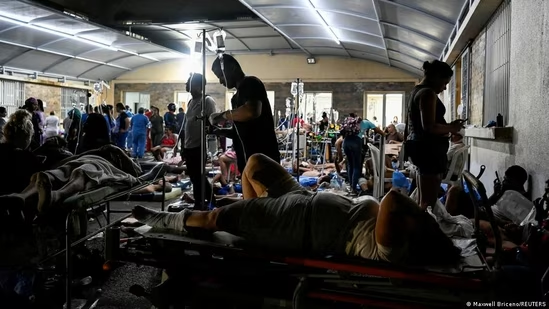
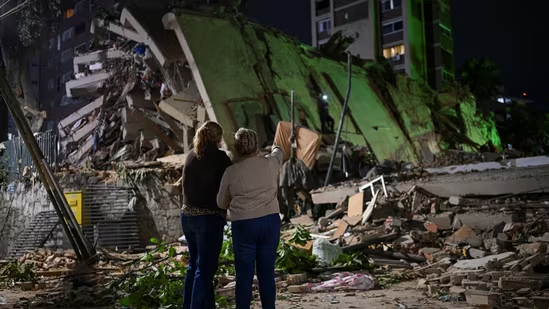
Two earthquakes, a magnitude 7.2 followed less than a minute later by a magnitude 7.5, struck Venezuela on Wednesday evening, killing at least 32 people and injuring more than 700.
The first earthquake’s epicentre was located around 160km west of Caracas, near the coastal town of Morón, in Yaracuy state, at a depth of 22km. The second was logged at a depth of 10km.
The earthquakes shut Caracas’s main airport, suspended the capital’s subway and gas services, and were felt as far away as Brazil’s Amazon, and in Bogotá, Colombia.
The death toll was expected to rise. Venezuela’s acting president Delcy Rodríguez said the fatality figures currently exclude data from La Guaira state, which has been described as a “disaster zone” and one of the hardest hit areas in the South American country. The US Geological Survey’s (USGS) predictive modelling has also estimated that the toll could run into the thousands.
The USGS measured the first earthquake at magnitude 7.1 before revising it to 7.2 within hours. That revision indicates just how complex it is to collect data and calculate an earthquake’s size.
Calculating the size
Earthquakes occur when built-up stress along a fault is suddenly released and the rock on either side moves. Venezuela’s earthquakes on Wednesday ruptured a strike-slip fault system running along the country’s northern coast, meaning that two blocks of rock slid past one another.
This movement or collision releases energy that travels outward through the earth as a wave. Seismic stations positioned around the world pick up that wave as it passes, each one recording the motion of the ground at its own location.
The instrument that does this is a seismograph. A unit includes a seismometer, the sensor that is typically a pendulum or a mass mounted on a spring.
In seismic centres, a seismograph is bolted to the ground, so when the earth shakes, the whole instrument shakes with it — except for the mass on the spring, which has inertia and tends to stay where it is. A recording device mounted on that mass traces the relative movement between the mass and the rest of the instrument as the ground moves beneath it. That relative movement is what becomes the seismogram, the wave chart depicting the earthquake.
A single seismograph can confirm that an earthquake happened nearby and how strong the shaking felt at that one point. It cannot, by itself, say where the earthquake originated. That process requires a network of stations across an area.
Earthquakes send out two main types of waves at different speeds: a faster “P wave” and a slower “S wave”. The gap between their arrival times at a specific station tells scientists how far that station is from the epicentre. With three or more such distance estimates from different stations, the source can be triangulated.
The USGS describes the underlying computation as an iterative process: a computer assumes a location, depth and origin time, compares the predicted wave-arrival times against what each station actually recorded, and adjusts its guess closer with every pass until the predicted and observed times line up as closely as possible. This is why earthquake-prone countries maintain dense networks of stations.
In India, this network is run by the National Center for Seismology (NCS), under the Ministry of Earth Sciences. As listed on the NCS’s public monitoring portal, the network comprises 172 seismic observatories across every state and Union territory — from Campbell Bay in the Andaman & Nicobar Islands to Hanley in Ladakh. Some stations are well over a century old: Mumbai’s station has operated since 1899 and Kolkata’s since 1898.
Also read: Venezuela earthquakes in visuals: Screams, panic as tremors ‘kept getting stronger’
The scales
Scales to measure magnitude, which describes the size of an earthquake at its source, have evolved over decades.
The first was developed in 1935 by Charles Richter, who was working on earthquakes in southern California. Richter’s scale — formally called local magnitude, or ML — measured the amplitude of the largest wiggle recorded on a seismograph. Richter borrowed the idea of a logarithmic scale from astronomy, wherein each unit represents a tenfold increase in the amplitude of the wave recorded. In simpler words, it means a magnitude-7 earthquake’s seismogram shows ten times the wave amplitude of a magnitude-6 earthquake’s.
But the Richter scale has its limitations. USGS scientists say it gets “saturated” for very large earthquakes, and that means it may not be able to reliably distinguish a big earthquake from an even bigger one. Because the scale was calibrated to the geology of southern California, it also needed adjustment for use elsewhere, since rock formations in different regions absorb seismic energy differently.
In 1979, seismologists Thomas Hanks and Hiroo Kanamori introduced moment magnitude (Mw), the scale that is now used more commonly.
Rather than measuring a single wiggle on a seismogram, Mw is calculated from the physical mechanics of the rupture itself: the rigidity of the rock that broke, the area of the fault that slipped, and the average distance it moved, according to USGS. Anchored to fault rather than to one type of wave on one instrument, the moment magnitude scale does not saturate and can take readings of all earthquake amplitudes.
But Mw takes longer to calculate, since it requires modelling the entire waveform rather than reading off a single peak. It is also harder to apply to the smaller earthquakes. For those, Richter’s scales are still used.
A history of trying to measure the ground moving
In ancient cultures, tremors were believed to have been caused by giant creatures stirring beneath the Earth’s surface — snakes, turtles, catfish, spiders — according to an account by the University of California-Santa Barbara’s Earth Research Institute (UCSB-ERI).
Then, Greek philosopher Aristotle came up with a theory that said winds trapped within the Earth caused it to shake.
The earliest known seismic instrument was built in AD 132 by Chinese scholar Zhang Heng. It was a large bronze urn ringed by eight dragon heads, each facing one of the compass’s directions. Under each dragon head was a toad sitting open-mouthed. A tremor would cause one dragon to release a ball from its mouth into the toad below it, so the direction of the dropped ball would indicate where the shock had come from. Historians don’t fully know how it worked, but have guessed that it may have some form of an internal pendulum.
But the study of detecting tremors began properly after 1755, when a devastating earthquake and tsunami killed an estimated 70,000 people in Lisbon, Portugal. The disaster pushed scholars to pivot to observations, cataloguing when and where earthquakes struck, and what physical effects they left behind.
Three 19th-century scientists, working independently in different countries, laid much of the groundwork for instrumented seismology. In England, the engineer Robert Mallet used gunpowder explosions to measure the speed of seismic waves through rock — a method still used in oil exploration today — and was among the first to estimate how deep underground an earthquake had occurred. In France, Alexis Perrey combed earthquake catalogues for patterns linked to the seasons and the phases of the moon. And in Italy, Luigi Palmieri built an electromagnetic seismograph, installed near Mount Vesuvius, that was among the first instruments able to routinely detect tremors too faint for people to feel.
The modern seismograph followed soon after. In the 1880s, three English professors — John Milne, James Ewing and Thomas Gray, all teaching at the Imperial College in Tokyo — built the first instruments sensitive enough for genuine scientific study of earthquakes, UCSB-ERI’s account says.
The USGS separately dates the first seismograph in the modern sense to 1890. In the US, the geologist Grove Karl Gilbert, examining the fault left by an 1872 earthquake in California’s Owens Valley, established that faults caused earthquakes rather than the reverse.
Building on Gilbert’s work, Harry Fielding Reid studied the fault that produced the 1906 San Francisco earthquake and concluded that stress builds up gradually within the earth over years before being released violently.
It took until 1935 for Richter to attach a number to the measurement, and another 44 years for Hanks and Kanamori to refine that number into the moment magnitude scale used today.
Large earthquakes
Earthquakes of magnitude 7 or above are uncommon, though they aren’t rare either. According to USGS records dating to 1900, the world experiences 16 “major” earthquakes — magnitude 7.0 or greater — on average in a year. Of those, around 15 typically fall in the magnitude-7 range, and one, reaches magnitude 8.0 or greater.
The year with the most ‘major’ earthquakes on record was 2010, when 23 were detected. The largest earthquake ever recorded by modern instruments struck Chile on 22 May 1960, when it registered magnitude 9.5 on a fault stretching almost 1,600km.
Venezuela, news agency AP reported, straddles the boundary between the South American and Caribbean tectonic plates, which makes strong earthquakes considerably less common there.
Wednesday’s earthquakes were among the strongest recorded in the country in more than a century. The country’s deadliest earthquakes remain a magnitude 6.3 quake that killed 236 people in Caracas in 1967, another in 1997 that killed 73 people, and an estimated 30,000 deaths from one that struck Caracas and Mérida in 1812.