
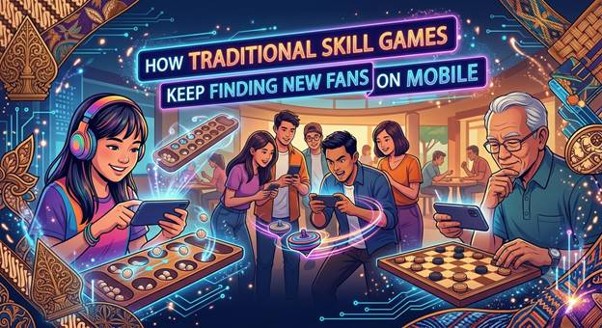
Digital entertainment moves fast, and most of the attention goes to the loudest products. Massive open worlds. Photorealistic graphics. Games that cost as much to make as a Hollywood film. Some of the most durable success stories in this business have nothing to do with spectacle. They belong to the older, quieter category of skill-based games, the kind that reward patience and sharp thinking rather than reflexes and a powerful graphics card.
What’s interesting is how well these games have adapted. Instead of getting buried by the industry’s obsession with scale, many traditional titles have quietly found a second audience through the one device almost everyone carries. The phone in your pocket has done more for classic competitive games than any console generation ever did.
The Quiet Strength of Skill-Based Play
Games built on chance give you a quick thrill and then move on. Skill-based games work differently. They ask you to come back, study what went wrong, and try again with a better plan.
That loop is the whole appeal. Every session teaches you something, and the improvement is yours to keep. You start reading patterns you used to miss. You make faster decisions under pressure. Progress feels earned, and earned progress is sticky.
This is why certain games survive for generations while flashier products vanish within a year. Chess is centuries old. Card games and tile games have outlived empires. The technology around them keeps changing, but the core pleasure of getting good at something hard never goes out of style.
Most people don’t notice this at first, but the difficulty is the feature, not the flaw. A game you can master in an afternoon rarely holds anyone for long.
Mobile Changed Who Gets to Play
For a long time, enjoying a traditional competitive game meant logistics. You needed a table, a group of friends, maybe a trip to a specific venue. That barrier quietly excluded a lot of people who might have loved the game if it had been easier to reach.
Smartphones erased most of that friction. A player can open a match while waiting for a train, during a lunch break, or on the sofa at midnight. The game meets people where they already are instead of asking them to rearrange their lives.
The technical side matters more than most players realize. Responsive interfaces, cloud infrastructure, and HTML5 have made it possible to run these experiences smoothly across cheap phones and premium tablets alike. A game no longer needs a dedicated app or a high-end device to feel fast and stable.
Platforms such as tangkasnet show how mobile accessibility and modern web technology can bring long-established skill games to audiences who might never have discovered them through traditional channels.
Accessibility, in plain terms, is growth. Every barrier you remove adds players who were interested all along.
The Shift in How People Actually Play
Watch how people use their phones and a pattern emerges. Sessions are shorter and far more frequent. A commuter might play three quick rounds in the morning and three more at night, never once sitting down for a marathon session. That fragmented rhythm suits skill games perfectly, because a single hand or match fits neatly into a five-minute window.
Developers have leaned into that behavior. Quick match-making, resumable games, and interfaces designed for one-handed use all reflect a simple truth about the mobile audience. Nobody wants to fight the menu before they can play. The friction has to disappear, and on the better platforms it mostly has.
Related: Why Are E-Bikes Becoming Popular Among Outdoor Enthusiasts?
Communities Are the Real Retention Engine
Here is something marketing teams often underestimate. People don’t stay for the game alone. They stay for the people around it.
Discussion forums, livestreams, chat groups, and social feeds have turned solitary hobbies into shared ones. A newcomer who would have quit in frustration now has a dozen places to ask questions. A veteran who has played for years finally has an audience that appreciates the difference between a lucky win and a smart one.
These communities do something valuable and slightly old-fashioned. They pass knowledge down. Strategies that once lived only in the heads of experienced players get written up, argued over, and refined in public. The learning curve gets gentler without the game getting easier.
Smart platforms have caught on. Instead of treating community as an afterthought, they build features that encourage conversation, friendly rivalry, and long-term participation. Leaderboards, replays, tournaments, and profile systems all feed the same loop. Players who feel connected tend to stick around, and players who stick around bring their friends.
Modern Polish Without Losing the Soul
There’s a real risk when you modernize an old game. Push too hard and you sand off the thing that made it special. The best developers understand this and tread carefully.
The improvements they focus on are mostly invisible when done right:
- Cleaner interfaces that stay out of the way
- Faster load times and fewer interruptions
- Stable performance on modest hardware
- Cross-platform play across phones, tablets, and desktops
Notice what’s missing from that list. Nobody is rewriting the rules. The strategic core stays intact while everything around it gets quietly better. A player from ten years ago could sit down and recognize the game instantly, even if it now runs on a device that fits in one hand.
Cross-platform flexibility deserves a special mention. Being able to start a match on a phone and continue it later on a laptop sounds minor. In practice, it keeps casual players engaged during the gaps in their day, which is exactly when most people actually play.
Why Difficulty Still Sells
The gaming market spent years chasing instant gratification. Endless rewards, constant dopamine, no friction. Some of that works, but it burns out fast.
Skill-based games take the opposite bet. They ask for effort up front and pay it back slowly. Observation, patience, and planning matter more than twitch reactions. You improve by losing to better opponents and figuring out why.
That long arc of mastery is a genuine competitive advantage in a crowded market. A player who has spent months sharpening their game isn’t going to abandon it for the next shiny release. They’ve built something, and people rarely walk away from things they’ve poured real effort into.
For a slice of the audience, this is the entire draw. They aren’t looking for a distraction. They want a challenge worth returning to.
The Business Logic Behind the Revival
None of this happens by accident. There are solid commercial reasons traditional skill games have earned fresh investment.
Retention comes first. Games that reward long-term improvement keep players engaged for years, not weeks, and long engagement is worth far more than a spike of downloads that fades by the following month.
Community comes second. An active player base markets itself. Word of mouth from an invested community costs nothing and converts better than most paid advertising ever will.
Low technical overhead comes third. A well-built skill game doesn’t need a blockbuster budget or a render farm. That keeps development lean and lets smaller studios compete on design rather than raw spectacle. In an industry where budgets keep ballooning, that’s a healthier place to stand.
The monetization side has matured too. The old model leaned on aggressive, interruptive advertising that pushed players away as fast as it earned a few cents. Newer approaches favor optional cosmetics, tournament entries, and light subscription tiers that respect a player’s time instead of hijacking it. A community that feels squeezed leaves, and the smarter operators have learned to earn revenue without poisoning the experience that brought people in.
Add these together and you get a category that quietly outperforms expectations. Not through hype, but through the boring reliability of players who keep coming back.
What Comes Next
The trajectory points in an encouraging direction. As phones get more powerful and networks get faster, the gap between a mobile session and a desktop one keeps shrinking.
Artificial intelligence is likely to reshape how newcomers learn. Picture adaptive tutorials that spot your specific weaknesses, personalized practice drills, and smart recommendations that shorten the frustrating early climb. Getting good could become less lonely and a lot less discouraging.
Community will stay at the center of all of it. Competitive events, shared replays, and player-driven discussion keep the culture alive in a way no algorithm can replicate on its own.
Within that landscape, bola tangkas stands as a clear example of how a classic competitive format can move onto modern platforms without surrendering the strategic depth that made it worth playing in the first place.
The Takeaway
Technology didn’t replace traditional skill games. It gave them somewhere new to grow.
Mobile devices lowered the barrier to entry. Responsive web tools made the experience smooth on almost any screen. Online communities turned solitary practice into a shared pursuit. Put those pieces together and you have a genre that keeps pulling in both grizzled veterans and curious first-timers.
The lesson for the wider industry is simple and a little humbling. Innovation doesn’t always mean building something bigger. Sometimes it means taking something proven and giving it the room to reach the people who were ready for it all along.