US President Donald Trump and the leaders of the North Atlantic Treaty Organisation (Nato) are heading to Ankara this week for a summit that could help determine the future of the alliance.
While Trump and other leaders are expected to clash over how to reduce the US’s military footprint in Europe, the Turkish government has been busy sprucing up Ankara, Turkey’s political capital.
Flowers have been planted, roads repaired, and huge banners erected to conceal unsightly details, including poorly maintained buildings.
The city is expected to enter a partial lockdown on Tuesday and Wednesday.
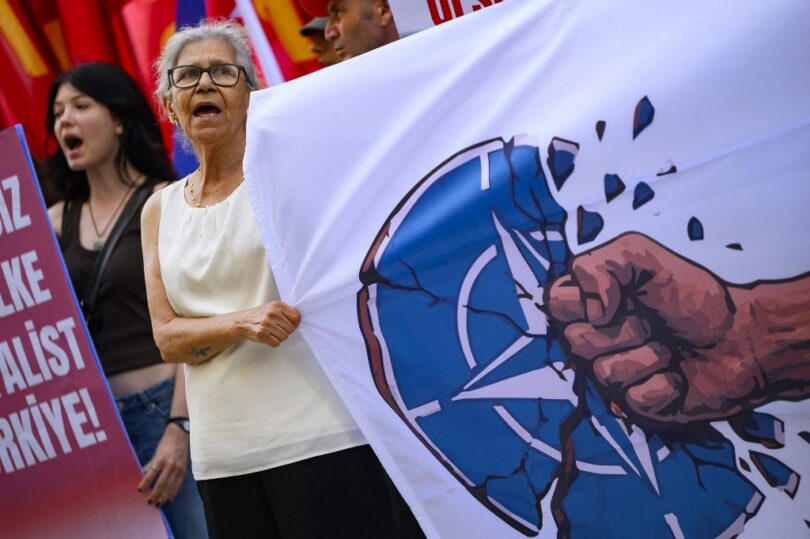
Efforts to prevent potential protests, or any “nuisance”, as Turkish officials put it, have gone so far that, in addition to members of known left-wing organisations, environmentalists and, as of Monday, pro-Palestinian activists, have also been temporarily detained to quell any surprise demonstrations in the capital.
CLICK FOLLOW: TO FOLLOW US
Sign up to get the latest insights and analysis on
Israel-Palestine, alongside Turkey Unpacked and other eSPORTY
Turkish officials see the summit as one of the most positive items on the agenda, linking Turkey’s defence-industry revival to the West and turning the event into an important marketing opportunity.
Ankara’s growing strength in aviation, particularly armed drones, as well as ammunition and naval shipbuilding, has already helped make Turkey a defence-industry power, with exports reaching $10bn in 2025.
While some European allies have expressed dismay over Turkish President Recep Tayyip Erdogan’s increasingly repressive handling of the domestic opposition, they have largely avoided criticising him and his government.
A local’s guide to Ankara ahead of the Nato summit
Read More »
They hope Ankara can help Europe kickstart a broader revival of the continent’s defence industry and chip in troops from its vast army, the second largest after the US within the alliance.
“This is a true endeavour on both sides of the Atlantic. Our defences are unmatched when we leverage assets, expertise and innovative capabilities from California to Kyiv, Copenhagen to Warsaw, Oslo to Ankara,” Ursula von der Leyen, the president of the European Commission, and Mark Rutte, the secretary-general of Nato, said in a joint article in the Economist over the weekend.
“The only way to get there is through co-operation: combining the efforts of countries and industries, allies and partners.”
European diplomats, speaking in closed-door meetings, already acknowledge Erdogan’s role in persuading Trump to come to Ankara and are relying on his support to convince Trump of Nato’s continued importance.
Nato 3.0
The zeitgeist of the summit is built around ambitious terminology, and this year one phrase has been making the rounds: Nato 3.0.
After the Cold War, Nato updated its plans and readiness posture in response to terrorist threats, a shift often described as Nato 2.0.
The new concept suggests that allies should focus on building up capabilities, modernising their defence-industrial infrastructure, and sharing more of the burden in Nato defence plans.
The aim is to make up for the gaps likely to be left by the US, after the Pentagon announced a six-month timeline to determine which troops, aircraft, and capabilities it will withdraw from Europe in order to focus more heavily on China.
European allies are already stepping up. Nato’s top commander, US Air Force General Alexus Grynkewich, told Reuters last week that European Nato allies have largely filled the gaps left by the US in the alliance’s defence plans.
The US has not publicly disclosed the details of its reductions, but according to figures provided to Reuters by a military source, the cuts range from refuelling aircraft to fighter jets, drones and ships.
The number of US F-15 and F-15E fighter jets available to Nato will fall by a third, to 99, while the number of MQ-4 and MQ-9 Reaper drones will be halved to 12, according to the source.
The number of KC-135 and KC-46 refuelling aircraft will fall to 63 from 79, while only one strategic bomber and one aircraft carrier would be allocated, rather than two.
Several European diplomats told Middle East Eye that Nato’s European pillar will be strengthened during the summit, as European allies pledge deeper cooperation, increased weapons production, and more operational commitments.
Guldener Sonumut, a Turkish journalist who has covered European affairs for decades, says Nato’s conventional defence responsibilities are expected to shift more heavily toward European allies and Canada as the United States gradually reduces its conventional military role.
“This will require changes in Nato’s command structure, with the US retaining strategic command and planning leadership while Europeans take on more operational responsibilities,” he wrote in his column on Sunday.
Turning point
The summit is also being presented as a turning point for the defence industry.
Nato’s Standardisation Agreements (Stanag) are expected to remain the central framework, limiting the European Union’s ability to build separate defence standards.
That is seen as beneficial for Turkey’s burgeoning defence industry, which already uses Nato standards.

France weighs up resetting Turkey ties as Europe’s security landscape shifts
Read More »
A defence-industry forum will be held during the Ankara summit on Tuesday, alongside the signing of a large number of multinational defence-industry cooperation agreements.
These are expected to cover areas ranging from multidomain operational capabilities to space intelligence.
Yahya Bostan, a columnist for the Yeni Safak daily, said during a broadcast last week that the recent debate between Turkey and Europe over Ankara’s place in the post-US security architecture of Europe has ended with one conclusion: Nato.
Bostan said that, instead of creating a new mechanism for security cooperation, European countries would increase their spending and participation under the Nato umbrella, together with Turkey.
Sonumut believes the US is likely to reiterate its role as Europe’s nuclear security guarantor within the alliance, potentially by expanding the number of countries hosting dual-capable systems, weapons platforms capable of carrying both conventional and nuclear warheads.
Those countries are currently limited to five, including Turkey. Finland’s parliament has already passed legislation allowing it to host such weapons.