
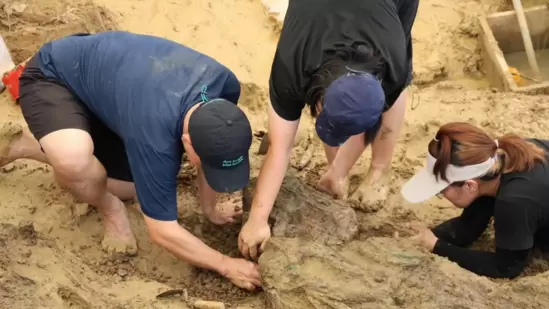
Archaeologists in western Thailand have unearthed two gold rings believed to be around 2,000 years old at a newly discovered archaeological site, officials said.
The rings were found alongside human skeletal remains during ongoing excavations at the Don Yai Thong archaeological site in Phetchaburi province last week, AP reported citing Thailand’s Fine Arts Department.
One of the rings found on Thursday was engraved with characters believed to be Bhrami script, an ancient Indian writing system. On initial assessment, experts identified the reading on the script as “pusarakhitasa” – which means “the one protected by Pushya.” It is said to be one of the most auspicious zodiac signs in Indian astronomy, the department said.
Also Read: Delhi’s Central Ridge hides historic carvings in plain sight
The other ring found is a plain gold ring without any pattern. Experts believe the rings’ owner may have been a merchant of the Indian ancient caste system Vaishyas, the department said.
Since February, archaeologists have uncovered eight human skeletons, along with bronze and gold jewellery, pottery, and other artefacts that suggest the site was used for ceremonial burials of wealthy individuals or members of the upper class.
About Don Yai Thong archaeological site
Located about 130 km southwest of Bangkok, the Don Yai Thong archaeological site was identified earlier this year after local residents discovered fragments of ancient bronze drums in a rice field, prompting a full-scale excavation.
Also Read: Archaeological site at Hoshiarpur’s Dholbaha, a window into Stone Age, fades into neglect
Experts have dated the site to Thailand’s late prehistoric period, also known as the Iron Age, which spans roughly 1,500 to 2,500 years ago.
The excavation is expected to conclude within the next month, after which the Fine Arts Department plans to display the discoveries for the public.
Ancient remains transferred
Meanwhile, in India, human skeletal remains excavated from the Indus Valley civilisation site of Rakhigarhi in Haryana have recently been handed over by the Archaeological Survey of India (ASI) to the Anthropological Survey of India (AnSI) for detailed scientific analysis.
The transfer, carried out under a newly signed memorandum of understanding between the two institutions, is expected to advance multidisciplinary research into one of the most significant urban centres of the Indus-Saraswati Civilisation, accoring to Ministry of Culture.
Rakhigarhi, located in Haryana and spread over nearly 550 hectares, is considered the largest known site of the Indus-Saraswati Civilisation.
Excavations have revealed continuous occupation from the Early to the Mature Harappan period, with discoveries including well-planned settlements, advanced drainage networks, craft workshops, trade links and burial sites.