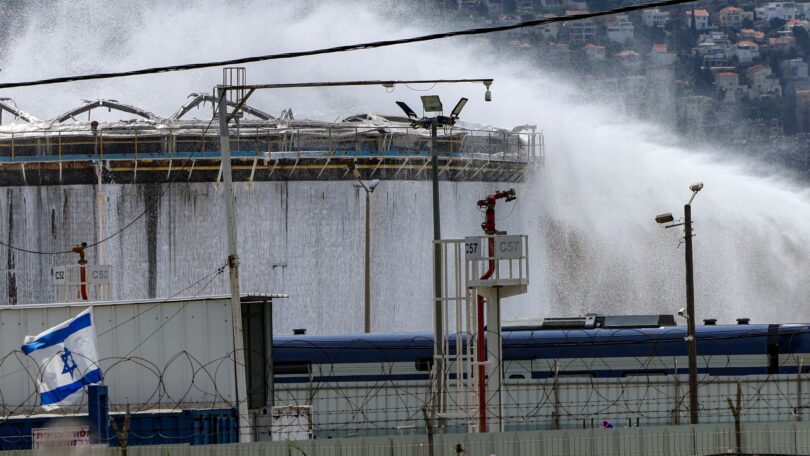
Israel’s largest oil refineries sustained far heavier damage from Iranian missile strikes during the US-Israeli war on Iran than authorities previously acknowledged, Israeli media reported.
Reconstruction works at the refineries in Haifa Bay, in the north of Israel, are expected to be completed in 2028.
Israel’s Channel 12 News reported on Monday that they sustained severe damage after two separate Iranian strikes earlier this year, despite Minister of Energy Eli Cohen and Bazan, the company operating the site, claiming no material damage had been recorded.
Bazan told the Tel Aviv Stock Exchange in March that the roof of a distillate tank had sustained “localised damage” and that all production facilities were operational.
“The company estimates that the damage is not significant. As of the time of this announcement, all the company’s facilities remain operational,” Bazan said at the time.
CLICK FOLLOW: TO FOLLOW US
Sign up to get the latest insights and analysis on
Israel-Palestine, alongside Turkey Unpacked and other eSPORTY
But according to Yeshiva World, citing the official report by the interior ministry, damage was reported at gas turbines, steam boilers, electrical rooms and other auxiliary systems that had not previously been publicly reported.
Channel 12 News reported that the Ministry of Interior had approved large-scale reconstruction works.
One oil derivatives storage tank struck during an attack in March is beyond repair. The channel reported that the refineries had also sustained damage last year, during Israel’s 12-day war with Iran. It said three Bazan employees were killed after Iranian missiles pierced the US-backed Iron Dome mobile air defence system in June 2025.
At the time, Bazan estimated the losses at $150-200m, while Israeli officials maintained that fuel supplies would not be affected.
Military censorship
The Bazan refineries are among Israel’s most strategically important industrial sites, supplying oil products for industry, agriculture, infrastructure and domestic consumption.
According to the company’s website, the refineries have the capacity to produce approximately 26,000 tonnes of oil per day and can process about 9.8m tonnes of crude oil annually.
The refineries in Haifa Bay were built during the British Mandate over Palestine, with the British authorities using the facilities to transport crude oil from Iraq through the Kirkuk-Haifa pipeline.
Israel’s ‘kill first’ strategy is now aimed at Turkey. Will the region respond?
Read More »
After Israel occupied Haifa and established the State of Israel during the 1948 war, the Israeli government took control of the refineries, with the Bazan cooling towers becoming one of the city’s most recognisable landmarks.
In recent years, Israel has refused to disclose the full extent of the damage caused by Iranian missile strikes, applying strict military censorship.
According to +972 Magazine, Israeli military censorship reached its highest level in 2024 since the outlet began collecting data in 2011, with approximately 8,000 articles either banned outright or partially censored.
While military censorship declined last year, with around 5,000 articles banned or partially censored, +972 Magazine still recorded the second-highest annual total of censored articles since 2011.
During the war, Iran is alleged to have struck several strategic sites across Israel, including the Kirya in Tel Aviv, the Weizmann Institute, the Nevatim airbase and the Haifa port area.
Earlier this month, the Times of Israel reported that a hangar at the Ramat David airbase had been damaged, citing low-resolution satellite imagery.